14
Oil change
IMPORTANT. Drain the oil while the engine in still warm to
ensure rapid and complete draining.
1. Remove the oil fill cap dipstick (8) and tip sideways to
drain the oil.
2. turn up right and clean up any spillage and refill with fresh
oil checking the level as you go.
3. Reinstall the oil fill cap dipstick.
Note. Please dispose of used motor oil in a manner that
is compatible with the environment. We suggest you take
it in a sealed container to your local service station for
reclamation. Do not throw it in the trash or pour it into
the earth.
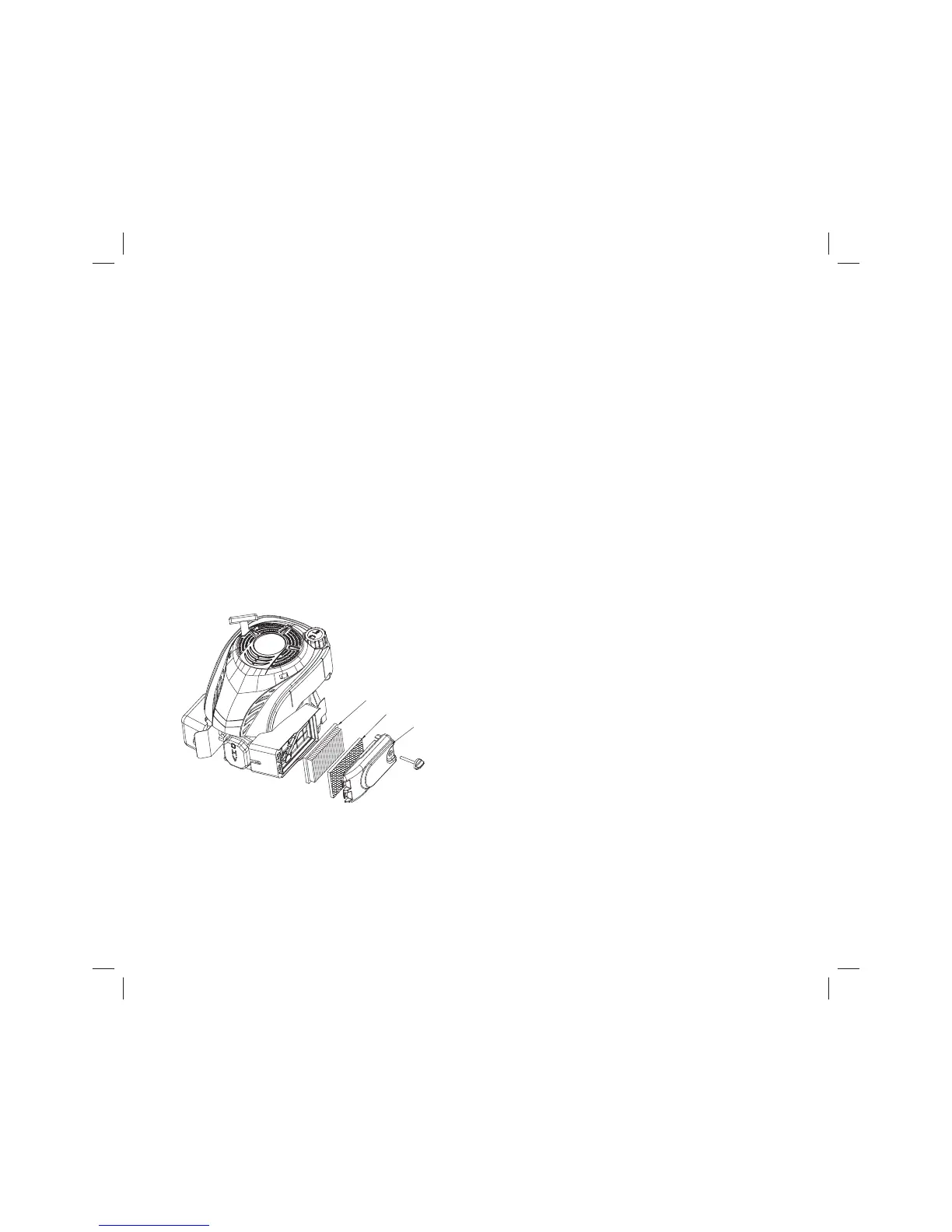
Air cleaner service
IMPORTANT. A dirty air cleaner will restrict air flow to the
carburettor. To prevent carburettor malfunction, service the
air clearer regularly.
Check that the air filter is clean and dry of dirt. Filters thick
with debris will not allow the engine to breath and result in
difficult starting and poor engine performance.
1. Remove the wing bolts and the air cleaner cover.
Be careful to avoid dust and debris falling into the bottom
of air cleaner.
2. Remove the foam element and paper element.
3. Check, clean or replace the damaged air cleaner parts.
4. Install all parts back and fix the screw.
CAUTION. Never use fuel or low burning point solvents
to clean the air cleaner element. A fire or explosion
could result.
CAUTION. Clean the foam element in a solution of
household detergent and warm water. Tap the element
lightly several times on a hard surface to remove excess
dirt, or blow compressed air through the filter from the
inside out. Never try to brush the dirt off.
Spark plug
To ensure the engine is operating correctly, the spark plug
must be properly gapped and free of carbon deposits.
Always check the spark plug cable is firmly fitted to the top
of the spark plug.
CAUTION. If the engine has been running, the muffler will
be very hot. Be careful not to touch the muffler.
1. Remove the spark plug cap with a suitable wrench,
and clean any deposits.
2. Visually inspect the spark plug. Discard the spark plug
if there is apparent wear, or if the insulator is cracked
or chipped.
3. Check that the end of the spark plug is not blackened by
carbon build up. Clean with a soft wire brush if necessary.
4. Measure the plug gap with a feeler gauge. Correct as
necessary by bending the side electrode. The gap should
be 0.7 - 0.8mm.
Test the spark plug ignition by disconnecting the spark
plug wire from the spark plug. Hold the end of the spark
plug wire close to a metal surface. If the spark plug is
good, you will see a spark or you’ll hear a crackling noise.
This means that voltage is getting through the wire to the
spark plug.
Note: This should only be carried out by a confident end
user as if not careful, this procedure may result in a non
lethal electric shock. Petrol fumes need to be considered
with an open spark and people with pace makers.
HEPA filter
Foam
Cover


 To Next Page
 Loading...