Need help?
Do you have a question about the MUND CLIMA MUPR-H5A and is the answer not in the manual?
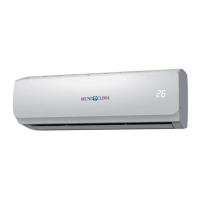
Provides images of the indoor and outdoor units of the air conditioner.
Details the physical dimensions of indoor and outdoor units for different models.
Illustrates the refrigeration circuit diagram for the air conditioner in cooling mode.
Explains the refrigerant flow and state changes during the cooling cycle.
Illustrates the refrigeration circuit diagram for the air conditioner in heating mode.
Explains the refrigerant flow and state changes during the heating cycle.
Presents the electrical wiring diagram for the indoor unit of the MUPR-H5A series.
Shows the wiring diagram for the outdoor unit of MUPR-09/12/18-H5A (2015-16) models.
Details the wiring diagram for the outdoor unit of MUPR-18-H5A (2017) models.
Presents the wiring diagram for the outdoor unit of the MUPR-24-H5A model.
Shows the wiring diagram for the MUPR-24-H5A (V2) outdoor unit.
Lists error codes, indicator blinks, and their corresponding fault descriptions for the air conditioner.
Key checks for initial troubleshooting, including voltage, connections, and cord matching.
Troubleshooting steps for when the air conditioner does not display power.
Procedure to diagnose and resolve issues with the indoor fan motor not operating.
Troubleshooting steps for when the outdoor unit of the air conditioner fails to operate.
Diagnosing problems related to the step motor responsible for louver movement.
Troubleshooting guide for when heating mode is active but no hot air is produced.
Steps to troubleshoot issues where the remote control is unresponsive or not functioning.
This document serves as a service manual for the MUNDOCLIMA INVERTER SERIE H5A, specifically the MUPR-H5A model, providing essential information for its installation, operation, and troubleshooting. The device is an air conditioning unit, comprising both an indoor unit and an outdoor unit, designed to provide either cooling or heating functionalities depending on the user's needs.
The MUPR-H5A operates on an inverter system, which allows for variable compressor speed, leading to more precise temperature control and improved energy efficiency compared to traditional fixed-speed systems. The core function of the device is to regulate the indoor temperature, offering both cooling and heating modes.
In Cooling Mode, the indoor unit acts as an evaporator, absorbing heat from the indoor air. Refrigerant, in a liquid state, enters the indoor heat exchanger at low pressure. As it evaporates, it absorbs heat from the room, turning into a steam-gas mixture. This low-pressure steam-gas then travels to the outdoor unit. In the outdoor unit, the compressor compresses the refrigerant, increasing its pressure and temperature. The hot, high-pressure gas then passes through the outdoor heat exchanger (condenser), where it releases heat to the outside air, condensing back into a supercooled liquid of high pressure. This liquid then goes through a capillary tube (throttling device), which reduces its pressure and temperature before it returns to the indoor unit to repeat the cycle. The indoor unit features a cross fan to circulate air over the evaporator, facilitating heat exchange, while the outdoor unit uses a propeller fan to dissipate heat from the condenser.
In Heating Mode, the roles of the indoor and outdoor heat exchangers are reversed, thanks to a 4-way valve (specific to heat pump models). The indoor unit now functions as a condenser, releasing heat into the indoor space. High-pressure, high-temperature gas from the compressor enters the indoor heat exchanger, where it condenses, releasing heat and warming the room. This supercooled liquid of low pressure then flows to the outdoor unit. The outdoor unit acts as an evaporator, absorbing heat from the ambient air. The refrigerant, now a steam-gas of low pressure, absorbs heat from the outside environment as it evaporates. This low-pressure steam-gas then returns to the compressor to be re-pressurized and heated, continuing the cycle. This allows the system to extract heat from the outside air, even in cooler conditions, and transfer it indoors.
The system incorporates various sensors to monitor and control its operation, including room temperature sensors, pipe temperature sensors, and exhaust (discharge) temperature sensors, ensuring optimal performance and safety.
The indoor unit is equipped with a display panel that provides feedback on the unit's status, likely including the set temperature and error codes. A step motor controls the louver, allowing for adjustment of airflow direction, which can be manipulated via a remote control. The remote control is a key interface for users to interact with the air conditioner, enabling them to turn the unit on/off, set the temperature, select operating modes (cooling, heating, dehumidifying), and adjust fan speed and louver swing. The system is designed to automatically adjust fan speed in cooling mode to maintain the set temperature. In dehumidifying mode, the compressor operates discontinuously to effectively remove moisture from the air.
The service manual emphasizes several key aspects for maintaining the device and troubleshooting common issues.
Troubleshooting Guide: A comprehensive error code list is provided, linking specific error codes (e.g., E1, E2, F0, P2) to potential faults such as sensor malfunctions (room temperature, pipe temperature, exhaust sensor), communication failures (indoor/outdoor unit, main PCB/display board), fan motor circuit faults, compressor issues (start failure, shell temperature protection, drive error), voltage problems (low/over voltage, under-voltage protection), and module protection faults. This allows service technicians to quickly diagnose problems based on the displayed error code.
Foremost Inspecting Items: Before extensive troubleshooting, the manual advises checking fundamental aspects:
Specific Troubleshooting Procedures: Detailed flowcharts are provided for common issues:
Wiring Diagrams: The manual includes detailed wiring diagrams for both indoor and outdoor units across different models and years (e.g., MUPR-09/12/18/24-H5A for indoor, MUPR-09/12/18-H5A (2015-16), MUPR-18-H5A (2017), and MUPR-24-H5A for outdoor units). These diagrams are crucial for technicians to understand the electrical connections of components like AC fan motors, step motors, display panels, compressors, orientation valves, and various sensors. They also highlight specific connections for power, communication, and sensor inputs. A recurring note in the wiring diagrams emphasizes that "Three Board Connect have no earth terminal, 'Y/G' direct connect to panel," which is an important installation and safety consideration.
Overall, the MUNDOCLIMA INVERTER SERIE H5A is a sophisticated air conditioning system designed for efficient temperature control, with a comprehensive service manual that supports detailed troubleshooting and maintenance for optimal performance and longevity.
 General
| Refrigerant | R410A |
|---|---|
| Power Supply | 220-240V, 50Hz |
| Noise Level (Indoor) | 42 dB |
| Operating Temperature (Cooling) | 18°C to 43°C |
| Additional Features | Auto Restart, Sleep Mode, Timer, Dehumidification |

 To Next Page