18
MOWING TIPS
• Tire chains cannot be used when the
mower hous ing is attached to trac tor.
• Mower should be properly leveled for
best mowing performance. See “TO
LEVEL MOWER HOUSING” in the
Service and Adjustments section of this
manual.
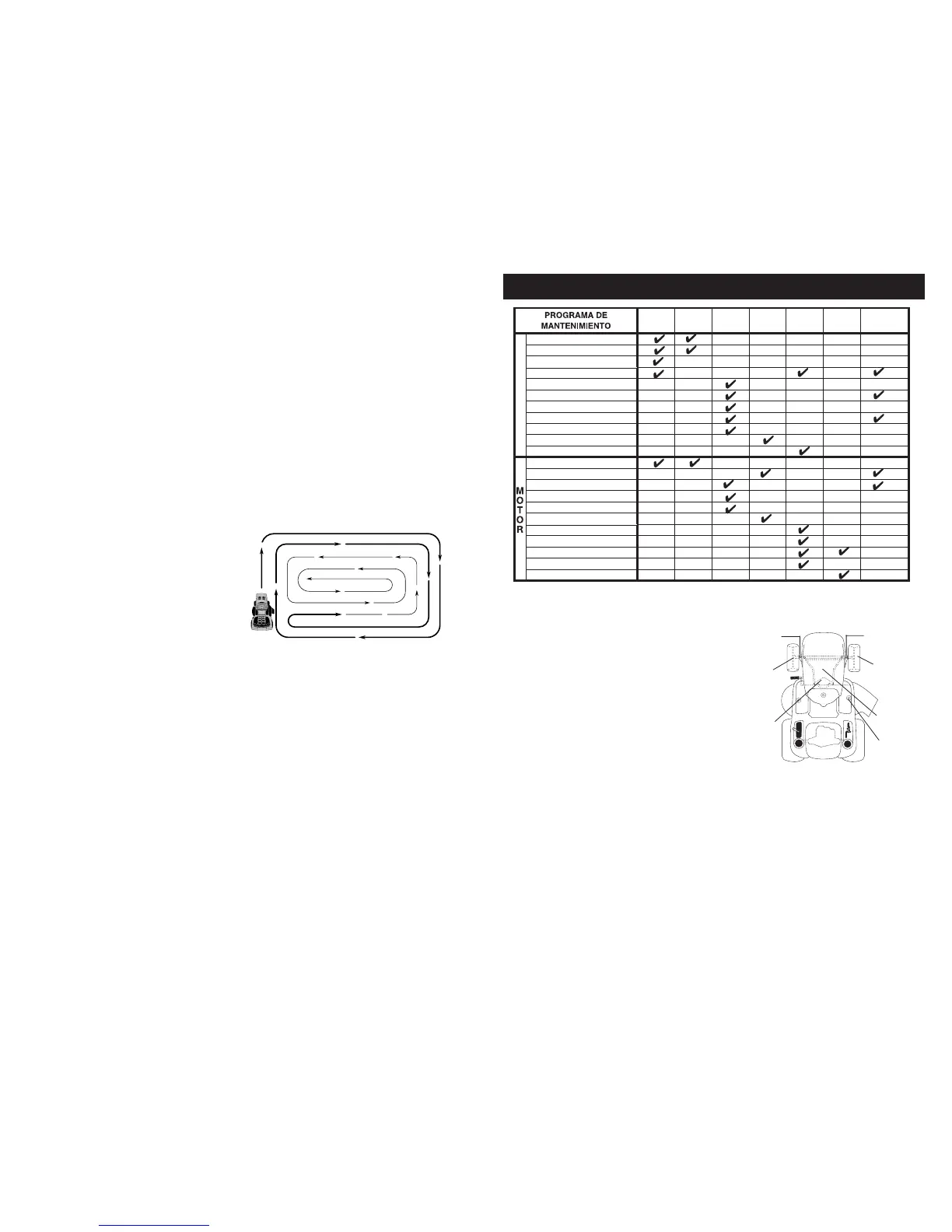
• The left hand side of mower should be
used for trim ming.
• Drive so that clippings are dis charged
onto the area that has already been
cut. Have the cut area to the right of
the tractor. This will result in a more
even dis tri bu tion of clippings and more
uniform cutting.
• When mowing large areas, start by
turning to the right so that clippings will
discharge away from shrubs, fences,
driveways, etc. After one or two rounds,
mow in the opposite direction making
left hand turns until finished .
• If grass is extremely tall, it should be
mowed twice to reduce load and pos-
sible fire hazard from dried clip pings.
Make first cut relatively high; the second
to the desired height.
• Do not mow grass when it is wet.
Wet grass will plug mower and leave
undesirable clumps. Allow grass to dry
before mowing.
• Always operate engine at full throt tle
when mowing to assure better mowing
performance and prop er dis charge of
material. Reg u late ground speed by
se lect ing a low enough speed to give
the mower cut ting per for mance as well
as the quality of cut desired.
• When operating attachments, se lect a
ground speed that will suit the terrain
and give best performance of the at-
tach ment being used.
• The attachments and ground drive can
now be used. If the engine does not
accept the load, restart the en gine and
allow it to warm up for one minute using
the choke as de scribed above.
COLD WEATHER STARTING (50° F and
below)
7. When engine starts, slowly push choke
control in until the engine begins to run
smoothly. Continue to push the choke
control in small steps allowing the en-
gine to accept small changes in speed
and load, until the choke control is fully
in. If the engine starts to run roughly,
pull the choke control out slightly for a
few seconds and then continue to push
the control in slowly. This may require
an engine warm-up period from several
sec onds to several minutes, depending
on the tem per a ture.
• The attachments can be used dur ing
the engine warm-up period and may
require the choke con trol be pulled out
slight ly.
NOTE: If at a high altitude (above 3000
feet) or in cold temperatures (below 32 F)
the carburetor fuel mixture may need to
be adjusted for best engine performance
(see “TO ADJUST CARBURETOR” in the
Service and Ad just ments section of this
manual).
51
02956
MANTENIMENTO
TABLA DE LUBRICACIÓN
➀ Grasa de proposito general
➁ Refiérase a la sección del “MOTOR” en
Mantenimiento
RECOMENDACIONES GENERALES
La garantía de este tractor no cubre los artícu-
los que han estado sujetos al abuso o a la neg-
ligencia del operador. Para recibir todo el valor
de la garantía, el operador tiene que mantener
la se ga do ra según las instrucciones descritas
en este manual.
Hay algunos ajustes que se tienen que hacer
en forma periódica para poder mantener su
trac tor adecuadamente.
Al menos una vez cada estación comprobar
si es necesario efectuar los adjustes descritos
en las secciones de Servicio y Ajustes de este
manual.
• Una vez al año, cambie la bujía, limpie o
cambie el filtro de aire y revise si las cuchillas
y las correas están desgastadas. Una bujía
nueva y un filtro de aire limpio aseguran una
mezcla de aire-combustible adecuada y le
ayudan a que su motor funcione mejor y que
dure más.
ANTES DE CADA USO
1. Revise el nivel del aceite del motor.
2. Revise la operación de los frenos.
3. Revise la presión de las llantas.
4. Verifique que el sistema de presencia del
operado y el sistema del ROS funcionen
adecuatamente.
5. Revise si hay sujetadores sueltos.
IMPORTANTE: No aceite o engrase los puntos
pivotes, los que tienen rodamientos de nilón
especiales. Los lubricantes viscosos atraerán
polvo y mugre, lo que acortara la duración de
los rodamientos. Si cree que lubricarse, use
solamente un lubricante tipo grafito de polvo
seco en forma moderada.
Revisar la operación del freno
Revisar la presión de las llantas
Vérifiéz la commande de présence
d'opérateuretlesistemadROS
Revisar si hay sujetadores sueltos
Afilar/cambiar las cuchillas de la segadora
Tabladelubricación
Revisar el nivel
Limpiar la batería y los terminales
Revisar el enfriamiento del transeje
Revisar el nivel del aceite del motor
Cambiar el aceite del motor (con filtro)
Limpiar el filtro de aire
Limpiar la rejilla de aire
Inspeccionar el silenciador/
amortiguador de chispas
Cambiar el filtro de aceite (si equipado)
Limpiar las aletas de enfriamiento
Cambiar la bujía
Cambiar el cartucho de papel del filtro de aire
Cambiar el filtro de combustible
Inspeccione las correas trapezoidales
Cambiar el aceite del motor (sin filtro)
CADA
8
HORAS
CADA
25
HORAS
CADA
50
HORAS
CADA
100
HORAS
CADA
TEMPORADA
ALMACENAMIENTO
ANTES DE
CADA USO
1- Cambiar más a menudo cuando se opere bajo carga pesada o en
ambientes con altas temperaturas.
2- Dar servicio más a menudo cuando se opere en condiciones sucias
o polvorosas.
3- Cambiar las cuchillas más a menudo cuando se siegue en suelo
arenoso.
4- No requerido si equipado con una batería libre de mantenimiento.


 To Next Page
 Loading...