Need help?
Do you have a question about the Mustang Survival MD3003 and is the answer not in the manual?
Verify the PFD has an unused CO2 cylinder and inspect inflator components, including the auto cap and indicator pin.
Ensure the PFD fits correctly by adjusting all belts and straps for a secure and comfortable fit.
Learn the correct way to put on the PFD like a jacket and secure the waist belt for proper fit.
Practice inflating the PFD using manual pull-tab, oral tube, or automatic immersion methods.
Re-arm the MD3003 PFD after manual inflation by replacing the CO2 cylinder and ensuring the green indicator pin is installed.
Be aware of risks like premature inflation, damage from double inflation, or inflation in awkward positions for the MD3031.
Convert the MD3031 to manual-only inflation to prevent accidental automatic inflation in high moisture conditions.
Re-arm the MD3031 for manual use with automatic backup, by installing a new bobbin and CO2 cylinder correctly.
Deflate the PFD by inserting the oral inflation tube dust cap into the valve and squeezing out air.
Follow the folding sequence to repack the deflated PFD, ensuring it is compact and ready for storage or deployment.
Understand that cold temperatures may reduce CO2 cylinder effectiveness; use oral inflation to top up the PFD.
Inspect CO2 cylinder, components for corrosion, and manual lever/indicator pin for proper installation.
Perform a leak test by inflating the PFD orally, letting it stand overnight, and checking if it holds pressure.
Test the oral inflation valve, inspect for damage, and replace the automatic inflator bobbin annually.
Test manual inflation by actuating the pull-tab, floating in shallow water, and checking for proper buoyancy.
Test automatic inflation for MD3031 by immersing the inflator in water and checking for quick, automatic inflation.
Test oral inflation by removing the CO2 cylinder and using your mouth to inflate the PFD for buoyancy testing.
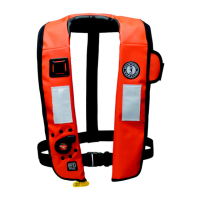
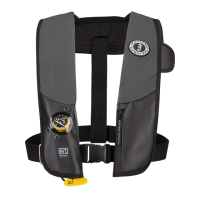
The Mustang Survival Inflatable PFD (Personal Flotation Device) is a safety device designed to provide buoyancy and aid in survival in water. It is available in two models: the MD3003, which is a manual inflation model, and the MD3031, which features manual inflation with an automatic backup system. Both models are approved by the U.S. Coast Guard as Type V PFDs, meaning they are approved only when worn and are considered special use devices. They are not recommended for non-swimmers or weak swimmers, and users must be at least 16 years old.
Unlike traditional PFDs that are inherently buoyant, these inflatable PFDs rely entirely on inflation for buoyancy. In their uninflated state, they present as a comfortable, slim collar designed for maximum mobility and minimum bulk. Inflation is achieved using a 33-gram CO2 gas cylinder.
For the MD3003 model, inflation is activated manually by jerking a pull-tab or orally by mouth. The MD3031 model offers additional flexibility, inflating automatically upon water immersion, or manually via a pull-tab, or orally. When inflated, the PFD provides 33.7 lbs of buoyancy, designed to support wearers with a chest range of 30-52 inches and weighing over 80 pounds. The primary function is to keep the wearer's head above water, maintain a face-up position, and increase the chances of survival and rescue, particularly in cold water conditions where hypothermia is a significant risk.
The PFD is designed for ease of use and comfort.
Regular inspection and maintenance are crucial to ensure the PFD remains in good and serviceable condition.
The manual emphasizes that these devices are intended to help save lives, underscoring the importance of proper fit, good condition, and regular checks of the inflation mechanism status indicators. It also advises against altering the PFD, using it as a fender or kneeling pad, or attaching it to the boat.
 General
| Model | MD3003 |
|---|---|
| Material | Nylon |
| Outer Fabric | 420 Denier Nylon |
| Type | Inflatable PFD |
| Size | Universal |
| Approval | USCG |
| Activation Method | Automatic/Manual |
| Product Type | Life Jacket |
| Certifications | USCG |


 To Next Page