The t generator produces random gates by generating a jittery master clock (which is output on t
2
) and
deriving from it two streams of random gates which are output on t
1
and t
3
.
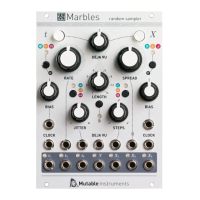
A. Clock rate. 120 BPM at 12 o’clock.
B. Clock range. Divides or multiplies the clock rate by 4.
C. Amount of randomness in the clock timing - perfectly stable, then simulating an instrumentalist
lagging and catching up, then… complete chaos.
D. Bias. Controls whether gates are more likely to occur on t
1
or t
3
. Several methods are available for
splitting the master clock into t
1
and t
3
, selected by the button [E]:
A coin is tossed at every pulse of t
2
, to decide whether the pulse is passed to t
1
or t
3
. BIAS controls the
fairness of the coin toss.
1.
t
1
and t
3
are generated by respectively multiplying and dividing t
2
by a random ratio. Turn the BIAS knob fully
clockwise or counter-clockwise to reach more extreme ratios.
2.
the triggers alternate between t
1
and t
3
, following the same kind of regularity as kick/snare drum patterns.3.
1. BIAS, RATE (with V/O scaling) and JITTER CV inputs.
2. External clock input. The clock signal patched in this input replaces the internal clock. In this case, the
RATE knob and CV input are re-purposed as a division/multiplication control, and the jitter setting is
applied to the external clock.
3. Gate outputs.
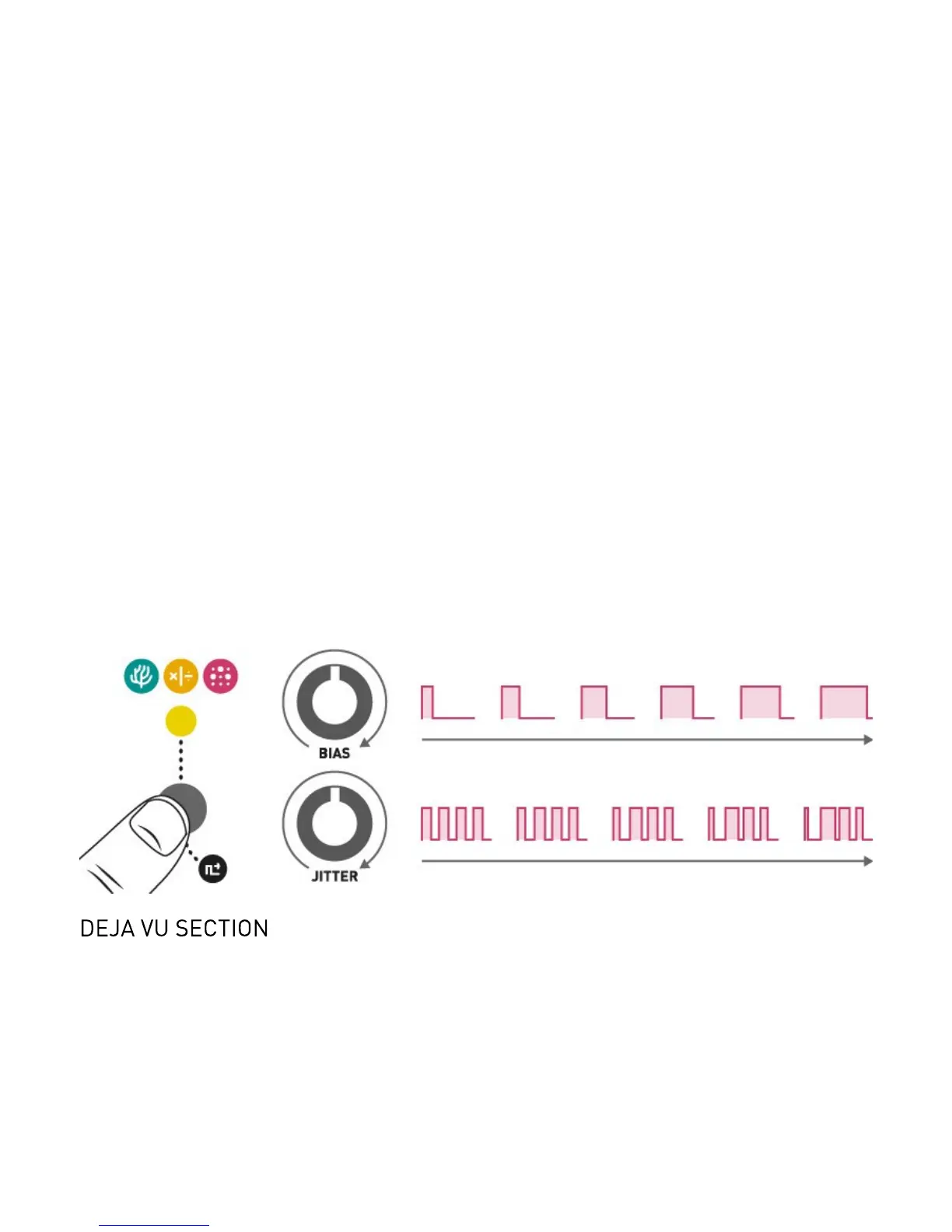
Hold the button [E] and turn BIAS to adjust the gate length from 1% to 99%, or JITTER to adjust the gate
length randomization (from deterministic to completely random).
Whenever the module needs to make a random choice (for instance, to decide on the amount of jitter to
apply on the next tick of its clock, or to generate a random voltage for one of its outputs), it queries the
DEJA VU section. The DEJA VU section either recyles a previously generated random choice, or samples
fresh random data from a hardware random source.
F. G. These buttons control whether the DEJA VU settings apply to the t or X section (or neither, or both).
For example, the module can generate a non-repeating sequence of voltages locked to a looping rhythm (t
enabled, X disabled); or cycle through the same sequence of voltages on an ever-changing rhythm (t
disabled, X enabled).
H. Probability of re-cycling random decisions/voltages from the past:
Mutable Instruments | Marbles
2 of 8


 To Next Page
 Loading...