Copyright Naim Audio 2010 Page 3 of 8
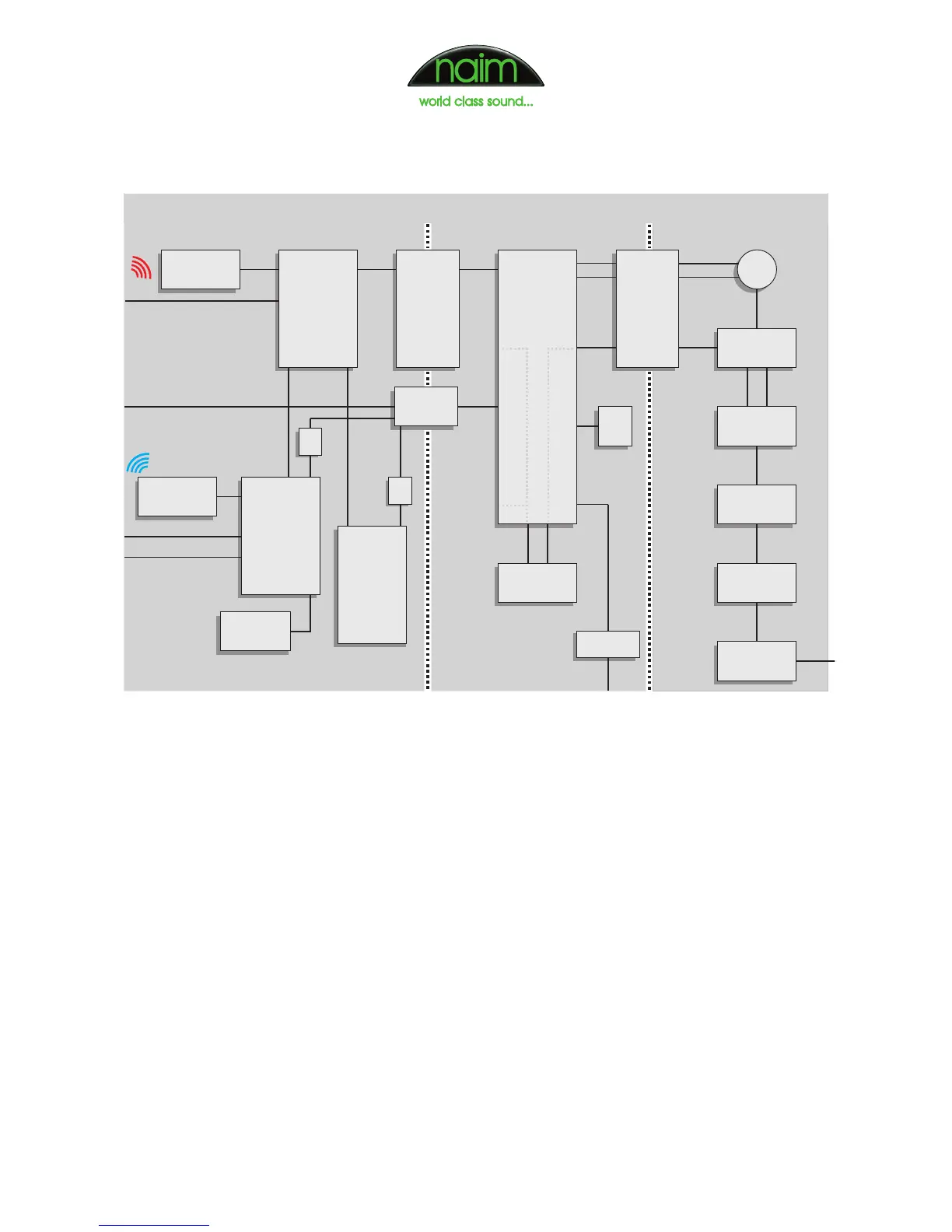
digital audio data source is isolated from the DSP and, in
turn, the DSP is isolated from the master clock and DAC.
In this way the maximum isolation is achieved between
digital sources and analogue output. Power supplies for
each section of the signal path are also independent, as
explained later.
DSP Section
The NDX shares some of the technology developed for the
Naim DAC, as the three following sections (‘RAM buffer
jitter removal’, ‘Oversampling and analogue filtering’ and
‘Digital filtering using Naim algorithms’) explain.
RAM buffer jitter removal
Naim’s buffer or memory method of jitter removal relies
on a simple concept: the audio data is clocked into the
memory at the incoming, inconsistently timed rate and is
then clocked out of the memory and into the DAC chips
using a precise clock. The rate at which the memory fills
and empties is controlled by selecting the master clock
that best matches the average incoming clock frequency.
In this way the data entering the DAC chips is completely
isolated from the incoming jitter. Only in rare cases will
none of the Naim NDX’s selectable master clocks be
NDX Internal Architecture
Dataflow
When the NDX requests a music file, the UPnP
™
server
concerned will packetize the file into a TCP (Transmission
Control Protocol) stream for transport across the network.
The NDX accepts this TCP stream, unpacks it and buffers
the data in memory. This buffering takes up the inevitable
variations in network latency which could otherwise cause
audible clicks and pops or even drop-outs. From this
buffer, located immediately after the Streamer Module,
the data is clocked out to the DSP as a digital audio
stream, using differential transmission to reduce radiated
electrical noise from this fast digital signal. This differential
digital stream is then galvanically isolated from the DSP
section using a high-speed pulse transformer. The full
internal functions of the DSP are explained later in this
document. Buffered I
2
S data output from the DSP is opto-
isolated before the DAC section, where it is converted to
an analogue signal. The analogue signal is then filtered to
remove the out-of-band artefacts that are a by-product of
the digital to analogue conversion process.
Isolation
To reduce noise transfer to the analogue domain from
its digital circuits and connections the NDX incorporates
galvanic isolation between key sections of its circuit. The



 To Next Page