
 Need help?
Do you have a question about the NaturalPoint TrackIR 5 and is the answer not in the manual?
Details disclaimers about manual content, copyright, and trademarks.
Provides information about NaturalPoint Inc. and their products.
Provides initial steps for quickly getting started with the TrackIR.
Recommends reading the manual completely for a better understanding.
Lists the hardware and software specifications required for TrackIR.
Details the components included in the TrackIR package.
Specifies which TrackIR hardware versions are compatible with the software.
Recommends creating a system restore point before installation.
Provides instructions for installing the TrackIR software and drivers.
Instructions on how to position the TrackIR unit for optimal use.
Initial steps for using the TrackIR after software and hardware setup.
Explains the functionality of TrackIR Enhanced games and simulations.
Defines and explains the concept of Six Degrees of Freedom (6 DOF) tracking.
Information about third-party software that can enhance TrackIR functionality.
Describes the two types of tracking available for different TrackClips.
Explains the meaning of the status LEDs on the TrackIR camera.
General introduction to the TrackIR software interface and purpose.
Details on global tracking settings like speed and smoothing.
Information on advanced customization, profiles, and motion curves.
Options for customizing the software window's appearance.
Explains the options available in the software's main menu.
Configuration settings for the TrackIR application behavior.
How to access the software's help resources and manual.
Details about the information pane showing device, profile, and title status.
Selects the tracking clip (standard or PRO) for the software.
Adjusts the responsiveness of head movement to in-game view.
Stabilizes head movement for smoother in-game view control.
Creating, copying, deleting, and saving custom profiles for different games.
Adjusts axis response curves and creates dead zones for precise control.
Assigns specific profiles to TrackIR Enhanced titles for automatic loading.
Configures camera-related options like LEDs, brightness, and processing mode.
Provides a 3D representation of how adjustments affect in-game view.
Shows a 2D image of what the camera is tracking for setup and diagnostics.
Details the function of the hotkey buttons on the status bar.
Explains the meaning of the color-coded status indicators.
Optimal distance for balancing motion range and tracking precision.
Recommendations for lighting conditions to ensure optimal tracking.
Resolves issues with software loading but the device not being detected.
Addresses erratic tracking caused by interference or incorrect settings.
Troubleshoots issues where hotkeys are not functioning as expected.
Guides users on adjusting speed settings for better view control.
Offers solutions for jittery in-game view control, often related to smoothing.
Provides guidance on adjusting settings for mushy in-game view control.
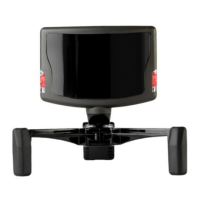
The TrackIR is a head tracking input device designed for use with gaming and simulation PC titles. It functions as an infrared camera that tracks the position of your head using one of two track clips: the standard TrackClip or the TrackClip PRO. The standard TrackClip, which attaches to the brim of a hat or visor, has three reflective markers that direct infrared light back to the camera. The TrackClip PRO, which attaches to most PC headsets, comes with active LED markers that send infrared light directly to the camera.
The TrackIR uses either of these clips to determine the position and orientation of your head, sending that data to over 100 TrackIR Enhanced games and simulations. This allows you to control your in-game view with your actual head movement in three-dimensional space, providing an added dimension to your gaming experience. It is designed to work alongside mice, keyboards, and joysticks, and replaces the traditional function of a joystick's POV hat switch.
The device tracks six axes of movement in three-dimensional space, collectively termed "Six Degrees of Freedom" (6 DOF). These include three for rotation (yaw, pitch, and roll) and three for translation (x, y, and z). TrackIR's three-point tracking system allows all 6 DOF to be tracked, resulting in a precise correlation between actual and in-game movement.
To get started, ensure all software and hardware are properly installed. The TrackIR software is the interface between the device, TrackIR Enhanced games, and the user, and must be running for the TrackIR to function. A list of TrackIR Enhanced games can be found in the "Titles" tab of the software or on the TrackIR website. After verifying a game is TrackIR Enhanced, ensure the TrackIR software is running before starting the simulation. Once the game is running, you should be able to control the view by moving your head. Some games may require you to enable TrackIR support in their in-game menu or activate the virtual cockpit.
For optimal performance, place the TrackIR on a surface directly in front of your face, as close to level with the top of your head as possible, typically on top of your computer monitor. If using a laptop, it can be clipped to the top of the screen. Position the camera so your head is in the center of its view. If you desire more room to move around, position the device further away (between 2 and 5 feet is recommended). When using the TrackClip PRO, ensure its LEDs are in the center of the camera's view. Once the camera is positioned, secure the USB cable with the strain relief clip in the base.
The TrackIR camera features status LEDs that provide visual cues about the software's status. For TrackIR 5, a left green light indicates a clip is being tracked, a right green light means a TrackIR Enhanced Title is running and registered, and both green lights signify both conditions are met. Both orange lights indicate TrackIR is paused, while both off means no clip is tracked and no TrackIR Enhanced Title is running or registered. For TrackIR 3 & 4, an off front status LED means no clip is tracked and output is not paused; green means a clip is tracked and output is not paused; orange means a clip is tracked and output is paused; red means no clip is tracked and output is paused; and flashing blue or green indicates low power or standby mode. The blue case LED for TrackIR 3 & 4 is off if no TrackIR Enhanced Title is running, and glowing blue if one is running and registered.
The TrackIR software offers various settings to customize your experience. In the Basic Settings section, you can adjust global tracking settings such as speed, smoothing, and tracking type for all games. Speed adjustments multiply responsiveness on all axes, affecting all profiles. Smoothing stabilizes head movement, providing a steadier view when increased and more responsive panning when decreased, also applied globally to all profiles.
The Advanced Settings section allows for more detailed customization, including profile management, motion curve editing, tracking preview, view control, assigning profiles to titles, and adjusting camera hardware settings. Profiles are collections of settings (motion curves, hotkeys, axis enabling/disabling) that optimize TrackIR for specific game conditions and personal preferences. The software ships with default profiles like "Default" (optimized for a broad range of genres with a strong dead zone to prevent unintended movements) and "Smooth" (minimal dead zone, even motion scaling, ideal for flight and racing). The "One:One" profile provides an unscaled 1:1 ratio between actual and in-game head movement, primarily for testing.
You can create, copy, and delete profiles. Hotkeys can be mapped to keys or buttons on other input devices to perform functions like Pause, Center, or Precision. "Pause" temporarily stops head tracking, fixing the in-game view. "Center" re-centers your in-game view, redefining your current head position. "Precision" enables a mode that temporarily steadies the view by increasing smoothing, useful for precise aiming in combat simulators. Hotkeys can be toggled on/off, set to toggle mode (single press activates, second press deactivates), and trapped (preventing other programs from using them).
Axis checkboxes allow you to enable or disable head tracking for each particular axis. TrueView accounts for virtual rotation when applying physical translation, allowing you to lean and zoom in the direction you are virtually facing. Disabling TrueView means physical translation supersedes virtual rotation, always moving the in-game view straight ahead.
Motion curves allow you to adjust the response speed for each axis to your head movement. These curves amplify real head movement, providing complete control over in-game view. You can create a dead zone to negate small, unintentional head movements when the view is centered. Control points on the graph can be clicked and dragged to change the curve's shape, or values can be manually entered. The X value represents actual 3D head movement (degrees or cm), while the Y value represents its multiplication factor. For example, a control point (15,3) means 15 degrees of real movement results in 45 degrees of in-game movement. You can zoom in/out on the graph using the scroll wheel or by dragging a region. The "Mirror" option allows independent manipulation of control points on the graph. "Invert" reverses tracking for an axis, useful for camera placement behind your head. "Limit" enables 180-degree view limits on rotational axes. Curve templates like "One:One," "Deadzone," "Smooth," "Fast," and "Slow" can be applied or created.
The Title Management section lists all TrackIR Enhanced Titles, allowing you to sort by genre and assign profiles that will automatically load when a title starts. You can filter titles and add/remove them from a favorites list.
Global Camera Settings include Status LEDs Enabled (turns camera status LEDs on/off), Status LEDs Brightness (adjusts brightness for TrackIR 5 cameras only, not affecting tracking), Light Filter Threshold (controls how much light TrackIR sees, filtering out unwanted reflections in bright conditions), IR Brightness (adjusts infrared light brightness to help the camera track reflective markers), and Camera Rotation (sets the correct rotation if the unit is clipped to different parts of your monitor).
Video Processing Mode offers "Standard" (for TrackIR 3 or 4, or TrackIR 5 in extremely bright, unstable conditions) and "Precision" (for TrackIR 5 only, offering superior resolution and tracking stability).
The Visual Preview includes a 3D View, providing instant feedback on how speed, smoothing, and curve adjustments impact in-game view control. You can customize the camera position, load panoramic backgrounds, view wireframe grids, third-person head previews, and toggle the HUD. "First Person" view shows what your view control looks like within a TrackIR Enhanced title. "Third Person" view offers various viewpoints that can be manipulated to change angle or zoom, representing real-life head movement and in-game view control. "Show HUD" toggles all windows on the 3D View Preview Window. "Show Pano" displays a 2D panoramic image for previewing settings in a game-like environment. "Load Pano" allows custom panoramic images. "Show Pano Grid" removes/reapplies the wireframe sphere. "Mirror Camera View" mirrors images in the Camera View for more intuitive use. The "Camera Window" shows a 2D image of what the TrackIR camera is tracking, helping adjust position and identify undesired light sources. "Left, Top, and Front Heads" preview windows show a third-person view of the head model, providing instant feedback on how current settings translate in-game. "6 DOF Data" displays raw head tracking data.
The Status Bar includes Hot Keys (displaying and allowing activation of assigned functions like Center, Precision, Pause) and Software Status Indicators (Green On/Off for camera connection, Yellow On/Off for marker tracking, Blue On/Off for TrackIR Enhanced title recognition).
For optimal gaming environment, maintain a distance of 24-36 inches between the TrackIR and the user for the best balance between range of motion and tracking precision, with no more than 4 feet between the reflective target and the TrackIR. Dim or turn off lights in the room and remove highly reflective materials from the camera's view. You can check what the camera sees by opening the Camera View.
For maintenance, if experiencing erratic tracking or "jumps" instead of smooth panning, it may be due to interference from another light source. Check the "Camera View" for more than three green dots, indicating highly reflective items or direct light sources. Move these objects, reposition the camera, increase light filtering on the Camera tab, or reposition your monitor. If hotkeys are not working, it may be due to a conflict with other system properties or another hotkey assignment; select a different key. If speed settings don't feel right, refer to sections 5.7.2 and 5.8.1.3 for adjustment information. If in-game view control feels jittery, increase smoothing slightly (section 5.7). If it feels mushy, it indicates too much smoothing, and should be decreased.
In case of software loading issues or the LED indicator not coming on, ensure proper software and hardware installation. If the TrackIR was connected before software installation, shut down the software, unplug the unit for 30 seconds, plug it back in, wait another 30 seconds, and restart the software. Check Device Manager for TrackIR 3, 4, or 5 under NaturalPoint Devices. If an unknown device or one with a yellow/black "?" is listed, remove/uninstall it, disconnect TrackIR, reboot, unplug extraneous USB devices, uninstall NaturalPoint software, reboot twice, then reinstall the software and reconnect TrackIR. If problems persist, a system restore to an earlier time may be necessary.
 General
| Type | Head tracking device |
|---|---|
| Interface | USB |
| Compatibility | Windows |
| Software | TrackIR Software |
| Framerate | 120 fps |
| Connection | Wired |
| Tracking Technology | Infrared (IR) |
| Included Accessories | USB cable |

 To Next Page