1
SECTION 55 -- ELECTRICAL SYSTEM -- CHAPTER 5
603.54.471.00 -- 11 -- 2004
SECTION 55 -- ELECTRICAL SYSTEM
Chapter 5 -- BATTERY
CONTENTS
Section Description Page
55 000 Technical information 1..........................................................
Description and operation 1......................................................
55.301.040 Removal and re--installation 2....................................................
Battery checking and maintenance 3..............................................
Charging the battery 4...........................................................
Battery problems -- Frequent causes 8.............................................
55 000 TECHNICAL INFORM ATION
TYPE OF BATTERY
CHARACTERISTICS
TD60D/TD70D/TD80D/
TD90D models
TD95D model
(optional for
other models)
Voltage (V) 12
Cold start amperage (C.C.A) 1x760 1x800
Capacity (Ah) 105 120
Number of elements 6
Number of plates per element 16 21
Energy reserve (SAE) (min.) 160 210
Weight (kg) (lb) 25 (55.12) 35 (77.16)
Earth (ground) terminal Negative
DESCRIPTION AND OPERATION
Both types of battery are of the “sealed,
maintenance--free” type.
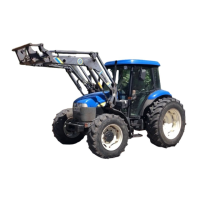
105 Ah batteries are fitted on TD60D, TD70D,
TD80D and TD90D models. The battery is
positioned in front of the radiator, in the front axle
support compartment (Fig. 1).
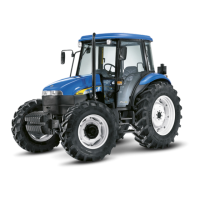
120 Ah batteries are fitted on TD95D models with cab
air conditioning and are optional for TD60D, TD70D,
TD80D and TD90D models. The battery is installed
above the front axle support (Fig. 2).
NOTE: “Maintenance--free” means that the battery
electrolyte, in normal conditions of use, does not
leak. It could leak if the battery is loaded over 14.4 V.
This, in fact, causes the water to boil due to gas
formed as the battery charges up completely. It can
be caused by a faulty charging system, by quick
charging or topping up.
The four main functions of a battery are:
• to supply a source of electricity for starting,
ignition and instrument lighting and functioning.
• to control voltage in the electrical system.
• to supply electricity when the power required is
higher than that produced by the alternator.
• to support inactive loads from radio and
microprocessor memory.
Each element of the battery consists of positive and
negative plates, positioned alternatively, one next to
the other. Each positive plate is separated from the
adjacent negative plate by means of a porous
insulating spacer. If one of the positive plates
touches a negative plate in the element, the element
will short--circuit and be irreversibly damaged. The
positive plates are welded to a collecting bar and
form a positive terminal. The negative plates are
welded to a similar collecting bar and form a negative
terminal.
Each positive plate consists of a lead grid with lead
peroxide pasted to the grid holes. The negative
plates consist of a lead grid with lead sponge pasted
to the grid holes.
The plates are covered by an electrolyte which
consists of diluted sulphuric acid solution.
The battery casing is made of polypropylene.



 To Next Page
 Loading...