12
Operating Instructions - SOLO PRO 290 RTF 2.4 GHz No. NE2516
This function is required in order to
create the communication link bet-
ween receiver and transmitter. „Bin-
ding“ only needs to be carried out
when the receiver is used with the
transmitter for the first time. It is ad-
visable to place the transmitter 0.5
m or less from the receiver aerial, to
eliminate possible influences from
other transmitters during the binding
process.
Procedure:
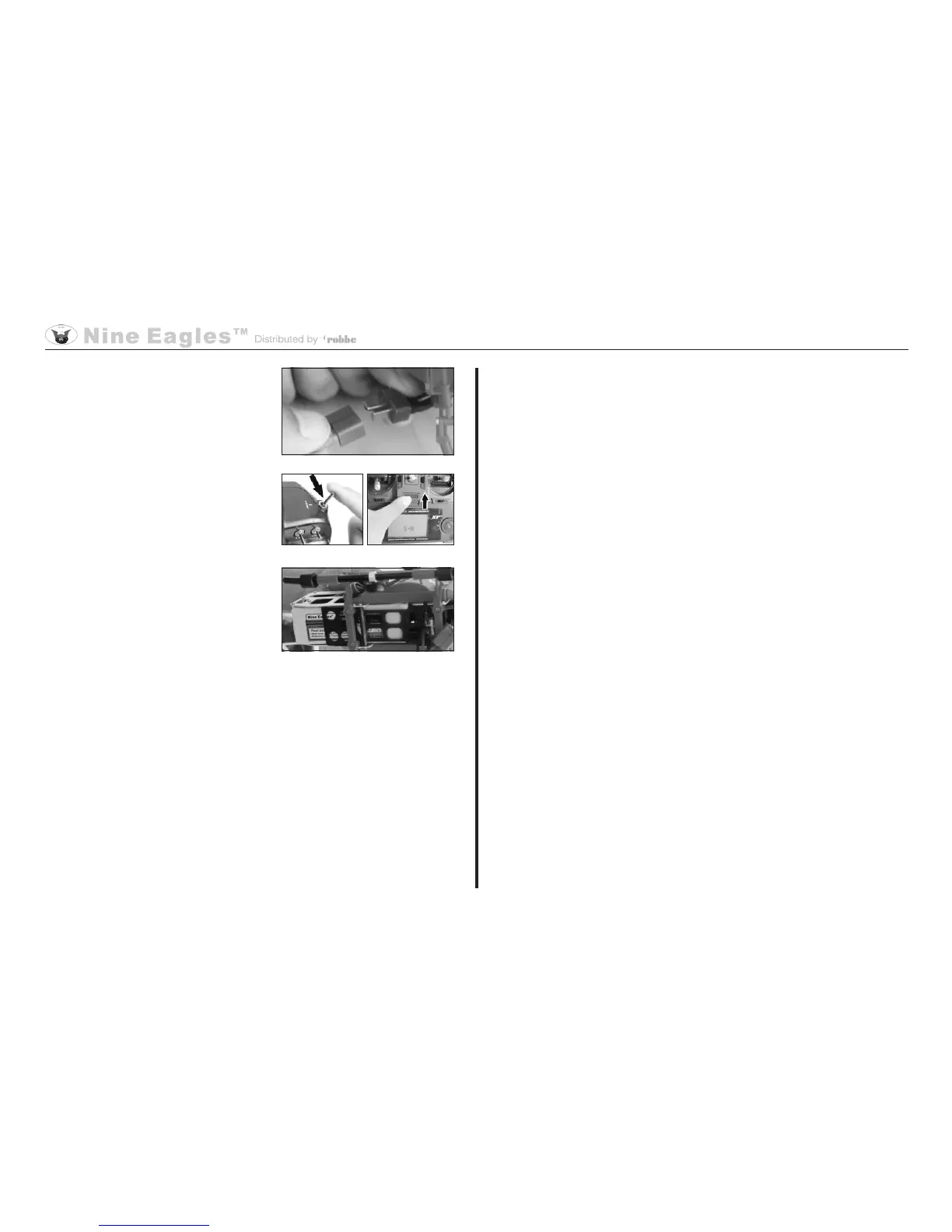
1.) Disconnect the electric motor
from the speed controller (Fig. 1).
2.) Hold the Trainer button pressed in
while you switch the transmitter on. You will now see „S-H“ flas-
hing on the LCD screen, and the buzzer sounds a warning (Figs.
2 and 3).
3.) Place the flight battery close by (Fig. 4) and connect the receiver:
the monitor LED flashes.
4.) Press the Binding button on the receiver: the monitor LED flashes
at a higher rate, indicating that the receiver is entering Binding
mode.
5.) The receiver is ready for use as soon as the LED glows constant-
ly. If the binding procedure was successful, the LCD screen on
the transmitter reverts to the normal information display.
Binding the receiver
Fig. 2 Fig. 3
Fig. 1
Fig. 4
Pre-flight safety check
Before flying the model check that the receiver battery is fully
charged, and that the transmitter batteries still have adequate
capacity.
Ensure that the throttle stick is at the lowest position (fully back)
before switching the model on, and that all other sticks and swit-
ches are in the normal position.
Check that all servos are working perfectly.
Check that each component has been installed correctly.
Check that the whole model is in perfect technical condition.
When it is time to switch the receiver and transmitter on, please
observe the following procedure:
Always switch the transmitter on first, and only then the receiver.
After a flight you should always switch the receiver off first, and
only then the transmitter. If you fail to keep to this sequence, the
model could be uncontrollable.
Check that all linkages are correctly fitted and devoid of lost moti-
on; replace them if necessary. Sloppy linkages result in instability
in flight.
Before flying the model, check that the connection between flight
battery and model is secure. Vibration can cause loose connec-
tors to come adrift in flight, rendering the model uncontrollable.


 To Next Page
 Loading...