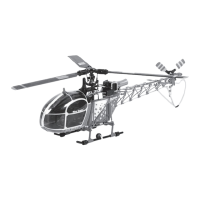
Contents Page
Explanation of specialist terms / Contents 3
Safety Notes 4, 5
Set contents / Specification / Recommended accessories 6
Transmitter description Mode 1 7
Transmitter description Mode 2 8
Transmitter LCD screen / collective pitch throttle setting 9
Receiver socket sequence / Charging the flight battery 10
Safety Notes, LiPo batteries 11
Re-binding the transmitter / safety checks 12
Pre-flight preparations 13, 14
Important advice / The first few flights 15
Tail rotor and gyro neutral positions 16
Possible problems / transmitter settings 16
Causes of problems 17
Trim settings, Mode 1 and Mode 2 18
Controlling the model in Mode 1 and Mode 2 19
Comformity declaration / Disposal of batteries 20
Explanation of specialist terms:
Climb and descent ("Throttle/pitch"): This controls the
model's climb and descent.
Yaw: The model's movement around the vertical axis;
the helicopter rotates to right or left.
Elevator: The model's movement around the lateral
axis,
forward or reverse flight
Roll: The model's movement around the longitudinal
axis,
sideways movement to right or left
Mode 1: Function assignment of the control move-
ments relative to the stick movements.
In this case collective pitch / motor speed (throttle) and
roll are controlled by the right-hand stick; pitch-axis
and tail rotor by the left-hand stick.
Mode 2: Function assignment of the control move-
ments relative to the stick movements.
In this case collective pitch / motor speed (throttle) and
tail rotor are controlled by the left-hand stick; pitch-axis
and roll by the right-hand stick.
Dual Rate: Switchable travel reduction for control mo-
vements.
Binding: Creating the radio link between transmitter
and receiver.
3
Operating Instructions - SOLO PRO 290 RTF 2.4 GHz No. NE2516


 To Next Page
 Loading...