SSS0650
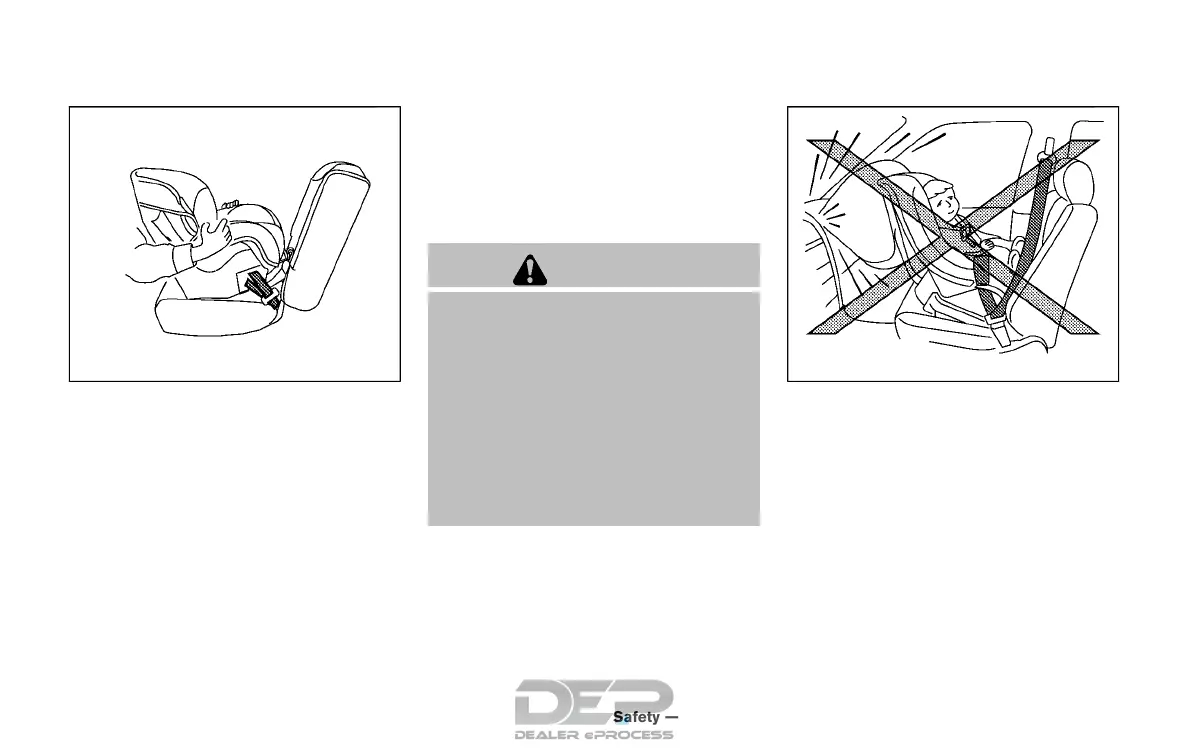
Rear-facing — step 4
4. After attaching the child restraint, test it
before you place the child in it. Push it from
side to side while holding the child restraint
near the LATCH attachment path. The child
restraint should not move more than 1 inch
(25 mm), from side to side. Try to tug it
forward and check to see if the LATCH
attachment holds the restraint in place. If the
restraint is not secure, tighten the LATCH
attachment as necessary, or put the restraint
in another seat and test it again. You may
need to try a different child restraint or try
installing by using the vehicle seat belt (if
applicable). Not all child restraints fit in all
types of vehicles.
5. Check to make sure the child restraint is
properly secured prior to each use. If the
child restraint is loose, repeat steps 1
through 4.
REAR-FACING CHILD RESTRAINT IN-
STALLATION USING THE SEAT BELTS
WARNING
The three-point seat belt with Auto-
matic Locking Retractor (ALR) must be
used when installing a child restraint.
Failure to use the ALR mode will result
in the child restraint not being properly
secured. The restraint could tip over or
be loose and cause injury to a child in a
sudden stop or collision. Also, it can
change the operation of the front
passenger air bag. See “Front passen-
ger air bag and status light” (P.1-46).
SSS0100
Rear-facing — step 1
Refer to all Warnings and Cautions in the “Child
safety” (P.1-16) and “Child restraints” (P.1-18)
before installing a child restraint.
Do not use the lower anchors if the combined
weight of the child and the child restraint
exceeds 65 lbs (29.5 kg). If the combined
weight of the child and the child restraint is
greater than 65 lbs (29.5 kg), use the vehicle’s
seat belt (not the lower anchors) to install the
child restraint. Be sure to follow the child
restraint manufacturer’s instructions for installa-
tion.
Follow these steps to install a rear-facing child
restraint using the vehicle seat belts in the rear
Safety — Seats, seat belts and supplemental restraint system 1-25



 To Next Page