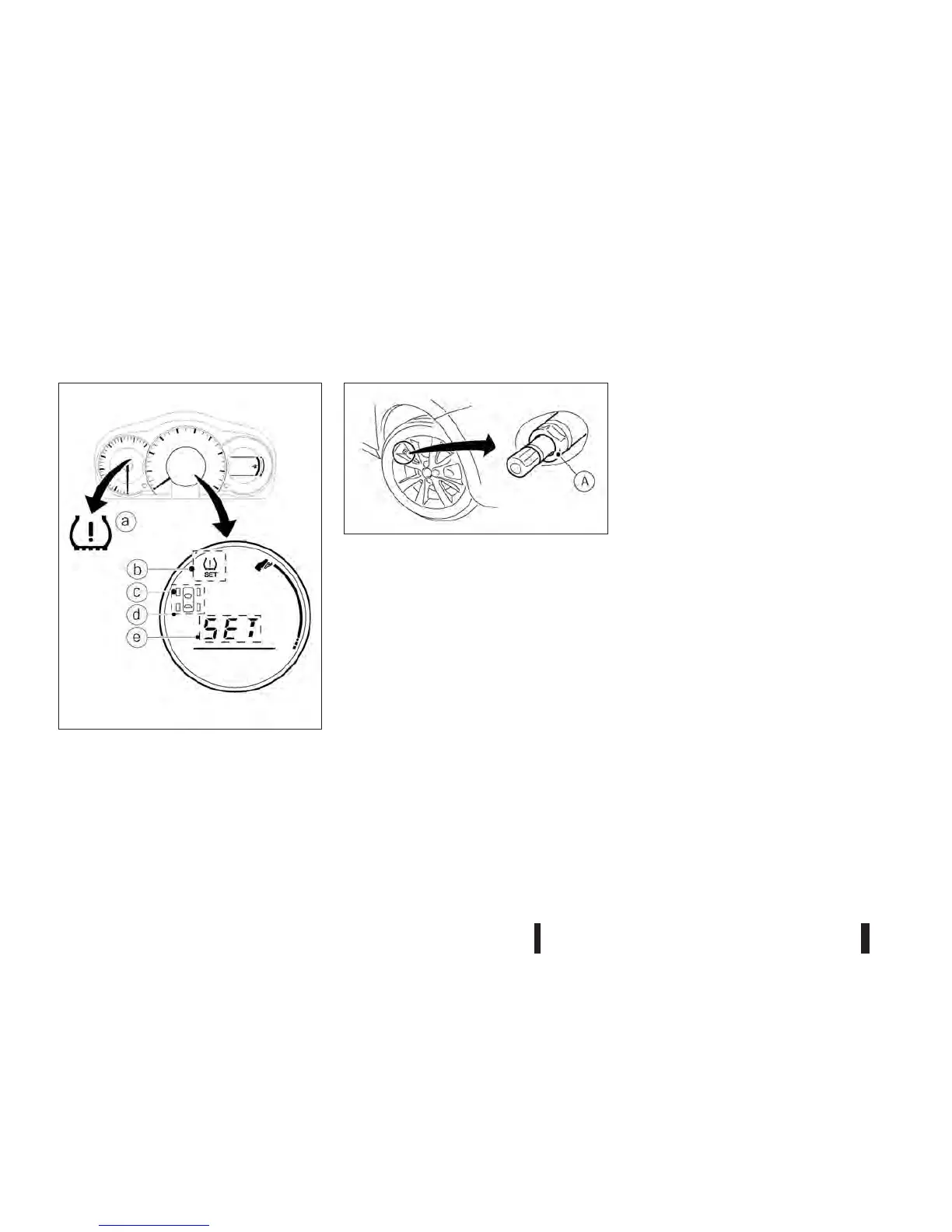
ja
TPMS indicator light
jb
TPMS set indicator light
jc
Tyre indicator light
jd
TPMS tyre location indicator light
je
SET indication (reset procedure only)
jA
Tyre valve with sensor
The tyre pressure monitoring system monitors the
tyre pressure of the four wheels while the vehicle is
in motion. Following a loss in pressure, the system
will warn the driver using a visual warning. Each
TPMS sensor
jA has a registered wheel location
and sends pressure and temperature data via radio
to a receiver inside the vehicle.
Each tyre, including the spare (where fitted), should
be checked monthly when cold and inflated to the
inflation pressure recommended by the vehicle
manufacturer on the vehicle placard or tyre inflation
pressure label. (If your vehicle has tyres of a differ-
ent size than the size indicated on the vehicle plac-
ard or tyre inflation pressure label, you should deter-
mine the proper tyre inflation pressure for those
tyres.)
The Tyre Pressure Monitoring System (TPMS) con-
trols the TPMS indicator light
ja to illuminate when
one or more tyres are significantly under-inflated.
Accordingly, when the TPMS indicator light illumi-
nates, safely stop the vehicle to check the tyres as
soon as possible and inflate the tyres to the proper
pressure. Driving on a significantly under-inflated
tyre causes the tyre to overheat and can lead to tyre
failure. Under-inflation also reduces fuel efficiency
and tyre tread life which may affect the vehicle’s
handling and stopping ability.
Note that the TPMS is not a substitute for proper
tyre maintenance. It is the driver’s responsibility to
maintain correct tyre pressure, even if under-infla-
tion has not reached the level to trigger the illumina-
tion of the TPMS indicator light
ja.
The TPMS indicator light flashes for a short period
and then turns on continuously if the system is not
operating properly. This sequence will continue
upon subsequent vehicle start-ups as long as the
malfunction exists. When the malfunction warning
light is illuminated, the system may not be able to
detect or signal low tyre pressure as intended.
TPMS malfunctions may occur for a variety of rea-
sons including the installation of replacement or al-
ternate tyres or wheels on the vehicle that prevent
the TPMS from functioning properly. Always check
the TPMS indicator light after replacing one or more
tyres or wheels on your vehicle to ensure that the
replacement or alternate tyres and wheels allow the
TPMS to continue to function properly.
•
The TPMS does not monitor the tyre pressure of
the spare tyre.
•
The TPMS will activate only when the vehicle is
driven at speeds above 25 km/h (16 MPH). Also,
NSD484
NCE373
TYRE PRESSURE MONITORING
SYSTEM (TPMS)
5-4 Starting and driving



 To Next Page