6. To prevent slack in the seat belt webbing, it is
necessary to secure the seat belt in place with
locking devices attached to the child restraint.
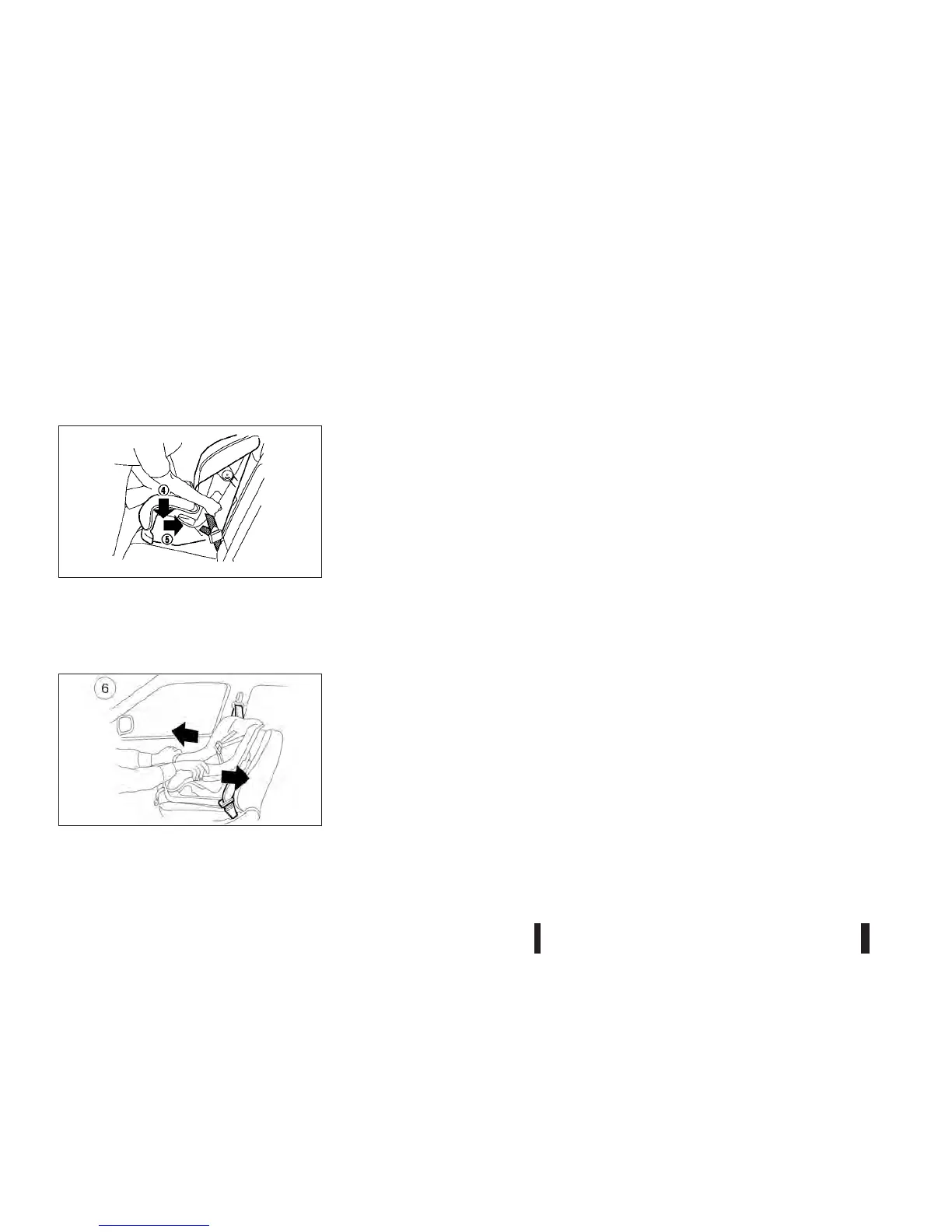
7. Remove any additional slack from the seat belt;
press downward
j4 and rearward j5 firmly in
the centre of the child restraint with your knee to
compress the vehicle seat cushion and seatback
while pulling up on the seat belt.
8. Test the child restraint before you place the child
in it
j6 . Push the child restraint from side to side
and tug it forward to make sure that it is held
securely in place.
9. Check to make sure that the child restraint is
properly secured prior to each use. If the child
restraint is loose, repeat steps 6 through 8.
PRECAUTIONS ON SUPPLEMENTAL
RESTRAINT SYSTEM (SRS)
This Supplemental Restraint System (SRS) section
contains important information concerning the driv-
er’s and passenger’s supplemental front-impact air
bags, and pre-tensioner seat belts.
Front seat-mounted side-impact
supplemental air bag system
This system can help cushion the impact force to
the chest and pelvis areas of the driver and front
passenger in certain side-impact collisions. The front
seat-mounted side-impact supplemental air bag is
designed to inflate on the side where the vehicle is
impacted.
Roof-mounted curtain side-impact
supplemental air bag system
This system can help cushion the impact force to
the head of the driver and passengers in front and
rear outboard seating positions in certain side-im-
pact collisions. The roof-mounted curtain side-im-
pact supplemental air bag is designed to inflate on
the side where the vehicle is impacted.
Supplemental front-impact air bag
system
This system can help cushion the impact force to
the head and chest area of the driver and/or front
passenger in certain frontal collisions. The supple-
mental front-impact air bag is designed to inflate on
the front where the vehicle is impacted.
SSS0647BZ
Step 7
NIC1941
Step 8
SUPPLEMENTAL RESTRAINT
SYSTEM (SRS)
1-26 Safety — seats, seat belts and supplemental restraint system



 To Next Page