The brake pedal must be depressed and
the shift lever button pushed in to move the
shift lever from N (Neutral) or any drive
position to P (Park). Apply the parking brake.
When parking on a hill, apply the parking brake
first, then place the shift lever into the P (Park)
position.
R (Reverse)
CAUTION
To prevent transmission damage, use the
R (Reverse) position only when the vehicle
is completely stopped.
Use the R (Reverse) position to back up. Make
sure the vehicle is completely stopped before
selecting the R (Reverse) position. R (Reverse)
speed is limited to 30 mph (48 km/h). Do not
exceed 30 mph (48 km/h) in the R (Reverse)
position. The brake pedal must be de-
pressed and the shift lever button pushed
in to move the shift lever from P (Park), N
(Neutral) or any drive position to R (Re-
verse).
N (Neutral)
Neither forward nor reverse gear is engaged. The
engine can be started in this position. You may
shift to N (Neutral) and restart a stalled engine
while the vehicle is moving.
D (Drive)
Use this position for all normal forward driving.
L (Low)
Use this position for maximum engine braking on
steep downhill gradients/climbing steep slopes
and whenever approaching sharp bends. Do not
use the L (Low) position in any other circum-
stances.
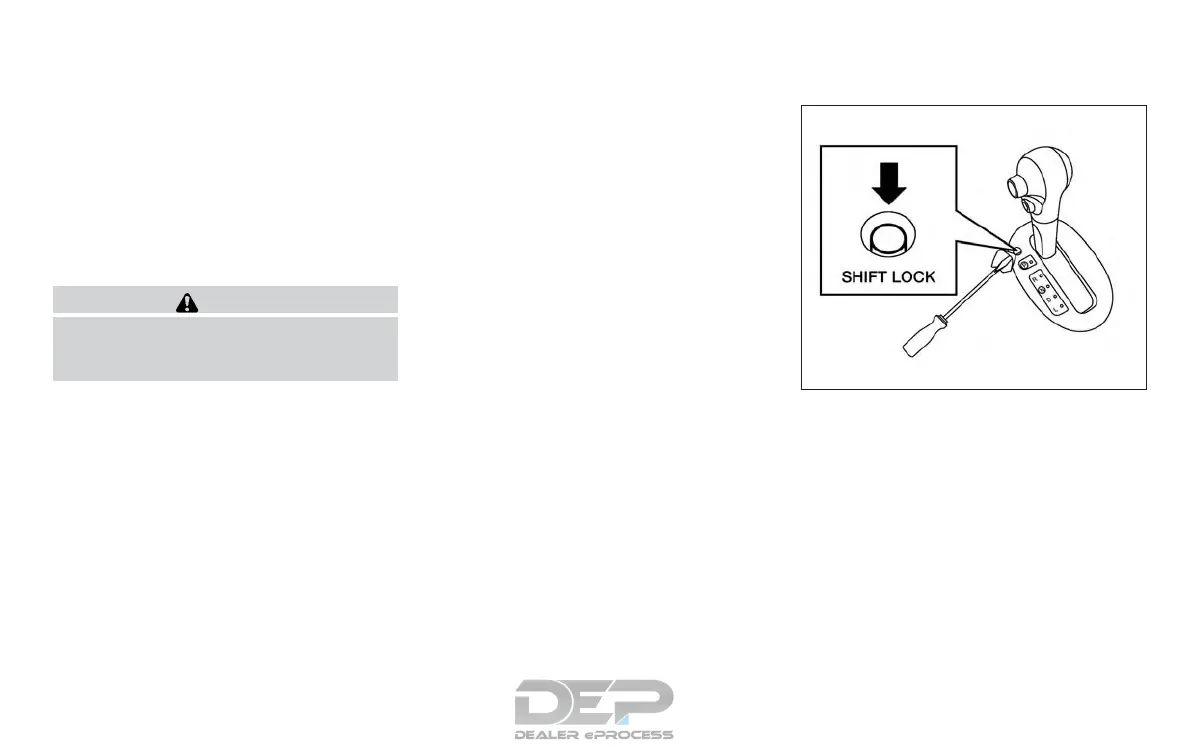
Shift lock release
If the battery is discharged, the shift lever may not
be moved from the P (Park) position even with the
foot brake pedal depressed.
To move the shift lever, perform the following
procedure:
1. Place the ignition switch into the LOCK po-
sition and remove the key.
2. Apply the parking brake.
3.
Using a protective cloth on the tip ofa3mm
screwdriver, remove the shift lock release cover.
● If available, a plastic trim tool can also be
used.
LSD2194
Starting and driving 5-17



 To Next Page