SMALL CHILDREN
Children that are over 1 year old and weigh at
least 20 lbs (9 kg) should remain in a rear-facing
child restraint as long as possible up to the height
or weight limit of the child restraint. Children who
outgrow the height or weight limit of the rear-
facing child restraint and are at least 1 year old
should be secured in a forward-facing child re-
straint with a harness. Refer to the manufactur-
er’s instructions for minimum and maximum
weight and height recommendations. NISSAN
recommends that small children be placed in
child restraints that comply with Federal Motor
Vehicle Safety Standards or Canadian Motor Ve-
hicle Safety Standards. You should choose a
child restraint that fits your vehicle and always
follow the manufacturer’s instructions for instal-
lation and use.
LARGER CHILDREN
Children should remain in a forward-facing child
restraint with a harness until they reach the maxi-
mum height or weight limit allowed by the child
restraint manufacturer.
Once a child outgrows the height or weight limit
of the harness-equipped forward-facing child re-
straint, NISSAN recommends that the child be
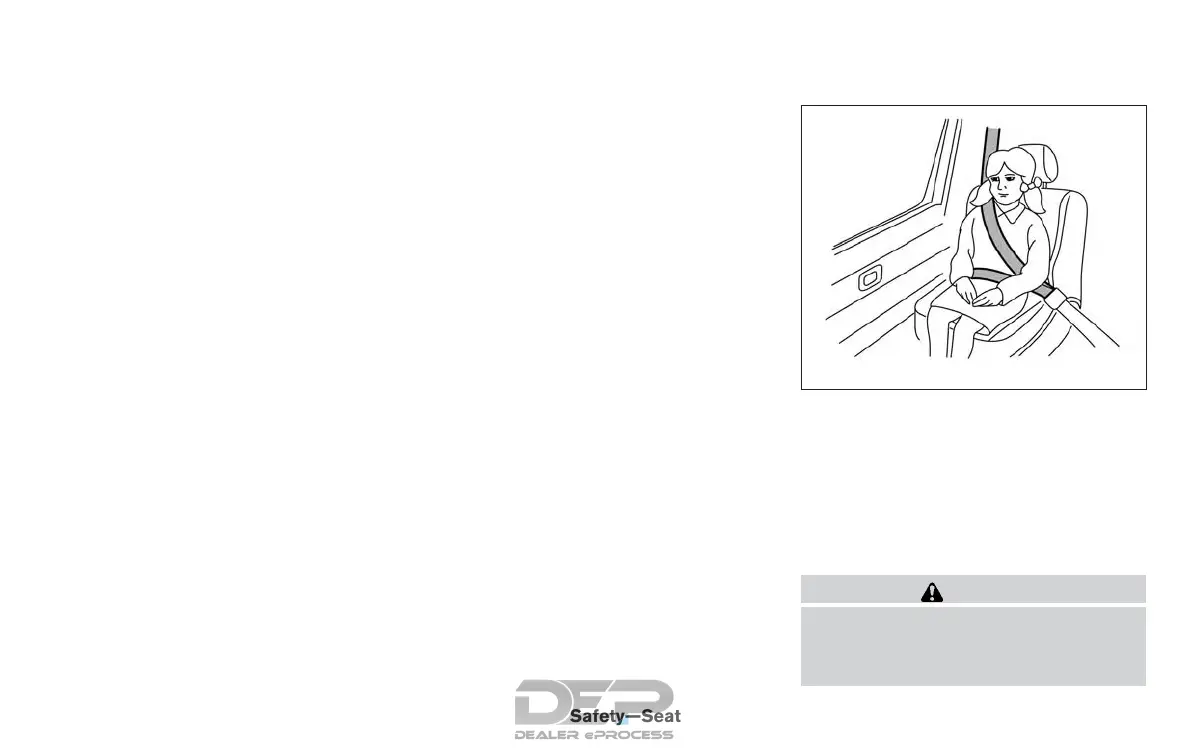
placed in a commercially available booster seat to
obtain proper seat belt fit. For a seat belt to fit
properly, the booster seat should raise the child
so that the shoulder belt is properly positioned
across the chest and the top, middle portion of
the shoulder. The shoulder belt should not cross
the neck or face and should not fall off the shoul-
der. The lap belt should lie snugly across the
lower hips or upper thighs, not the abdomen. A
booster seat can only be used in seating posi-
tions that have a three-point type seat belt. The
booster seat should fit the vehicle seat and have
a label certifying that it complies with Federal
Motor Vehicle Safety Standards or Canadian Mo-
tor Vehicle Safety Standards.
A booster seat should be used until the child can
pass the seat belt fit test below:
● Are the child’s back and hips against the
vehicle seatback?
● Is the child able to sit without slouching?
●
Do the child’s knees bend easily over the front
edge of the seat with feet flat on the floor?
● Can the child safely wear the seat belt (lap
belt low and snug across the hips and shoul-
der belt across mid-chest and shoulder)?
● Is the child able to use the properly adjusted
head restraint/headrest?
● Will the child be able to stay in position for
the entire ride?
If you answered no to any of these questions, the
child should remain in a booster seat using a
three-point type seat belt.
NOTE:
Laws in some communities may follow dif-
ferent guidelines. Check local and state
regulations to confirm your child is using the
correct restraint system before traveling.
WARNING
Never let a child stand or kneel on any seat
and do not allow a child in the cargo area.
The child could be seriously injured or
killed in a sudden stop or collision.
LRS2690
Safety—Seats, seat belts and supplemental restraint system 1-21


 To Next Page
 Loading...