Sound Generation
32
Decay:
▶
Press Decay (Comb Filter).
▶
Sweep the Encoder slowly across the entire range.
▶
Change both Pitch and Decay and try out the various timbral eects.
ߊ Decay controls the feedback of the delay. It determines the amount of the
signal making its rounds in the feedback loop, and thus the time it takes
for the oscillating feedback loop to fade out. This depends very much on
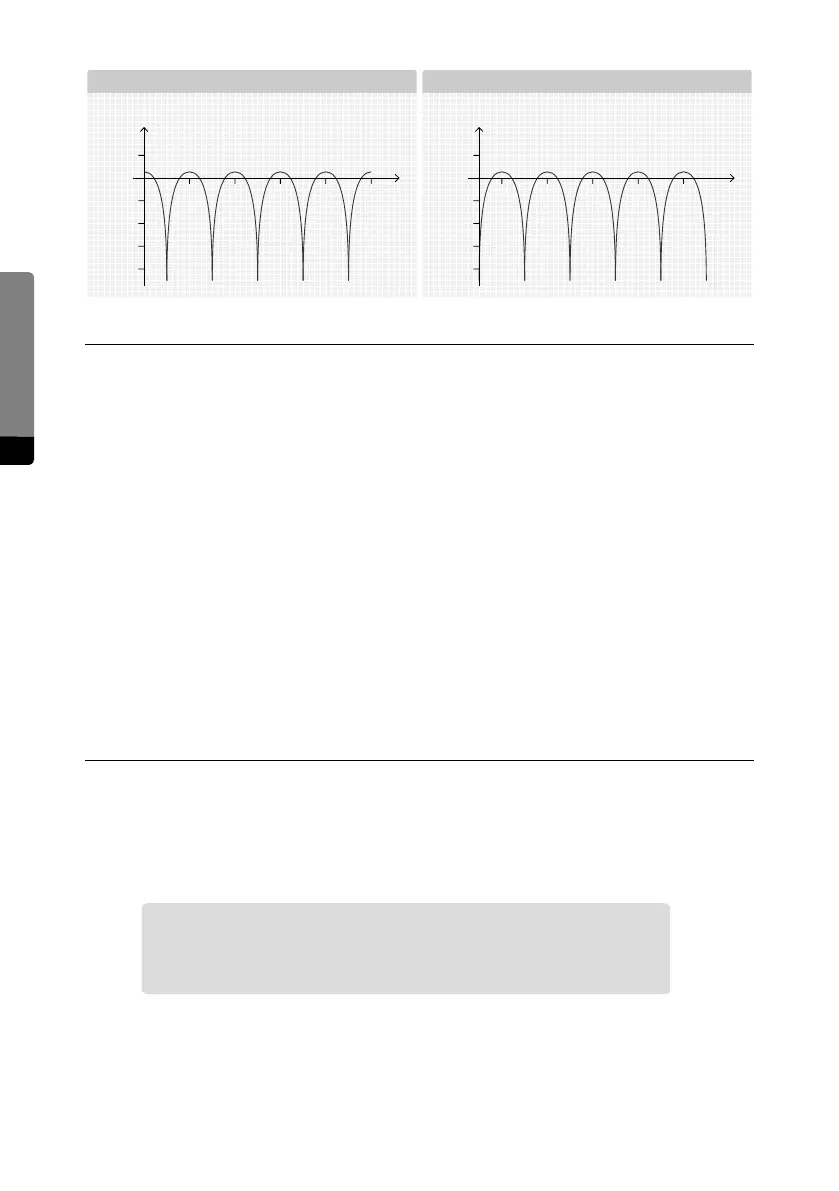
the delay time dialed in (“Pitch”). When changing Pitch slowly, you can
hear the “peaks” and “troughs” in the frequency spectrum, i. e. boosted
and attenuated frequencies.
⚠
Please note there are positive and negative Decay values. Negative
values invert the phase of the signal (negative feedback) and provide
dierent sonic results with a certain “hollow” character – good for e.g.
bell-like timbres …
Exciting the Comb Filter:
So far, we have been working with a sustained / static input signal. Even more inter-
esting is the use of an impulse to stimulate the feedback loop of the Comb Filter:
▶
Turn the output signal of Oscillator/Shaper A into a short and sharp “click”
by dialing in suitable parameter values for Envelope A:
Magnitude
(dB)
Frequency
Ratio
20 dB
0 dB
– 20 dB
0.51.0 2.0 3.0 4.0 5.0 1.5 2.5 3.5 4.5
– 40 dB
– 60 dB
– 80 dB
Magnitude
(dB)
Frequency
Ratio
20 dB
0 dB
– 20 dB
– 40 dB
– 60 dB
– 80 dB
Non-inverted Mix Inverted Mix
Attack: 0.000 ms Decay 1: 2.0 ms
Breakpoint: 100% Decay 2: 4.0 ms
Sustain: 0.0 % Release: 4.0 ms


 To Next Page