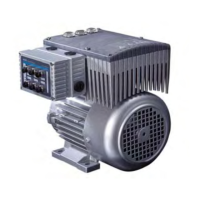
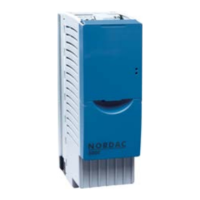
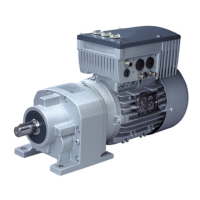
NORDAC SK 750E manual
18 Technical design subject to change BU 0750 GB
2.7 Wiring instructions
The inverters were designed to be operated in an industrial environment where a high level of industrial inter-
ference is to be expected. In general, if installation has been carried out in a workmanlike manner, safe and
trouble-free operation is ensured. For even the limit values of the EMC directives to be met, following the in-
structions given below should eliminate any interference problems.
1) Make absolutely sure that all devices in the cabinet or in the field are effectively earthed using short
earth conductors with a large cross section which should be connected to a common earth connection
point or an earth bus bar. It is of special importance that any control device linked with the inverter (e.g.
an automation device) is connected to the same earth connection point as the inverter itself via a short
conductor with a large cross-sectional area. Flat conductors (such as metal bows) should be preferred
as they show less impedance at high frequencies.
2) The PE conductor of the motor controlled by the inverter should be connected as directly as possible to
the earth connection point which is connected to the heat sink, as should the PE of the mains supply
cable of the respective inverter. By providing a central earth bus bar in the switch cabinet and jointly
connecting all PE conductors to this bar, trouble-free operation is normally ensured (see also Sections
8.3/8.4 EMC directives).
3) Use shielded cables for control circuits if possible. Terminate the screen at the end of the cable care-
fully and see to it that no greater length of wire runs unshielded.
The shield of analogue setpoint cables should be connected to earth at the frequency inverter at one
end only.
4) When laying the wiring a certain distance should be ensured between control lines and load lines, us-
ing for instance separate cable ducts etc. When lines are crossing try to arrange them so as to form a
90° angle.
5) Take appropriate measures to ensure that no interference will be emitted by the contactors in the cabi-
nets. Alternating current contactors should have RC suppressors while direct current contactors should
be provided with freewheeling diodes, with the interference suppression components being fixed
to the contactor coils. Varistors for overvoltage limitation can also be used to achieve the desired ef-
fect of voltage suppression. Especially if the contactors are controlled by the relays in the inverter,
noise suppression is indispensable.
6) Use screened or armoured cables for the load connections (motor cables) and connect the screen-
ing/armouring to earth at both ends, directly at the PE of the frequency inverter or at the angle bracket
connector if possible.
In addition absolutely see to it that the wiring meets the stipulations for EMC (see also Sections 8.3/8.4
EMC). An integrated motor filter is available as an opion if required.
7) Select the lowest possible switching frequency. With this measure the intensity of the electromagnetic
interference produced by the inverter will be reduced.
When installing the inverters never and on no account do anything to violate
the safety regulations!
Control lines, supply lines, and motor leads must be laid separately. They should never be laid in
the same conduit/installation duct together.
The test equipment for high-voltage insulation must not be used for cables which are connected to
the inverter.


 To Next Page
 Loading...