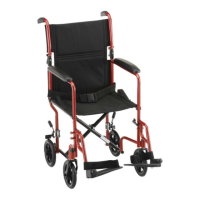
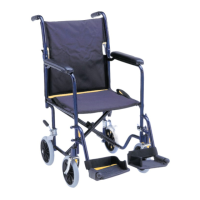
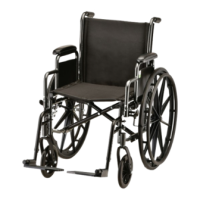
Need help?
Do you have a question about the Nova 300 Series and is the answer not in the manual?
This document is a user manual for the NOVA 300 Series Transport Chair, designed to provide mobility assistance. It includes essential information for owners and caregivers on the safe operation, maintenance, and adjustment of the chair.
The NOVA 300 Series Transport Chair is a mobility aid designed to transport individuals who require assistance with walking or prolonged standing. It is intended for use with a caregiver who pushes the chair. The chair features a folding mechanism for easy storage and transport, and includes hand brakes for speed control and wheel locks for stability during transfers. Footrests are provided for user comfort and support, and can be adjusted for height or removed. The chair is equipped with a seat belt to secure the user during transport.
Unfolding and Folding: To unfold the chair, it should be removed from its packaging and placed on the ground. The folding push handles are brought upward to lock into the frame. The seat upholstery is then pushed down and outward until the seat is fully opened and the tubes engage into the seat supports. When folding, the middle of the seat is pulled upward from the front and rear until the chair is completely folded. The back/push handles are then released and folded down by pushing on the release paddle.
Footrest Attachment and Adjustment: Footrests are attached by aligning the attachment plates with holes over the pins and lowering them onto both pins. They are then swiveled inward until the silver release lever engages and locks them into the forward position. To remove footrests, the silver release lever is pushed inward, and the footrests are swiveled outward and lifted from the pegs.
Footrest height adjustment varies by model. For models 307/319, a tool wrench is used to slightly loosen a silver hex screw on the bottom of the footrests, allowing the footplate to be pulled to the desired length (minimum 2 1/2 inches from the ground). The hex screw is then re-tightened. For models 327/329/330/332/352, the height adjustment knob is turned counter-clockwise to remove it, the inner tube is adjusted to the desired height, and the knob is screwed back into the adjustment leg and tightened.
Brake Operation: The chair features hand brakes for speed control, which are engaged by squeezing them. For parking, the park brake is engaged by pushing down on a handle at the rear of the hand brake until it locks into a downward position. To release, the handle is pulled up. The wheel brakes are to be engaged when entering or exiting the chair.
User Transfers: To sit down, the rear wheel locks are engaged by pushing down on the brake handle. The footrests are flipped into an upright position, allowing the user to stand between them with their legs touching the seat upholstery. A caregiver assists the user in slowly lowering into the chair from behind. To rise, the wheel locks are engaged, footrests flipped up, and the user places both feet firmly on the ground, rising slowly with caregiver assistance. For transfers from a seated position (models 352/332), the chair is placed alongside the desired seating device, wheel locks engaged, and the arm on the side of the transfer is removed or flipped back by pressing on plastic covers. Footrests are released and swung to the outer sides of the chair frame or flipped upward to a vertical position, after which the user can be carefully transferred with caregiver assistance.
Safety Warnings: The manual emphasizes several critical safety warnings. The user weight limit is 300 lbs for most models and 400 lbs for model 332. The back support must always be in the upright locked position, and the user secured with the seat belt. All grips and textured surfaces must be secure. Initial and follow-up product inspections are mandatory. Wheel locks must be engaged when entering or exiting. Push handles should be tested to ensure push pins are securely in place. A caregiver must always be behind the chair with a secure grip on both handles when the user enters or exits. The chair should not be operated on streets or roadways, and users should not stand on footrests. Wheel locks are not to be used to slow descent down an incline or to stop a moving chair. Direction changes on inclines should be avoided. The chair should not be scooted or operated without an assistant. It should only be sat on when fully open and in its normal usable position. Ramps or inclines greater than 9 degrees of slope, stairs, moving walkways, escalators, roads, streets, or highways are prohibited. Extreme caution is advised in crowded or outdoor areas. The chair should not be operated in bad weather or on slippery/unstable ground. Crossing curbs, bumps, trenches, or uneven surfaces should be avoided to prevent tipping. Reaching for or picking up objects from the floor while seated is prohibited as it can cause tipping. The chair should not be tilted while occupied. Lifting the product by pulling on removable parts is not allowed. Standing on the product, frame, or any other part is prohibited. Footrests should not be used as a platform. Carrying heavy weight while occupying the product is not recommended. Lifting weights or exercising while occupying the product is also prohibited. The transport chair is not approved as a vehicle seat and must be on a level surface during transfers.
Brake Adjustment: The braking system is preset from the factory. If brakes are too loose, the tension adjustment screw locking nut is loosened, and the screw is turned one full turn clockwise (as viewed from the back of the chair). This process is repeated until adjustment is achieved, then the locking nut is tightened. If brakes are too tight, the screw is turned counter-clockwise.
Safety Inspection and Maintenance Schedule: Regular cleaning and inspections are crucial for proper function and to identify loose or worn parts. Over-tightening parts or hardware can damage the frame. The product should not be operated if any parts or hardware are missing. A dealer or qualified professional should perform maintenance at least every six months, or immediately if any item needs service. More frequent maintenance may be required with heavy use. A complete safety inspection, including all items, is recommended after any excessive use.
Inspection Items and Schedule:
General Maintenance Guidelines: Minor adjustments detailed in the manual can be attempted by an able-bodied individual. Any adjustments or repairs not detailed in the manual should only be performed by a dealer or licensed technician. Individuals with muscular or balance problems should seek assistance for adjustments. After any adjustment and before use, all attaching hardware, including grips, screws, nuts, bolts, clamps, fasteners, and parts, must be tight and secure. Only parts, accessories, or adapters manufactured by NOVA Medical Products, Inc. should be used with this product.
 General
| Seat Depth | 16" |
|---|---|
| Back Height | 16" |
| Folded Width | 12" |
| Frame Material | Aluminum |
| Weight Capacity | 300 lbs |
| Seat Width | 18", 20", 22" |
| Product Weight | 36 lb (without front rigging) |
| Overall Width Open | 24" (16" Seat), 26" (18" Seat), 28" (20" Seat), 30" (22" Seat) |
| Footrest Style | Swing-away |

 To Next Page