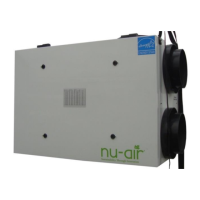
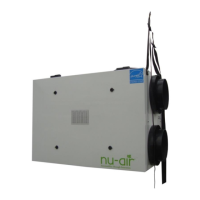
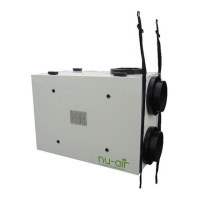
Nu-Air Ventilation Systems Inc. - HRV Operating &Installation Manual
Rev October 10, 2010 - 19 -
4.11 Furnace Interlock
For simplified duct systems, it is recommended that the HRV be interlocked with the furnace blower
such that the furnace fan runs when the HRV is on to distribute supply air throughout the space.
Depending on local Codes, you may choose to interlock whenever the HRV/ERV is operating at any
speed, or just high speed (see illustration Section 10.2). To prevent unintended operation of the air
conditioning system (some thermostats connect Y and G internally), the G line must be isolated. See
figure below.
Connect to the 10-terminal block, I1, I2 and C.
5. START-UP
• Ensure the controls are connected in accordance with Section 3.
• For electrical hook-up, plug into a 120 volt receptacle.
• Ensure that the machine is piped to an adequate drainage source, i.e. through the drain hose
supplied.
6. OPERATING HINTS
When a dehumidistat is used, set it at the desired level. Look for signs of excessive humidity or
dryness. Let your windows be your guide. As outdoor temperatures decrease – the comfortable humidity
level also decreases.
Winter Operation – 40% - 50% is recommended. Lower settings may be necessary in colder zones to
keep windows free of condensation.
Spring/Fall Operation- 50% - 60% is recommended
Summer Operation – On extremely humid days it is best not to run the HRV during the day. At night
turn the machine on high speed using the dehumidistat. This will help keep your home cool and
your basement fresh. In the morning, turn the machine off again. The normal summer setting is 55%
- 75%. Alternatively plug the HRV into an electrical timer set to switch on/off at desired intervals.



 To Next Page
 Loading...