Truck Campers • nucamprv.com14 nucamprv.com • Truck Campers 15
LOADING & HAULING
VEHICLE MATCH
Selecting the right combination of truck for your nuCamp truck camper,
requires understanding a few guidelines. Your dealer will be a valuable
source of information when matching a camper to your truck. We have
outlined several important things to note when matching your camper to
an appropriate truck.
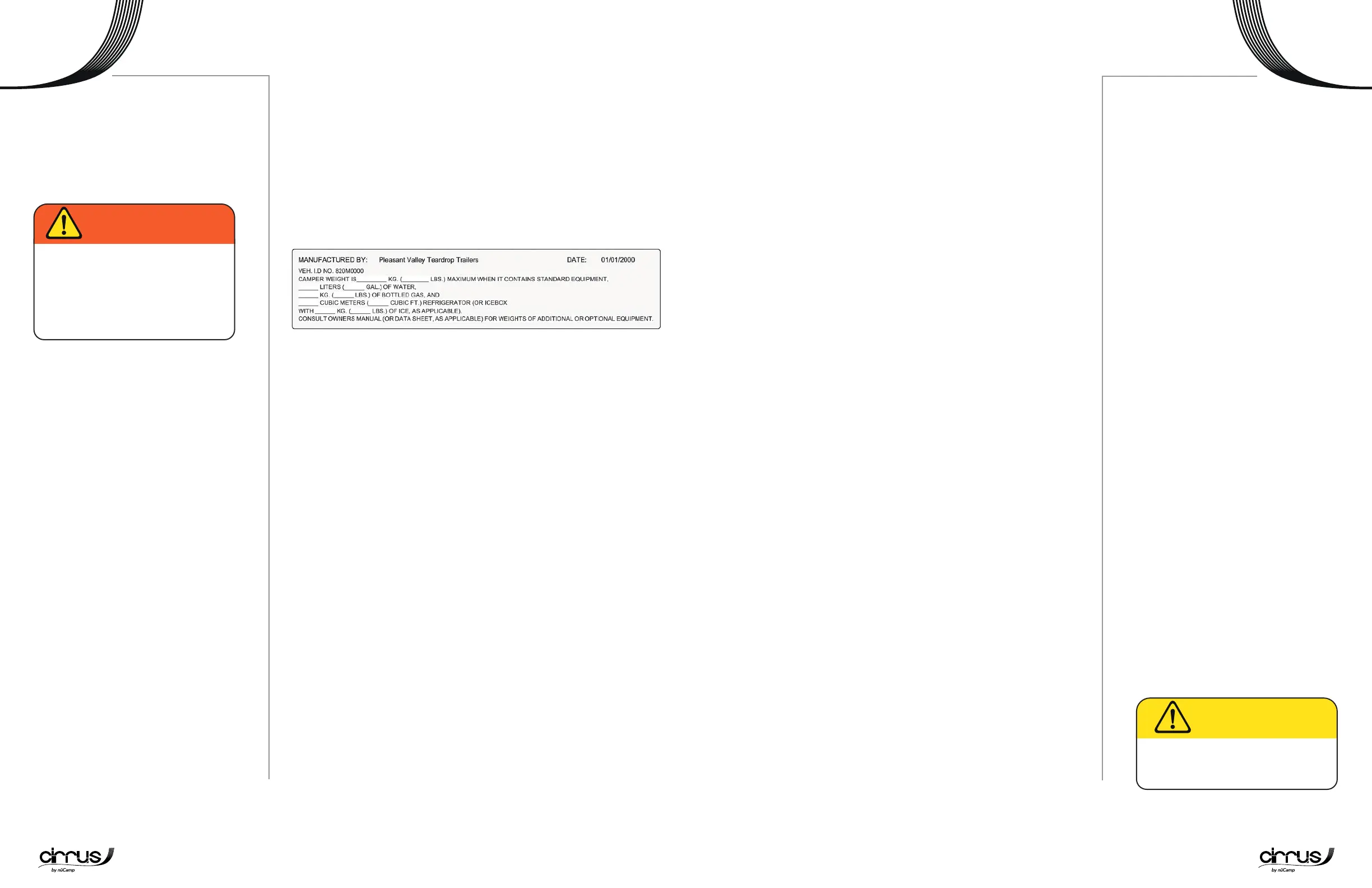
• You must begin with the weight information supplied on the data
plate of your camper, located near the rear by your camper
entrance. An example is as follows.
• Option Weights. In addition to knowing the weights of your
specic camper, you must know the additional option weights
on your camper. Since each camper is weighed individually upon
completion of its manufacturing, factory installed options will be
included in the weight reected on your camper’s data plate.
The options listed are items that were specically designed by
nuCamp to be installed on your truck camper by your dealer:
1. Rear Awning Option adds a maximum of 47 lbs.
2. Lagun Table Option adds a maximum of 5 lbs.
• To estimate the total cargo load that will be placed on a truck, add
the weight of all passengers in the camper, the weight of supplies,
tools, and all other cargo, the weight of installed additional or
optional camper equipment, and the manufacturer’s camper
weight gure. Select a truck that has a cargo weight rating that
is equal to or greater than the total cargo load of the camper and
whose manufacturer recommends a cargo center of gravity zone
that will contain the camper’s center of gravity when it is installed.
• Truck payload capacity is the amount of weight a truck is designed
to carry. Campers are considered “truck payload”. New trucks
have their payload capacity posted in the glove box or on a
specication sheet supplied with the truck owner’s manual. Trucks
that have many options and/or a 4-wheel drive option have less
payload. When calculating payload, truck manufacturers assume all
seat positions are lled with persons weighing 150 pounds each.
• Center of gravity is crucial to understanding truck and camper
matching. Truck manufacturers are also required to provide a ‘center
of gravity zone’ for camper loading. To determine if your truck/
camper combination is within the proper center of gravity limits,
observe these steps:
a. Find the center of gravity for your type model.
b. Determine the recommended center of gravity zone for
your truck, as listed in your truck owner’s manual. If you
cannot nd this information, contact the nearest
manufacturer’s representative for your truck. The zone is
normally measured from the rear of the cargo area.
c. In a properly matched combination of truck and camper,
point ‘B’ (camper center of gravity) will fall within points ‘C’
and ‘D’, (truck’s center of gravity zone).
• The bed of your truck typically is fastened to its frame with mounts
allowing for some movement. Enough clearance must be allowed
between truck and camper to prevent damage that can be caused
by racking, twisting, and bouncing during normal driving conditions.
• The cab-over of the camper should never be closer than 1 ½" to the
highest point of your truck’s cab to allow clearance for cab marker
lights or tracking system antennas, if equipped.
• A minimum of ¼" clearance between the truck bed side rails and
the camper wing is required. Some truck models have a tapered
bed, meaning the bed depth is different between the front and rear.
This can make the camper look tilted (front higher than the rear)
along the bed of the truck.
• It may be necessary to place a bed mat in the truck bed to raise the
camper to the minimum clearance requirements.
• A minimum of ½" clearance between the truck’s tail lights and
camper bumper exterior is also required. Adding a spacer at
the front of the camper or in the front of the truck bed can help
ensure proper clearance. If you add a spacer, make sure you do not
compromise the center of gravity position of your truck.
• Using a truck with under-rated towing and loading capacities to
haul a camper can cause serious stability problems. Additionally,
the strain put on the engine, structural frame and drivetrain of the
truck may lead to serious maintenance problems. The maximum
towing and payload capacities of your truck must never be
exceeded. Refer to your tow vehicle’s Owner’s Manual for the
towing capacity of your tow vehicle, in terms of maximum Gross
Weight (GW), maximum Gross Vehicle Weight Rating (GVWR) and
Payload Capacity.
• As always, your nuCamp dealer will have lots of experience to
assist you in matching your truck and camper. Rely on their
expertise to guarantee compatibility. Your dealer can also assist
with setting your camper in proper position on your truck bed.
SPEED
In ideal road conditions, the maximum recommended speed for safely
hauling a camper is 60 mph. Your camper is more prone to imbalance
under higher speeds, increasing the possibility for loss of control. Your
truck tires can also overheat, increasing the possibility of a blowout.
Failure to properly match the camper and
truck can result in undesirable handling
characteristics and create a safety hazard.
DO NOT load your vehicle beyond its
gross vehicle weight rating (GVWR) and/
or gross axle weight ratings (GAWR).
Excessive speed could result in tire
overheating and blowout. Do not exceed
60 MPH in normal road conditions.


 To Next Page
 Loading...