nucamprv.com • Teardrop Campers 23Teardrop Campers • nucamprv.com22
• Specialized Trailer (ST) tires are greatly different than passenger (P) car or light truck (LT) tires
Passenger car and light truck tires are designed for traction in driving conditions such as
stopping, pulling, swerving, or turning. They require tires with more exible sidewalls.
Trailers do not have applied driving torque to their axles, but they carry heavy loads and have a
higher center of gravity. Trailer tire sidewalls are engineered to reduce sway and handle heavier
loads. Use recommended tires with the ST rating for your travel trailer.
• Tire industry standards restrict speeds of “ST” tires to 65 MPH under normal ination and loads,
unless noted differently on the sidewall of the tire.
• Store your trailer in a cool, dry place indoors to minimize the harsh effects of the sun on your
tires. If storing outdoors, tire covers will serve the same purpose.
• When replacing tires, you must purchase tires that are the same size as the trailer’s factory-
installed original tires or another manufacturer-recommended size. To determine the correct
size, check the Tire and Loading Information label as shown on page 25 or on the sidewall of the
tire you are replacing. Consult your tire dealer for assistance.
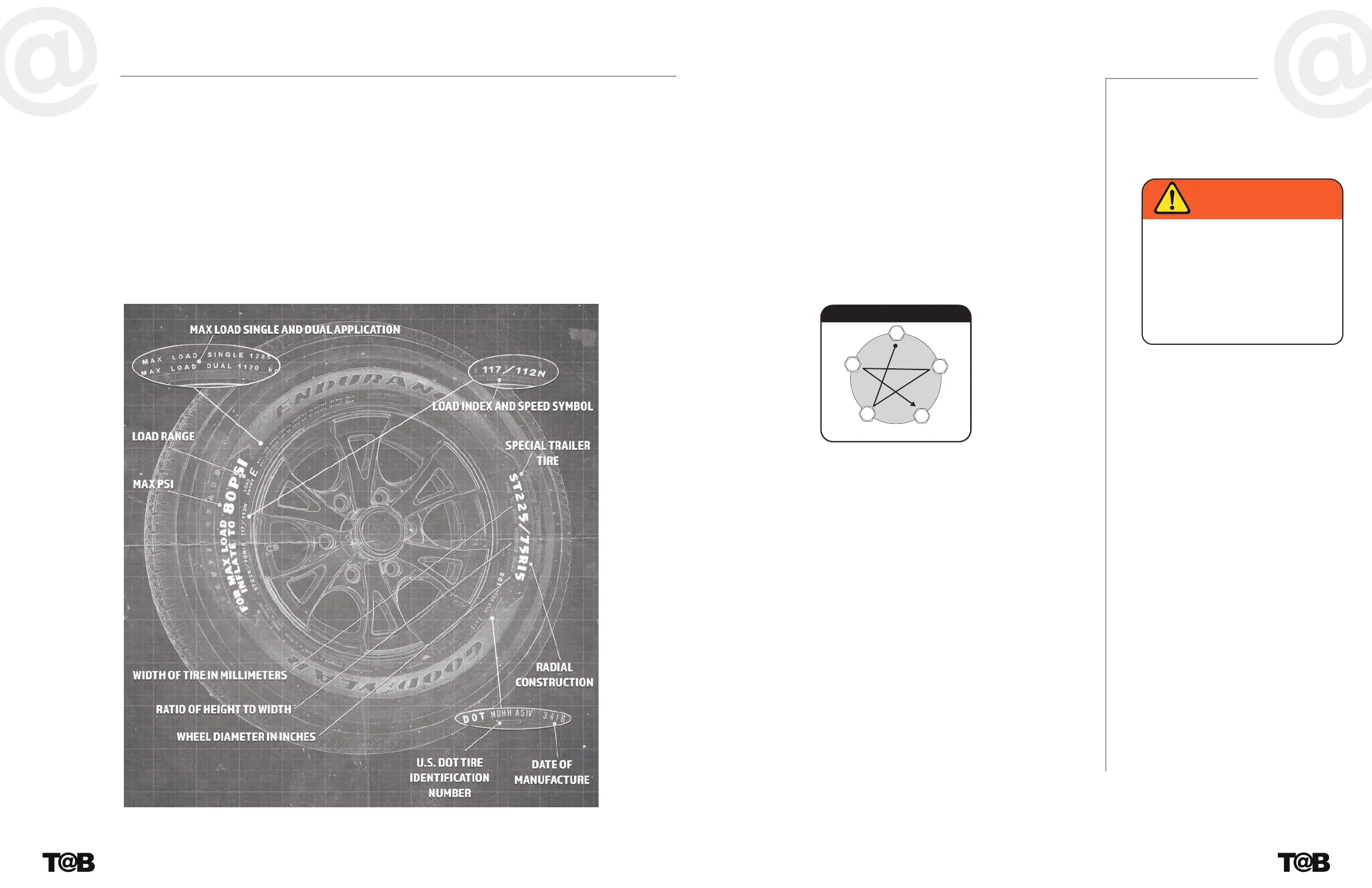
Federal Law requires standardized information on the sidewalls of all
tires to identify and describe the characteristics of the tire. This also
helps provide a tire identication number in case of recalls and for
safety standard certications. The image on page 22 is intended as a
demonstration only concerning standardized information on a tire. It is not
the actual tire that your trailer is equipped with.
LUG NUTS
To keep wheels properly attached to the hub, lug nuts must be properly
tightened. Lug nuts often loosen slightly after rst being assembled. After
you purchase your trailer (and after remounting wheels at any time) you
must tighten the lug nuts at 10, 25, 50 miles and before each trip you take.
To tighten the lug nuts, use a calibrated torque wrench, set to 90 ft.-lbs.
pressure, in the proper sequence as follows:
WEIGHT DEFINITIONS
It is very important to stay within the weight ratings of your trailer and tow
vehicle. Learning these denitions will help you safely manage your trailer’s
weight and balance. Towing vehicle and trailer weight numbers typically
fall into these two categories:
• Ratings are maximum limits that under no circumstance should
be exceeded. These limits are established by nuCamp and our part
manufacturers in the design of the trailer.
• Weight and Load are generally interchangeable terms. Weight is
measured by putting a vehicle, trailer, cargo or other components
on a scale. Vehicles and cargo have weight or mass, which create
loads on tires, axles, and hitches.
Common Denitions:
GAWR (Gross Axle Weight Rating): The maximum weight each axle is
designed for and rated to carry.
GVWR (Gross Vehicle Weight Rating, also called GTWR or Maximum
Loaded Trailer Weight Rating): The maximum operating weight of a trailer
as specied by the manufacturer including the vehicle’s chassis, body, fuel,
accessories, and any cargo.
GVW (Gross Vehicle Weight, also called GTW for Gross Trailer Weight):
The total actual weight of your trailer or tow vehicle plus cargo, as
measured on a scale.
Metal creep, inadequate torque
and loosening lug nuts after factory
installation will cause a rim to loosen
or wheel to part from a trailer. Loss of
control, serious injury and death may
result. Tighten lug nuts after the rst 10,
25, and 50 miles after wheel mounting
and before every trip.
1
2
LUG NUT TIGHTEN ORDER
4
5
3



 To Next Page