DOWNRANGE
VELOCITIES
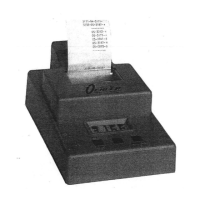
The Model 35P with printer
is
appropriate for measuring downrange
velocities. To measure ballistic coefficients, use one
M35P at the muzzle
and a second one downrange. Accuracy is critical, so a spacing
of
at least 4
feet
is
preferred and 8 feet is still better. Verify system accuracy by first
shooting with both systems near the gun to assure that the readings agree on
each shot. Then move the downrange system without disturbing screen
spacing adjustments. For the best results, use Oehler's Ballistic
Explorer
computer program to calculate the ballistic coefficients and to project
downrange performance
of
your loads.
MUZZLE
VELOCITIES
FROM
INSTRUMENTAL
VELOCITIES
The velocity recorded
by
the chronograph corresponds to the velocity at the
midpoint
of
the screens. This velocity is lower than true muzzle velocity by
the amount
of
velocity lost between the muzzle and the midpoint
of
the
screens. Typically the midpoint
is
12 feet or 4 yards from the muzzle.
Look
in
the tables provided
by
the ammo or bullet manufacturer to frod the
velocity lost in the
first 100 yards at your approximate velocity level.
Divide the 100 yard velocity loss by 25 to find the loss
in
4 yards. Add the
4-yard loss to your chronograph reading to get muzzle velocity.
WOUNDEDSKYSCREENS
It
is
not feasible for
us
to
repair wounded skyscreens. It often costs more to
repair a skyscreen than to make a new one. Naturally we will repair or
replace at no charge any defective sky screen returned to
us.
We accept full
responsibility for defective parts or workmanship, and you are responsible for
bullet holes. Oehler has available extra plastic cases, lenses, and diffusers
for those who nick their screens and want to make their own repairs.
If
you
shoot the "eye"
or
the cable
of
the screen, consider it dead.
Page
20
STANDARD DEVIATION
AND
LOAD
DEVELOPMENT
What is standard deviation and what does it mean? Because standard
deviation and average go hand-in-hand, let's
fIrst talk about averages.
If
you
talk about average velocity, everyone knows what you mean.
You measure
the velocity
of
several shots and you average your readings.
If
someone asks
you the velocity
of
that arnrno, you say that it
's
about 2950 feet per second.
You naturally quote the average velocity, and the listener understands. You
know that some shots will be faster than average and some will be slower.
You don't even worry about the exact defInition
of
average; it's about the
middle.
Confusion doesn't come until someone asks if the velocity
is
uniform. You
are comfortable with quoting the average velocity, but you know that it
doesn't tell the whole story. The average does not tell you how much the
velocity readings scatter above and below the average. How do you describe
uniformity
or
assign it a number grade? The standard deviation
is
a n'umber
that describes uniformity. The smaller the number, the more uniform the
velocity. A standard deviation
of
zero means every velocity was the same.
A standard deviation
of
28 fps means you expect two-thirds
of
the individual
velocities
tobe
within 28 fps
of
the average.
Mathematicians and statisticians have talked about uniformity for years.
They may call the lack
of
uniformity dispersion
or
variance. They may talk
about the difference between highest and lowest and call it range, extreme
variation or extreme spread. They may talk
in
terms
of
the coefficient
of
variation. They prefer to talk and think
in
terms
of
standard deviation.
Standard deviation
is
the best measure
of
uniformity, and it fIts recognized
procedures, equations and textbooks.
Modern shooters consider standard deviation as the best measure
of
velocity
uniformity.
In
the past, shooters used extreme spread or mean absolute
deviation as the indicator
of
uniformity. This was a matter
of
pre-calculator
convenience. Statisticians knew that standard deviation was a better
measure
of
uniformity, but nobody wants to calculate it manually.
If
you've
never computed standard deviations manually, be assured that the pleasure
ranks right
up
there with spit-shining combat boots. You avoid it if at all
possible. With machines to do the tedious calculations, we can now all use
standard deviation as the measure
of
uniformity.
Page
21


 To Next Page
 Loading...