EasyManua.ls Logo

OEM BCM94360CD - User Manual

OEM BCM94360CD
9 pages
Print Icon
To Next Page IconTo Next Page
Loading...
OEM Installation Guidance Document
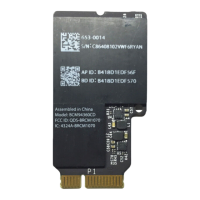
For Broadcom 802.11a/g/n/ac WLAN + Bluetooth PCI-E Custom Combination Card
BCM94360CD
FCC ID: QDS-BRCM1070; IC: 4324A-BRCM1070
Page 1 of 9
Conditions on using BRCM regulatory approvals:
A. Customer must ensure that its product (the CUSTOMER Product”) is electrically
identical to Broadcom’s reference designs. Customer acknowledges that any
modifications to Broadcom’s reference designs may invalidate regulatory approvals in
relation to the CUSTOMER Product, or may necessitate notifications to the relevant
regulatory authorities.
B. Customer is responsible for ensuring that antennas used with the product are of
the same type, with same or lower gains as approved and providing antenna reports to
Broadcom.
C. Customer is responsible for regression testing to accommodate changes to
Broadcom’s reference designs, new antennas, and portable RF exposure safety
testing/approvals.
D. Appropriate labels must be affixed to the CUSTOMER Product that comply with
applicable regulations in all respects.
E. A user’s manual or instruction manual must be included with the customer
product that contains the text as required by applicable law. Without limitation of the
foregoing, an example (for illustration purposes only) of possible text to include is set
forth below:
1. USA—Federal Communications Commission (FCC)
FCC COMPLIANCE STATEMENT:
This device complies with part 15 of the FCC Rules. Operation is subject to the following
two conditions:
(1) This device may not cause harmful interference, and (2) this device must accept any
interference received, including interference that may cause undesired operation.
INFORMATION TO USER:
This equipment has been tested and found to comply with the limits for a Class B digital
device, pursuant to Part 15 of FCC Rules. These limits are designed to provide reasonable
protection against harmful interference in a residential installation. This equipment
generates, uses, and can radiate radio frequency energy. If not installed and used in
accordance with the instructions, it may cause harmful interference to radio
communications. However, there is no guarantee that interference will not occur in a
particular installation. If this equipment does cause harmful interference to radio or
television reception, which can be determined by tuning the equipment off and on, the

Question and Answer IconNeed help?

Do you have a question about the OEM BCM94360CD and is the answer not in the manual?

Overview

This document provides OEM installation guidance for the Broadcom BCM94360CD, an 802.11a/g/n/ac WLAN + Bluetooth PCI-E Custom Combination Card. The device is identified by FCC ID: QDS-BRCM1070 and IC: 4324A-BRCM1070.

Function Description

The BCM94360CD is a wireless local area network (WLAN) and Bluetooth combination card designed for integration into host devices, primarily Netbook, notebook, or laptop computers. It supports 802.11a/g/n/ac wireless standards, enabling high-speed data communication over various frequency bands, and also incorporates Bluetooth functionality for short-range wireless connectivity.

Important Technical Specifications

Regulatory Compliance:

  • FCC (USA): Complies with Part 15 of the FCC Rules. Operation is subject to two conditions: (1) the device may not cause harmful interference, and (2) it must accept any interference received.
    • 5GHz Operation: Restricted to indoor use for the 5.15 to 5.25 GHz frequency range to reduce potential for harmful interference to co-channel Mobile Satellite systems.
    • Radar Interference: High power radars are allocated as primary users of the 5.25 to 5.35 GHz and 5.65 to 5.85 GHz bands, which can cause interference with and/or damage to this device.
    • Antenna Gain: Only antennas of the same type and with equal or lower gains as filed under the FCC ID number can be used.
    • Antenna Impedance: The required antenna impedance is 50 ohms.
  • Industry Canada (IC): Complies with licence-exempt RSS standard(s). Operation is subject to two conditions: (1) the device may not cause interference, and (2) it must accept any interference received.
    • Antenna Gain (IC): Approved to operate with an onboard antenna or a detachable WLAN antenna with a maximum gain of 3.9dBi/2.4GHz and 5.8dBi/5GHz. Any other detachable antennas with different types or higher gains are strictly prohibited.
    • 5GHz Operation (IC):
      • 5150-5250 MHz band is for indoor use only.
      • Maximum antenna gain for 5250-5350 MHz and 5470-5725 MHz bands must comply with the e.i.r.p. limit.
      • Maximum antenna gain for 5725-5825 MHz band must comply with e.i.r.p. limits for point-to-point and non point-to-point operation.
      • Users are advised that high-power radars (primary users) in the 5250-5350 MHz and 5650-5850 MHz bands could cause interference and/or damage.
  • Europe (EU): Marked with CE 2155 symbol, indicating compliance with the R&TTE Directive.
    • 802.11a Restrictions: For indoor use only when using channels 36, 40, 44, 48, 52, 56, 60, or 64 (5150–5350 MHz).
    • DFS and TPC: Must remain enabled for compliance with EC regulations.
    • Country Selection: The country where the access point is installed must be selected to ensure compliance with local regulations.
    • 2.4GHz (France):
      • Indoor use: maximum power (EIRP*) of 100 mW for 2400-2483.5 MHz.
      • Outdoor use: maximum power (EIRP*) of 100 mW for 2400-2454 MHz and 10 mW for 2454-2483 MHz.
  • Taiwan (NCC): Complies with regulations for low-power radio-frequency electric machinery.
    • 5GHz Band: Operation in the 5.25G ~5.35G band is restricted to indoor use.
  • Japan (MIC): Radio devices using 5.15-5.35GHz bands are restricted to indoor use only.

RF Exposure:

  • Separation Distance: For mobile configurations, a separation distance of at least 20 cm must be maintained between the transmitting antenna(s) and the body of the user or nearby persons during normal operating conditions.
  • Antenna Placement: Transmitting antenna(s) can only be installed in the display section of a computer.
  • Co-location: The antenna(s) used for this transmitter must not be co-located or operating in conjunction with any other antenna or transmitter within a host device, except in accordance with FCC multi-transmitter product procedures.

Usage Features

OEM Responsibilities for Integration:

  • Electrical Identity: The customer's product must be electrically identical to Broadcom's reference designs. Modifications may invalidate regulatory approvals.
  • Antenna Management: Customers are responsible for ensuring antennas are of the same type and lower gain as approved, and for providing antenna reports to Broadcom.
  • Regression Testing: Customers are responsible for regression testing for changes to Broadcom's reference designs, new antennas, and portable RF exposure safety testing/approvals.
  • Labeling: Appropriate regulatory labels must be affixed to the customer product. For FCC/IC, the label must include "Contains FCC ID: QDS-BRCM1070 and/or IC: 4324A-BRCM1070" or use electronic labeling. For Taiwan, the module certification ID (CCXXxxLPyyyZz) must be visible externally on the platform if the module itself is not visible.
  • User Manual Inclusion: A user's manual or instruction manual must be included with the customer product, containing all required regulatory text.
    • FCC: Includes interference statements and troubleshooting measures (reorient/relocate antenna, increase distance, connect to different circuit, consult technician).
    • IC: Includes general compliance statements and specific caution regarding 5GHz indoor use and radar interference.
    • EU: Includes information about CE marking, usage restrictions, and country-specific details (Czech, France, Italy).
    • Taiwan: Includes NCC statements regarding low-power radio-frequency electric machinery and 5GHz indoor use.
    • Korea: Includes a mandatory statement about potential radio interference and human safety.
    • Brazil: Includes an interference statement.
    • Mexico: Includes a mandatory statement about operation conditions.
  • Module Installation/Removal: The final system integrator must ensure no instructions are provided in the user manual for installing or removing the transmitter module, unless two-way authentication between the module and host system is implemented.
  • Host Manual Regulatory Statement: The final host manual must include the FCC Part 15 Class B digital device compliance statement and troubleshooting measures.

Country-Specific Usage Notes:

  • Italy: For private use, a general authorization is required if WAS/RLANs are used outside own premises. For public use, a general authorization is required.
  • Brazil: "Este equipamento opera em caráter secundário, isto é, não tem direito a proteção contra interferência prejudicial, mesmo de estações do mesmo tipo, e não pode causar interferência a sistemas operando em caráter primário." (This equipment operates in secondary character. It can be affected by harmful interference. However, it cannot cause interference to systems operating in primary character.)

Maintenance Features

OEM Responsibilities for Support:

  • Brazil - Anatel: PC-OEMs must arrange for local offices or distributors to provide maintenance, technical assistance, or replace faulty products. All warranty services will be provided by distributors or PC-OEM sales support, with an official agreement stating warranty responsibilities.
  • South Africa – ICASA: PC-OEMs must arrange for importers to supply spare parts and carry out repairs.
  • Indonesia – POSTEL, Kenya – CCK, Nepal - NTA: PC-OEMs must arrange for importers to provide product warranty and after-sales services.
  • Mexico: PC-OEMs must arrange for importers to provide User Manuals in Spanish.
  • CB Certifications: PC-OEMs must provide User Guides in the language suitable for the countries when shipping products to countries listed in the CB reports.

OEM BCM94360CD Specifications

General IconGeneral
BrandOEM
ModelBCM94360CD
CategoryWireless Access Point
LanguageEnglish