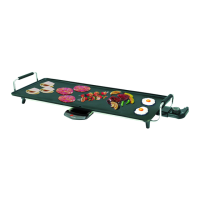
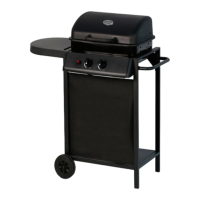
The Ohmex Grill 3660 is an electric grill barbecue designed for both indoor and outdoor use, offering a compact and easy-to-assemble solution for cooking various foods.
Function Description
The Grill 3660 is primarily designed for grilling meats, fish, skewers, and vegetables. Its non-stick cooking plates are inclined to allow excess fat to drain into a removable collection container, promoting healthier cooking without excessive smoke or odors. The appliance can be used with the lid open or closed, offering flexibility for different cooking styles and better control over the cooking process.
Important Technical Specifications
- Power Supply: 220-240V~ 50Hz
- Power: 1600W
- Cooking Surface: 1032 cm²
- Adjustable Thermostat: 150÷220°C
- Coating: FDA-certified Xylan double non-stick coating
- Heating Elements: Incorporated resistors
- Fat Collection: Includes a fat collection container
The grill has a maximum height of 1200mm and a maximum width of 1230mm when assembled. When folded for storage, its dimensions are approximately 1000mm in height, 380mm in width, and 480mm in depth, emphasizing its compact design for minimal space requirement.
Usage Features
Ease of Use:
The Grill 3660 is designed for simplicity. It is compact, easy to assemble, and store, making it suitable for terraces or verandas. The immediate installation allows for quick setup.
Cooking Experience:
- Healthy Cooking: The inclined non-stick plates facilitate the drainage of excess fat into a removable container, resulting in healthier meals with less odor and smoke.
- Flavor Preservation: When using the lid (A), foods retain their distinct flavors, leading to tender meat and crunchy, savory vegetables.
- Temperature Control: The adjustable thermostat (D) allows users to select desired cooking temperatures, ranging from "thermostat turned on" (setting 1) to "maximum temperature cooking" (setting 5). Intermediate settings include "maintains food hot" (setting 2), "low-temperature cooking" (e.g., fish, setting 3), and "medium temperature cooking" (e.g., chicken, setting 4). An indicator light (D2) turns on when the thermostat is active and off when the set temperature is reached, signaling readiness for cooking.
- Preheating: For optimal results, especially with larger meat cuts, preheating the grill with the lid closed for 6-8 minutes is recommended. For sausages or smaller meat pieces, the lid may not be necessary during preheating.
- Food Handling: Always use plastic or wooden utensils resistant to high temperatures to avoid damaging the non-stick coating. Metal or sharp tools (forks, tongs, knives) should never be used on the cooking plate.
- Fat Management: Ensure the fat collection container (E) is correctly positioned and not full between cooking sessions. It is very hot during and after use, so oven mitts or a kitchen glove should be used when handling. Pouring a little water into the container can facilitate cleaning.
- Safety during Cooking: The appliance heats up significantly during use. Care should be taken not to touch hot accessible parts to avoid burns. It should not be left unattended while operating. In case of burns, rinse immediately with cold water and seek medical attention if necessary.
- Ventilation: When used in enclosed spaces, an aspiration fan or adequate room ventilation is advised, especially during first use when a slight smoke emission and particular odor might occur (this is normal and temporary).
- Placement: The grill must be placed on a horizontal, stable, and heat-resistant surface. Objects like covers or vases should not be placed on the appliance. Maintain at least 30 cm of clear space around the appliance and 50 cm above it. Keep it away from sinks and taps. The power outlet should be easily accessible for disconnection. Do not place the appliance under a power socket.
- Food Preparation: Frozen foods should be thawed before grilling. "Soft" meats are ideal for grilling, and marinating overnight can enhance tenderness. Avoid overcooking meat to prevent loss of flavor and dryness. Grilled foods should not be flipped too often. For skewers, wooden or bamboo skewers should be soaked in water to prevent burning; metal skewers should not be used.
- Cooking Times: Indicative cooking times are provided in the manual, but these can vary based on food type, size, thickness, environmental conditions, and personal preference.
Maintenance Features
Effortless Cleaning:
The double non-stick coating on the plates and the removable fat collection container make cleaning easy and quick.
General Cleaning Guidelines:
- Disconnection and Cooling: Always disconnect the appliance from the power socket and allow it to cool completely before cleaning.
- Thermostat and Power Cord: The thermostat (D) and power cord should be cleaned with a barely damp cloth. Never submerge the thermostat, plug, or power cord in water or any other liquid. If any component is damaged, it should be replaced by the manufacturer or an authorized service center.
- Cooking Plate: After use, wipe off cooking residues from the plate (B) with absorbent paper. The heating element is integrated into the plate. Never pour cold water on a hot plate (B) to avoid damage or hot water splashes.
- Lid and Fat Collection Container: The lid (A), non-stick plate, and fat collection container (E) can be washed in hot water with dish detergent. The fat collection container can also be washed in the dishwasher on the upper shelf.
- Cart and Shelves: The cart, shelves, and other parts can be cleaned with a soft cloth dampened with water.
- Drying: All components should be dried with a soft cloth.
- Storage: Store the assembled appliance in a non-heated environment. The thermostat should be protected from moisture. If not used for a long period, cover the appliance with a towel to protect it from dust and moisture.
Safety during Cleaning:
- No Abrasives: Never use strong or abrasive detergents, glass wool, steel wool, or abrasive sponges, as these can damage the non-stick surface.
- Thermostat Compatibility: Do not use a different thermostat to operate the appliance.
Environmental Information / Disposal at End-of-Life:
The appliance complies with directives 2011/65/UE (RoHS) and 2012/19/UE (WEEE). The crossed-out wheelie bin symbol indicates that the product and its batteries must be collected separately from other waste at the end of their useful life. Users should take the product to an appropriate recycling center or return it to the dealer when purchasing a new appliance. Used batteries must be removed, collected separately, and delivered to designated collection points. Proper separate collection contributes to preventing negative environmental and health effects and promotes material reuse and recycling. Illegal disposal can result in administrative sanctions. Packaging waste should also be sorted and delivered to appropriate collection centers.

 Need help?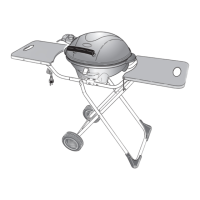

 To Next Page
 General