This document is an installation and operation manual for the Ojeda FMH Series commercial refrigeration units, including models FMH-12, FMH-27, and FMH-49. These units are designed for merchandising packaged food and beverage products in indoor environments.
Function Description
The Ojeda FMH Series coolers are commercial refrigeration units designed to maintain the proper temperature of packaged fresh food and beverages. They are not intended to be "pull down" freezers, meaning products should be loaded at their intended merchandising temperature. The units are equipped with an electronic temperature control system that manages the refrigeration cycle based on the air temperature entering the evaporator. This control is factory-adjusted to turn off the refrigeration system at -10°F and start it at 0°F to achieve desired product temperatures. A start-up delay of 2 minutes is incorporated before the compressor(s) energize, preventing immediate restarts after power failures and allowing refrigerant pressures to equalize. The control also includes a factory-adjusted defrosting cycle, scheduled to last up to 15 minutes every 4 hours, to prevent ice build-up on the evaporator. The units feature a "maintenance-free" condenser design, which reduces the need for regular cleaning associated with fin and tube condensers, aiming to stabilize energy expenses and minimize preventive maintenance costs. Condensed water from the environment is collected on the evaporator and drains to an evaporator tray at the bottom of the unit, where it is evaporated using heat from the refrigeration system. Lighting within the unit can be controlled by a switch located on the left side of the upper section.
Important Technical Specifications
- Models: FMH-12, FMH-27, FMH-49
- Environmental Conditions: Designed for indoor operation only. Ambient temperature must be maintained less than 75°F / 55% RH. Cannot be installed in environments with explosive gases.
- Clearance: Requires at least 10 cm (4") of free space at the sides and back for proper air circulation.
- Electrical Requirements:
- FMH-12: Voltage (V): 120, Current (A): 3.5, Circuit Required (A): 15, NEMA Config.: 5-15P
- FMH-27: Voltage (V): 120, Current (A): 5, Circuit Required (A): 15, NEMA Config.: 5-15P
- FMH-49: Voltage (V): 120, Current (A): 7, Circuit Required (A): 15, NEMA Config.: 5-20P
- Power Cord: Equipped with a 3-prong (grounding) NEMA 5-15P type plug. Extension cords are not permitted and will void the warranty.
- Compressors: One and two-door FMH units have a single hermetic compressor.
- Shelves: Designed to withstand a maximum evenly distributed weight of 40 pounds per square foot. Products on each shelf must have 3 to 5 centimeters of free clearance from the next shelf for proper air circulation.
- Temperature Control: Factory-adjusted to turn off at -10°F and start at 0°F.
- Defrost Cycle: Scheduled for up to 15 minutes every 4 hours.
Usage Features
- Installation: Units should be moved as close to their final location as possible using a forklift (never push, pull, or strike the front or side glass). They must be leveled prior to operation and can be equipped with casters, 6" adjustable legs, or sealed to the floor per NSF guidelines.
- Placement: Avoid locations near heat and humidity sources (direct sunlight, toasters, ovens, coffee warmers, other appliances' condenser air discharge, infrared heaters, or other heat-generating appliances) and external doors.
- Shelf Positioning: Shelves are secured for transport and must be installed by inserting brackets into pilaster notches, ensuring they are horizontal and at the same level.
- Product Loading: Before loading products, allow the equipment to operate empty for at least two hours. Products should be loaded at their intended merchandising temperature. Do not block the lower ventilation grille, over-hang shelves, press products against the rear wall, or exceed shelf weight limits.
- Electronic Control: The control display illuminates upon plugging in the unit. Factory-programmed parameters cannot be modified without an access code, which is only available to the distributor's technical personnel.
- Lighting: The internal lamp can be turned off via a switch on the upper left section.
Maintenance Features
- Cleaning the Unit: Weekly cleaning is recommended using a damp cloth and neutral soap for both external and internal surfaces, followed by drying with a clean soft cloth. Flammable or abrasive products and water jets should never be used.
- Condenser Coil Cleaning: Although the condenser design is "maintenance-free," regular cleaning of accumulated dirt is crucial to prevent compressor failure, product loss, and increased energy costs, as these issues are not covered by warranty.
- Disconnect power to the unit.
- Remove the front lower grill assembly by unscrewing the two screws in the top corners.
- Clean accumulated dirt from the condenser coil(s) using a vacuum and/or a damp rag.
- Replace the grill assembly.
- Reconnect power and verify condensing unit(s) are running.
- If dirt cannot be adequately removed, a refrigeration service company should be contacted.
- Sliding Condensing Unit: The condensing unit can be pulled out approximately 40 cm (16") for servicing components like the condenser motor(s), compressor(s), and electrical components. This involves removing two screws from the lower front grill and the screws holding the front bracket, then gently sliding the unit out. All components must be returned to their original location after servicing.
- Technical Assistance: In case of technical issues, contact the distributor immediately, providing the equipment model and serial number. Always request original spare parts.

 Need help?
 General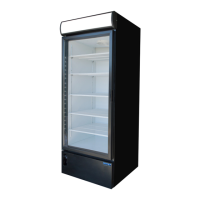

 To Next Page