WARNING
Page 2
Model:
Product Type:
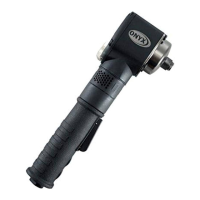
ONYX 1/2" NANO ANGLE IMPACT
WRENCH - 415FT/LB
1832
MAINTENANCE INSTRUCTION:
1.) LUBRICATION:
Before connection of the hose, apply 4 to 5
drops of a good quality air tool oil at the air
inlet. After 3 to 4 hours of operation, oiling may
be necessary again.
2.) TIGHTNESS OF PARTS:
Regularly check whether all connection parts
are fastened securely. Follow this procedure
daily before beginning work.
3.) STORAGE:
Avoid storing the tool in a location subject to
high humidity. If the tool is left unused, the
residual moisture inside the tool can cause rust.
Before storing and after operation, oil the tool at
the air inlet with a good quality air tool oil and
run it for a short period.
4.) DISPOSAL:
Follow national legislation of waste disposal.
5.) ORDERING SERVICE PART:
For further operational and handling information
or for replacement of parts and components,
contact the sales agent from where you
purchased the tool, or the service division of our
company, phone number 800-221-9705.
* When ordering parts and components, give
each part number, name, and quantities.
Users of this tool should review the chemical
composition of the work surface and any products
used in conjunction with this tool for any such
chemicals prior to engaging in any activity that
creates dust and/or microscopic particles.
Users should obtain the Material Safety Data Sheets
for all identified chemicals, either from the
manufacturer or their employer, and proceed to study,
understand, and follow all instructions and warnings
for exposure to such chemicals.
Some examples of these chemicals are: lead from
lead based paints; crystalline silica from bricks,
cement and other masonry products; and arsenic
and chromium from chemically treated lumber. A
listing of the chemicals can be obtained at
www.oehha.ca.gov under Propoisition 65.
In order to reduce their exposure to such chemicals,
users should always:
- work in well-ventilated areas.
- wear appropriate safety equipment and clothes that
are specifically designed to filter out microscopic
particles.
1. The tool shall not be used in potentially explosive
atmospheres.
2. Disconnect the air hose before changing or
adjusting any inserted tools.
3. Before using tool, please confirm all couplings
and plugs are fixed securely. An air hose that is
under pressure may lash out when disconnected
and could lead to serious injuries.
4. Prevent loose clothes, long hair or any other
personal accessories from coming close to
moving parts to reduce the risk of being caught,
trapped or drawn into the operation.
5. Excessive high air pressure that exceeds the
maximum pressure may cause injuries to user.
6. Exposure to strong vibration for extended time
may cause harm to operator.
7. WATCH YOUR STEP! Leaving excess hose
unattended near working area or walk path could
result in injury or death.
8. Wearing eye/face protection could reduce the
danger to person from high speed splinters
being emitted from the tool or work surface.
9. Wearing correct breathing protection will help
avoid inhaling dust or debris from work process
that can be harmful to your health.
10. High sound levels can cause permanent hearing
loss. Use hearing protection while operating tool.


 To Next Page
 Loading...