insulation through the grommet (8).
Insert a sufficient length of the cord so
that the wires can be connected to the
power terminals.
Before mounting the fan: remove all
foreign objects from its inside ; check
manually that the fan rotor turns freely;
make sure there is enough clearance
for the outlet check damper to open.
It is recommended to connect the
fan to the duct using a flexible pipe
connection!
• Place the fan housing (7) and the wall
plugs in the drilled holes.
• Fasten the fan to the holes in the
substructure by driving the screws into
wall plugs through the mount holes (6).
• Remove the outer insulation layer
from the power cord and remove 4 mm
insulation lengths from the wires.
• Run the power cord and connect
it according to the wiring diagram
applicable to this particular model.
• Verify the tightness of the wires in the
terminals.
• Check if the fan is firmly installed and
correctly wired.
• Check the tightness of the power
cord.
• Attach the housing dome (2) to the
central part of the fan housing (7) with
the screw (9).
- The power cord must be protected so
that water cannot penetrate along the
cord to interfere with the live parts.
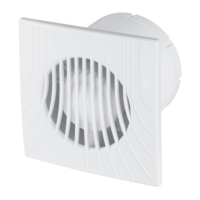
• Install the front panel (1), which
serves as a guard against touching the
moving parts.
ATTENTION! A rotating impeller can
crush your fingers!
It is forbidden to start the fan without
a protective mesh against touching the
moving parts!
First start
Start the air exhaust fan only with
all safety precautions in place and
all hazards eliminated. Check that it
runs steadily and the air is handled
efficiently (out of the room
and through the air exhaust ductwork
to the outside).
Check the operation of the fan (noise,
vibr
ation, the possibility to control the
rotation speed). Operate the air exhaust
fan only with the front panel installed,
as it is a direct touch guard on the
suction side. Depending on the actual
installation conditions, the fan may
require a protection against touching
the moving parts on the delivery side.
Suitable delivery-side direct guards
can be provided on request. If the fan
is guarded against direct touch due
to their installation conditions (e.g. in
line with the air exhaust ductwork),
no direct touch guard is required if
the installation conditions provide
an equivalent level of safety. Note
that the air exhaust fan user is liable
for compliance with current safety
standards and may be held liable for
accidental injury or death caused by
failure to provide the required safety
equipment.
Electrical connections
• Electrical connections and
commissioning of the fan shall only be
completed by qualified professional
electricians.
• Always follow the applicable
standards, safety regulations and
technical requirements specified by the
power company!
• The power supply line for the fan
requires a multi-pole circuit breaker
/ isolation switch with a minimum
• Adjust the operating parameters as
follows:
T, H versions: Set the delay time and
the humidity sensor using a tool with
rigid and flat tip on the potentiometers
located on the controller (5).


 To Next Page
 Loading...