WHEELS AND TIRES 3G- 57
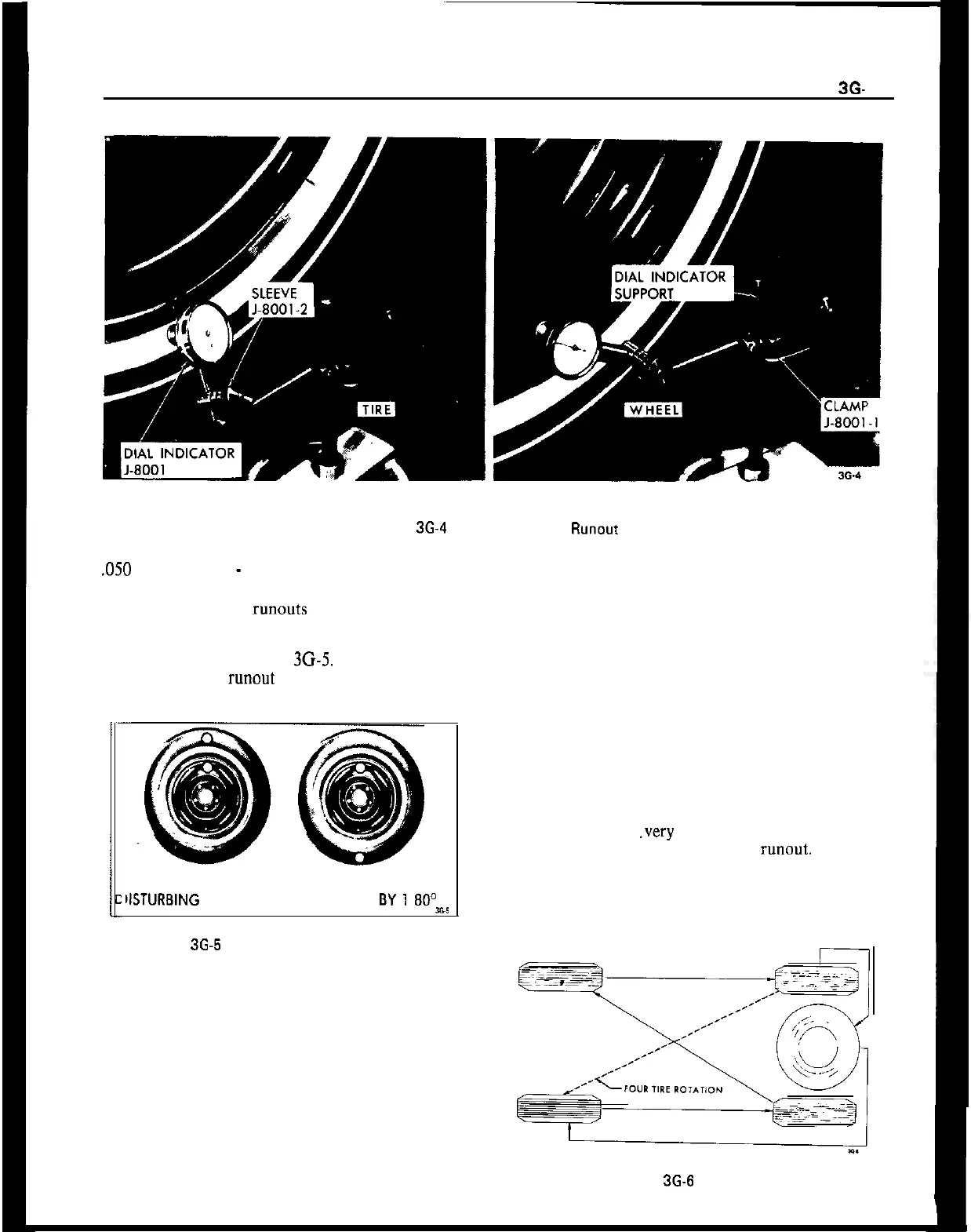
Figure
3G-4
Checking Lateral
Runout
,050
inch Lateral
-
Tire/Wheel Assembly
If the tire and wheel runouts are beyond any of the
maximum totals above, the tire should be reposi-
tioned 180 degrees opposite its original location on
the wheel. Refer to Figure
3G-5.
This will, in most
cases, reduce the runout and vibration to a satisfac-
tory level.
ASSEMBLY CAUSING REPOSITION TIRE/WHEEL
IISTURBING
VIBRATIONS MOUNTING
BY
1
80°
=%I
Figure
3G-5
Repositioning Tire on Wheel
There is no more work involved in repositioning a
tire on a wheel than there is in putting on a new tire,
and repositioning has a better chance of correcting
the difficulty.
It is important that only the tire/wheel assemblies
that are causing the disturbances be repositioned.
Since normally only one, and occasionally two, tire/-
wheel assemblies per vehicle could be causing the
disturbing vibration, it is recommended that reposi-
tioning be performed only when required. Reposi-
tioning of non-disturbing assemblies could cause
these assemblies to create vibration or roughness
problems.
After repositioning, balancing the tire/wheel assem-
bly is always necessary. It is very important that the
tire/wheel assembly be balanced accurately.
At this point, the car should be road-tested again to
assure that the disturbance has been corrected.
Tire Grinding
Tire grinding is
.very
effective in eliminating tire
complaints due to excessive tire runout. Grinding
can be accomplished on or off the car. Grinding is
approved by Opel, if done as recommended by the
equipment manufacturer
Figure
3G-6
Tire Rotation








 To Next Page