EasyManua.ls Logo

Oppermann Regelgeräte DDS-M984 Series - User Manual

Default Icon
6 pages
Print Icon
To Next Page IconTo Next Page
Loading...
Sensors PG1 | Data sheet No. 13251 | Version 09-2019 | 1 | 6
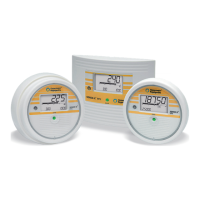
Pressure dierential
transmitter DDS-M984
DDS-MR984
Technical Data
Compressed medium: Air and non-aggressive media
Power supply:
3-wire-design 18 – 30 V AC / DC
2-wire-design 18 – 30 V DC
Output signal:
3-wire-design 0 – 10 V and 4 – 20 mA
2-wire-design 4 – 20 mA
Maximum current draw:
Without display 160 mA
With LED display 210 mA
Admissible ambient
conditions: -20 – 70 °C, 0 – 95 % RH
(non-condensing)
Long-term stability, type: ≤ ± 1 % of sensor reading/year
Load (at 4 – 20 mA): 20 – 500 Ω
Linearity (incl. hysteresis
and reproducibility): ≤ ± 0.5% of full scale, min. ± 1 Pa
Uncertainty (total error
excluding long-term and
temperature inuence): ± 1% of full scale, min. ± 1 Pa
Switching output (npn): max. 30 V DC/100 mA
1)
Output signal toggle: Linear/square root extraction
Zero setting adjustment: Manual
Response time settings: Short, 200 ms
long, 1 s (default setting)
Process ports: 6 mm hose anges
Electrical connection: Screw terminals for wires
and cores up to 1.5 mm²
Mounting: Screw mounted with sheetmetal
screws
Display, optional: Red LED display, 3.5-digit
1)
Housing material: Switch housing with process port P2,
ABS, light-gray;
mounting bracket with process port
P1, POM, white
Housing dimensions: Approx. Ø 85 mm, H 58 mm
Weight: Approx. 135 g
Protection type
iaw. EN60529: IP 54 with protective cover
Cable grommet for
protective cover: M 16 x 1,5 Polyamide threads
Standards / conformity: EN 60770, EN 61326
2011/65/EU (RoHS)
Sensor method: Piezo-resistive pressure sensor for
airows
1)
only on 3-wire design
Metric cable glands
Arbitrary installation orientation
Function
Pressure dierential transmitters of type series DDS 984 are
used to measure dierential, positive, and negative pressure in
gaseous, non-aggressive media. They have 2 sensor pressure
ranges and 2 output signals that can be selected alternatively
by swapping a jumper.
The pressure transducer converts the mechanical pressure
reading into an electrical sensor signal. The piezo-resistive
pressure transducer integrated into the DDS 984 pressure
dierential transmitter is congured so that the pressure to be
read is applied to a thin mono-silicon membrane. This deects
the membrane. The membrane is equipped with resistors based
on semi-conductor technology. These detect the mechanical
deection and generate an electrical output signal. The arran-
gement of the resistors at the same time results in temperature
response compensation. High-gain process ampliers convert
the signal from the pressure transducer into the output signal.
Within the specied error limits, the electrical output signal
changes proportionally to the applied pressure.
Possible applications include:
Building automation, air-conditioning and cleanroom
technology
Valve and damper control
Filter, ventilator, and blower monitors
Airow controls
Question and Answer IconNeed help?

Do you have a question about the Oppermann Regelgeräte DDS-M984 Series and is the answer not in the manual?

Summary

Function

Operating Principle

Explains how the pressure transducer converts mechanical pressure into an electrical signal using a mono-silicon membrane.

Possible Applications

Lists potential uses including building automation, HVAC, filter monitoring, and airflow controls.

Technical Data

Compressed Medium and Power Supply

Specifies media compatibility (air, non-aggressive) and power supply requirements (18-30 V AC/DC).

Output Signal and Current Draw

Details output signals (0-10V, 4-20mA) and maximum current draw for versions with/without display.

Environmental and Performance Specs

Covers ambient conditions, long-term stability, linearity, uncertainty, and response time settings.

Connection and Mounting Details

Includes process ports, electrical connections, mounting type, housing material, and dimensions.

Type Name Explanation

Type Name Structure

Breaks down the model numbering system, explaining series, sensor range, output signal, and display options.

Available Pressure Ranges

Presents a table detailing various sensor range combinations, safety pressure, and temperature error.

Installation and Startup Procedures

General Installation Guidelines

Emphasizes qualified personnel, adherence to local rules, and proper hose connection for accurate readings.

Startup and Operation

Covers power supply connection, hose requirements, output signal polarity, and zero point adjustment.

Installation Orientation

States that installation orientation is arbitrary due to the self-compensating piezo sensor cell.

Terminal Assignments and Settings

3-Wire Design Terminal Assignments

Details terminal connections for switching output, ground, output signal, and power supply.

2-Wire Design Terminal Assignments

Outlines terminal connections for output signal and power supply for the 2-wire configuration.

Simple Zero Point Setting

Explains how to calibrate the output signal to zero by pressing the 'M' button when not under pressure.

Switching Output Functionality

Describes the adjustable transistor switching output, its rating, and its function alongside analog output.

Optional Pressure Display

Notes the availability of a red LED display showing pressure readings in Pascal.

Configuration Options

Pressure Range Toggle

Explains how to select between lower (inserted jumper) and higher (pulled jumper) sensitive pressure ranges.

Adjustable Response Time

Details the two levels for response time adjustment to suppress pressure surges and turbulence.

Output Signal Toggle

Describes how to switch the 3-wire output signal between 0-10V and 4-20mA using a jumper.

Volume Flow Measurement

Explains the jumper setting for square root extraction to measure air volume based on pressure difference.

Adjusting the Switching Output

Guides on setting the switching output interconnect point by applying pressure and pressing 'S' button.

Programming

Offset Calibration

Details steps for null point calibration, showing/recalibrating offset values, and storing the offset.

Setting Switching Levels

Explains how to display, adjust, and store the switching levels for the output signal.

Peak Value Monitoring

Describes how to view and confirm maximum (high) and minimum (low) peak values measured by the device.

Dimensioned Drawing

Main Unit Dimensions

Provides overall dimensions for the DDS-984 transmitter, including front and side views.

Mounting Bracket Options

Illustrates various mounting brackets (6481, 6482, 6401, 6402) with their respective dimensions.

Duct Connection Nipples

Shows dimensioned drawings for duct connection nipples (6552, 6551) and rubber feed-throughs (6553).

Oppermann Regelgeräte DDS-M984 Series Specifications

General IconGeneral
BrandOppermann Regelgeräte
ModelDDS-M984 Series
CategoryTransmitter
LanguageEnglish

Related product manuals