Doubling the size of the objective lenses quadruples the light gathering ability of
the binocular. For instance, a 7x50 binocular has almost twice the light gathering
ability of a 7x35 binocular and four times the light gathering ability of a 7x25
binocular. This might lead you to assume that bigger is better when it comes to
the diameter size of the objective lenses, but in reality the size of the lens must
be considered along with exit pupil and intended usage to determine the best
binocular for you.
Field of View
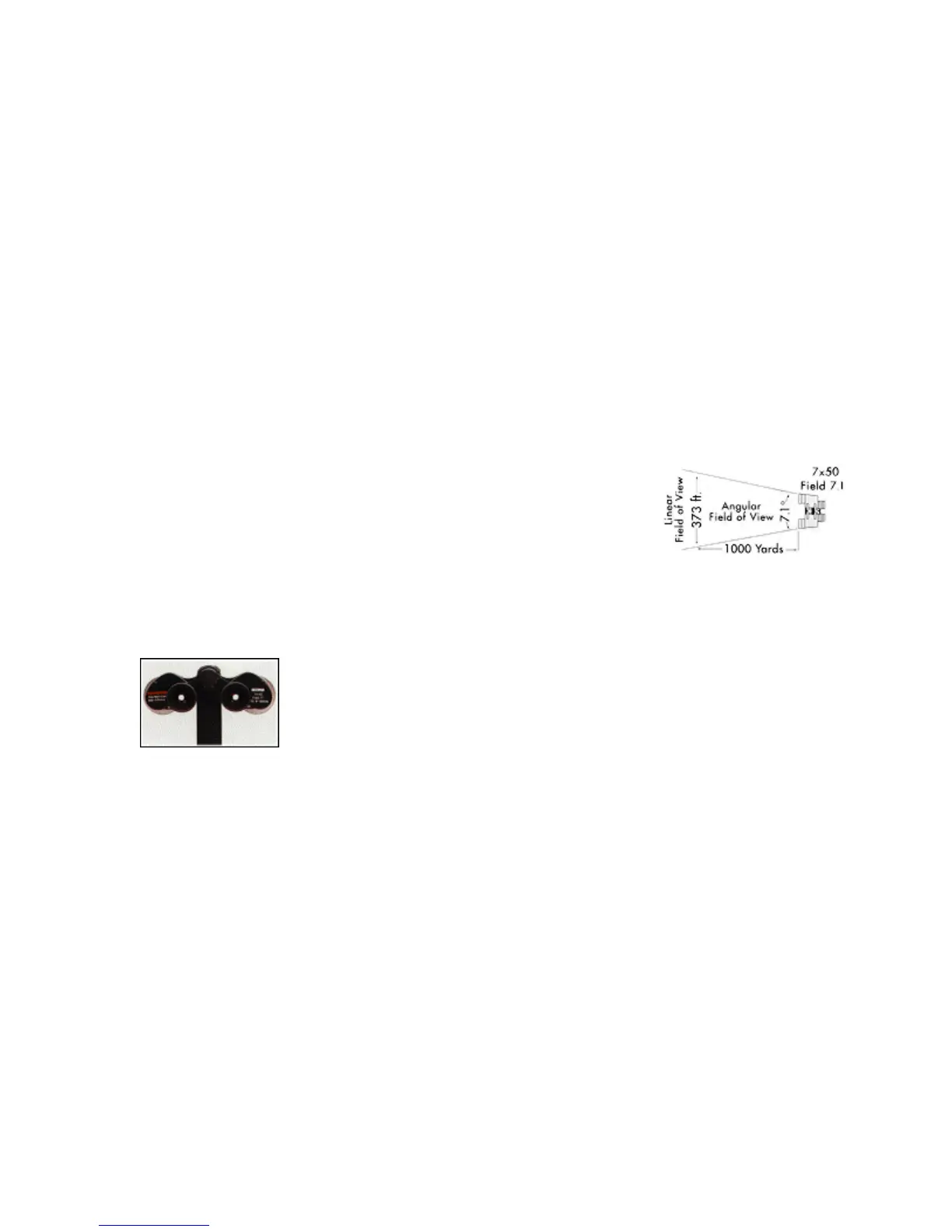
The size of the area that can be seen while looking through a pair of binoculars is
referred to as the field of view. The angular field of view is indicated on the
outside of the binocular, in degrees. The linear field of view refers to the area that
can be observed at 1,000 yards, and is expressed in feet. A larger field of view
translates to a larger area seen through the binocular.
Field of view is related to magnification, with greater
magnification creating a smaller field of view, in general. A
large field of view is especially desirable in situations where
the object viewed is likely to move, or when the user is
moving.
You can use angular field to calculate the linear field by multiplying the angular
field by 52.5. For example, if the angular field of a particular binocular is 8° then
the linear field will be 420 feet, i.e. the product of 8 x 52.5.
Exit Pupil
The diameter, in millimeters, of the beam of light that leaves
the eyepiece of a pair of binoculars is the "exit pupil". The
larger the exit pupil, the brighter the image obtained will be.
Having a large exit pupil is advantageous under low light conditions and at night.
For astronomical applications, the exit pupil of the binocular should correspond
with the amount of dilation of your eye's pupil after it has adapted to the dark.
This number will be between 5mm and 9mm. 9mm of dilation is the maximum
amount for the human eye, and this number tends to decrease with age.
To calculate the exit pupil, divide the size of the objective lens by the
magnification of the binocular. For example, the exit pupil of 7x42 binoculars is
42 ÷ 7 = 6mm.
Eye Relief
This refers to the distance, in millimeters, that a binocular can be held from the
eye and the full field of view can still be comfortably observed. Eyeglass wearers
in particular benefit from longer eye relief.
Brightness


 To Next Page
 Loading...