Operation
−19−
6.2 Starting, stopping
When either of the FWD input or REV input is turned ON after setting the rotation speed, the motor will rotate at the
specied speed.
If the signal (FWD input or REV input) which has been turned ON is turned OFF while the motor is rotating, the
motor will decelerate to a stop based on the specied deceleration time.
If the FWD input and REV input are turned ON simultaneously, the motor stops instantaneously.
FWD input REV input Motor shaft action
ON OFF Rotates in the forward direction
OFF ON Rotates in the reverse direction
OFF OFF Deceleration stop
ON ON Instantaneous stop
OFF
ON
OFF
REV input
FWD input
Motor movement
Forward direction
Reverse direction
Operation/Stop
Operation/
Instantaneous stop
Operation/Stop
Note
•
Do not operate the motor in vertical drive (gravitational operation).
•
Make sure that the motor case temperature does not exceed 90 °C (194 °F) during operation of
the motor. Operation exceeding case temperature 90 °C (194 °F) may signicantly deteriorate
the coils and ball bearings of the motor and shorten the motor's life span.
6.3 Setting the rotation speed
The rotation speed can be set using any of the following method (1), (2) or (3).
In the case of the combination type, the rotation speed of the gearhead output shaft varies depending on the gear ratio.
This manual describes the rotation speed of the motor output shaft.
Setting range
50 Hz: 90 to 1400 r/min
60 Hz: 90 to 1600 r/min
If the product is operated at 50 Hz when the rotation speed exceeding 1400 r/min has been set,
the motor will rotate around 1420 r/min although it is out of the setting range.
(2) External potentiometer
Supplied or sold separately
(3) External DC voltage
0 to 5 VDC or 0 to 10 VDC
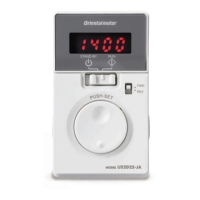
(1) Digital setting by the operation panel
(Factory setting)
Up to four types of operation data can be set.
The motor can be operated by selecting the operation data based on a
combination of ON/OFF status of the M0 and M1 inputs.
Remote
setting
See the next page for the setting procedures and methods of (1), (2) and (3).
Refer to p.23 for how to operate in two or more speeds.


 To Next Page
 Loading...