EasyManua.ls Logo

OSCAR 1 - Page 12

OSCAR 1
35 pages
Print Icon
To Next Page IconTo Next Page
To Previous Page IconTo Previous Page
Loading...
Chan
in
wheels
Several
types
af
wheel
åre
available.
The
pro-
cedure
for
changing
is,
however,
the
same
irre-
spective
of
type.
The
jack
and
the
tool
kit
åre
stored
to-
the
left
in
the
luggage
compartment.
The
spare
wheel
is
in
a
well
under
the
boot-floor.
Apply
the
parking
brake
and
engage
Ist
gear
or
reverse.
Place
chocks
in
front
of
and
behind
those
wheels
which
remain
on
the
ground.
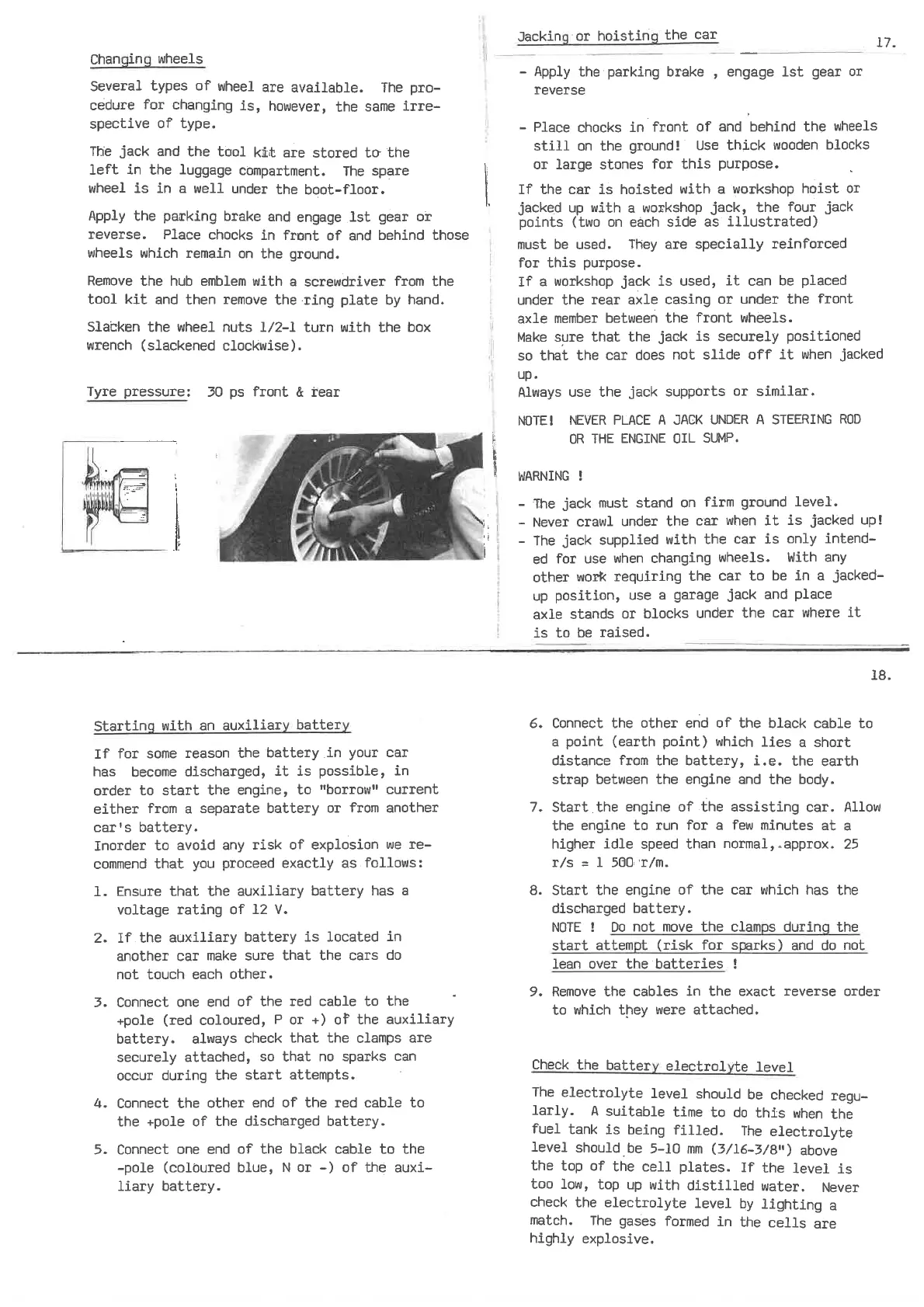
Remove
the
hub
emblem
with
a
screwdriver
from
the
tool
kit
and
then
remove
the
ring
plate
by
hånd.
Slacken
the
wheel
nuts
1/2-1
turn
iwith
the
box
wrench
(slackened
clockwise).
Tyre
pressure:
30
ps
front
&
rear
Jackin
or
hoistin
the
car ^
-
Apply
the
parking
brake ,
engage
Ist
gear
or
reverse
-
Place
chocks
in
front
of
and
behind
the
wheels
still
on
the
ground!
Use
thick
wooden
blocks
or
large
stones
for
this
purpose.
If
the
car
is
hoisted
with
a
workshop
hoist
or
jacked
up
with
a
uuorkshop
Jack,
the
four
Jack
points
(tuvo
on
eåch
side
as
illustrated)
must
be
used.
They
åre
specially
reinforced
for
this
purpose.
If
a
uuorkshop
Jack
is
used,
it
ean
be
placed
under
the
rear
axle
casing
or
under
the
front
axle
member
between
the
front
wheels.
Make
sure
that
the
Jack
is
securely
positioned
so
that
the
car
does
not
slide
off
it
when
jacked
up.
Aliniays
use
the
Jack
supports
or
similar.
NOTE!
NEVER
PLACE
A
JAGK
UNDER
A
STEERING
ROD
OR
THE
ENGINE
OIL
SUMP.
UARNING !
-
The
Jack
must
stand
on
firm
ground
level.
Sil
-
Never
crauul
under
the
car
when
it
is
jacked
up!
:'
-
The
Jack
supplied
wlth
the
car
is
only
intend-
'
ed
for
use
when
changing
wheels.
Uith
any
other
work
requlring
the
car
to
be
in
a
jacked-
up
position,
use
a
garage
Jack
and
place
axle
stands
or
blocks
under
the
car
where
it
is
to
be
raised.
18.
Startin
wlth
an
auxiliar
batter
If
for
same
reason
the
battery
in
your
car
has
become
discharged,
it
is
possible,
in
arder
to
start
the
engine,
to
"borrow"
current
elther
from
a
separate
battery
or
from
another
car's
battery.
Inorder
to
avoid
any
risk
of
explosian
uue
re-
commend
that
you
proceed
exactly
as
follows:
l.
Ensure
that
the
auxiliary
battery
has a
voltage
rating
of
12
V.
2.
If
the
auxiliary
battery
is
located
in
another
car
make
sure
that
the
cars
do
not
touch
each
other.
3.
Connect one
end
of
the
red
cable
to
the
+pole
(red
coloured,
P
or
+)
oF
the
auxiliary
battery.
always
check
that
the
damps
åre
securely
attached,
so
that
no
sparks
ean
occur
during
the
start
attempts.
4.
Connect
the
other
end
of
the
red
cable
to
the
+pole
of
the
discharged
battery.
5.
Connect
ane
end
of
the
black
cable
to
the
-pole
(col&ured
blue,
Nor
-)
of
the
auxi-
liary
battery.
6.
Connect
the
other
end
of
the
black
cable
to
a
point
(earth
point)
which
lies
a
short
distance
from
the
battery,
i.
e.
the
earth
strap
between
the
engine
and
the
body.
7.
Start
the
engine
of
the
assisting
car.
Allow
the
engine
to
run
for
a
few
minutes
at a
higher
idle
speed
than
normal,.
approx.
25
r/s
=
l
500
r/m.
8.
Start
the
engine
of
the
car
which
has
the
discharged
battery.
NOTE
!
Do
not
move
the
dam
s
durin
the
start
attem
t
(risk
for
s
arks)
and
do
not
lean
over
the
battenes !
9.
Remove
the
cables
in
the
exact
reverse
arder
to
which
they
were
attached.
Check
the
batter
electrol
te
level
The
electrolyte
level
should
be
checked
regu-
larly.
A
suitable
time
to
do
this
when
the
fuel
tank
is
being
filled.
The
electrolyte
level
should
be
5-10
mm
(3/16-3/8")
above
the
top
of
the
cell
plates.
If
the
level
Is
tao
low,
top
up
ivith
distilled
water.
Never
check
the
electrolyte
level
by
lighting a
match.
The
gases
formed
in
the
cells
åre
highly
explosive.