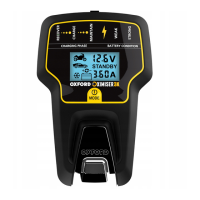
The Oxford Oximiser 601 is an essential 12V battery optimiser designed to charge, optimise, and prolong the life of 12-volt automotive batteries. It is suitable for charging most 12-volt batteries with capacities ranging from 4Ah up to 30Ah, including Maintenance Free and Gel types. This makes it ideal for scooters, motorcycles, golf trolleys, light aircraft, ride-on lawn mowers, and small cars such as classic and racing cars. While batteries smaller than 4Ah can be charged, it is recommended to do so for short periods only, monitoring battery temperature and disconnecting the charger once fully charged.
The Oximiser 601 employs a continuous yet reducing charge current to ensure correct battery charging. As the battery voltage increases, the charge rate automatically reduces. If a load is applied to the battery, the charger compensates by increasing the charge current to maintain the battery's condition.
Usage Features:
The device features a central display that provides crucial information:
- A guide to the battery voltage and charge status.
- Notification if a battery cannot be charged.
- Indication of battery connection errors due to reverse polarity.
The charging process involves several stages:
- Polarity Test: Upon connection, the Oximiser 601 performs a polarity check. A red LED under the warning symbol illuminates if the connections are incorrect, indicating that the positive and negative leads need to be swapped.
- Analysis: If the battery is permanently damaged, will not accept a charge current, or its voltage is below 3 volts, the Oximiser 601 will not attempt to recharge. A red LED (<3V) lights up, prompting the user to disconnect the charger from the battery.
- Recover: If the battery is deeply discharged to approximately 3.1 Volts, the Oximiser 601 will charge at up to 601mA/hr. It's important to note that batteries under 3V to 4V, or those that have dropped below 8 volts for extended periods, may not fully recover to full capacity.
- Bulk Charge: From 11.8 Volts, a maximum charging current is applied until the battery is recharged and reaches an "on-charge" voltage of 12.8V. At this stage, the battery can be used to start a vehicle, though full charge is not reached until the 14.1V light begins to glow.
- Maintain (Float Charge): From 12.8V, the charge rate continues to reduce as the voltage rises. The Oximiser 601 maintains and optimises the battery indefinitely as long as it remains connected. When the voltage exceeds 14.0V, the final light glows, and the charger applies a gentle trickle charge to keep the battery in perfect condition. If a small drain is applied to the battery (e.g., an accidentally left-on electronic item), the charger automatically increases the charge current to maintain battery condition.
To start the charging process:
- Correctly connect the Oximiser 601 to the battery terminals. If the red warning light indicates incorrect polarity or a battery voltage too low (<3V), address the issue before proceeding.
- The Oximiser 601 will automatically charge and maintain the battery as long as it is connected.
- The charging process can be interrupted by switching off the mains power and then disconnecting the leads. If mains power is off but the battery remains connected, it will not charge and will slowly discharge.
Safety and Connection Guidelines:
- Charger Location: Position the charger as far away from the battery as the DC cables permit. Never place it directly above or below the battery being charged, as gases or fluids can corrode and damage the charger. Ensure the area is well-ventilated, away from moisture, and allows for cooling and battery gas discharge. Do not cover the Oximiser 601 during use. The supplied wall bracket ensures optimum airflow.
- DC Connection - Standard Precautions: Connect and disconnect DC output clips only after setting any charger switches to "off" and removing the AC cord from the electric outlet. Never allow clips to touch each other.
- Battery Installed in Vehicle: When the battery is installed in a vehicle, position AC and DC cords away from moving engine parts. Stay clear of fan blades, belts, and pulleys. Check battery post polarity (positive posts are usually larger). For negative-grounded vehicles, connect the POSITIVE (RED) clip to the ungrounded positive post and the NEGATIVE (BLACK) clip to the vehicle chassis or engine block, away from fuel lines or sheet-metal parts. For positive-grounded vehicles, connect the NEGATIVE (BLACK) clip to the ungrounded negative post and the POSITIVE (RED) clip to the vehicle chassis or engine block. When disconnecting, turn switches off, disconnect the AC cord, remove the clip from the vehicle chassis, then from the battery terminal.
- Battery Outside Vehicle: Check battery post polarity. Connect the POSITIVE (RED) charger clip to the positive post. Position yourself and the free end of the cable as far away from the battery as possible, then connect the NEGATIVE (BLACK) charger clip to the free end of the cable. Do not face the battery when making the final connection. Connect the charger AC supply cord to the electrical outlet. When disconnecting, always reverse the connection sequence, breaking the first connection while standing as far away as practical.
- Permanent Ring Lead Connector: Ensure the permanent ring lead connectors are suitable for the battery screw clamp connections. Connect the red ring lead to the positive (+) and the black ring lead to the negative (-) battery connection, ensuring a secure fit. This lead can be left permanently on the battery, with the end connector positioned conveniently for quick connection to the Oximiser 601. The leads include a weatherproof cap to prevent corrosion.
Maintenance Features:
- Battery Maintenance: The Oximiser 601 is designed for long-term connection to a battery. For batteries with removable inspection caps, regularly check that fluid levels are above the minimum. Maintenance-free, AGM, or GEL batteries do not require fluid level checks.
- Winter Storage: To prolong battery life during winter, store bikes in places warmer than 0°C. If the bike is outside, remove the battery and store it in a warm location to prevent freezing and cracking. A fully charged battery is less likely to freeze.
- Storage Surface: If removing the battery, do not store it on concrete or metal surfaces, as these can cause discharge over time. Instead, place it on wood or another non-conductive surface.
- Regular Charging: Keep your battery maintained by leaving the Oximiser 601 connected for long periods. If saving mains electricity, charge the battery at least once a month and then disconnect all leads.
Important Safety Instructions:
- This manual contains important safety and operating instructions for the Oximiser 601.
- The appliance is not intended for use by persons (including children) with reduced physical, sensory, or mental capabilities, or lack of experience, unless supervised or instructed by a responsible person. Children should be supervised to ensure they do not play with the appliance.
- Do not expose the charger to rain or snow; it is for indoor operating use only and is not water-resistant.
- Use only attachments recommended or sold by the manufacturer to avoid fire, electric shock, or injury.
- Pull by the plug, not the cord, when disconnecting to reduce the risk of damage.
- An extension cord should only be used if absolutely necessary, ensuring it has the correct pin number, size, shape, proper wiring, and sufficient wire size for the charger's AC ampere rating.
- Do not operate the charger with a damaged cord or plug; replace it immediately. Oxford Products cannot offer repair facilities.
- Do not operate the charger if it has received a sharp blow, been dropped, or otherwise damaged. Opening the charger case will invalidate the Oxford Products guarantee.
- Do not disassemble the charger.
- Unplug the charger from the outlet before any maintenance or cleaning to reduce the risk of electric shock.
- This product is designed for Lead Acid, AGM, Maintenance Free, and Gel batteries with a capacity between 4 and 30 Ah. It must not be used for charging non-rechargeable, Ni-CAD, NiMH, or Lithium batteries.
- Risk of Explosive Gases: Working near a lead-acid battery is dangerous as batteries generate explosive gases during normal operation. Always follow instructions, those marked on the battery, and those published by the battery manufacturer.
- To reduce the risk of battery explosion, ensure proper ventilation, wear eye and clothing protection, and avoid smoking, sparks, or flames near the battery or engine.
- Be cautious when using metal tools near the battery to prevent short circuits or explosions.
- Remove personal metal items (rings, bracelets, necklaces, watches) when working with a lead-acid battery, as a short circuit can cause severe burns.
- Only use the charger for LEAD-ACID batteries. Do not use it to supply power to low-voltage electrical systems other than starter-motor applications, or for charging dry-cell batteries, as this can cause them to burst and cause injury or property damage.
- NEVER charge a frozen battery.
Preparing to Charge:
- If removing the battery from a vehicle, always remove the grounded terminal first, ensuring all accessories are off to prevent arcing.
- Study the battery manufacturer's specific precautions regarding cell caps, charging rates, and adding distilled water if necessary. Do not overfill.
- Ensure the area around the battery is well-ventilated during charging.
- Clean battery terminals carefully, avoiding contact with eyes.
- Determine the battery voltage and ensure it matches the charger's output rating.
The advanced electronic programming of the Oximiser 601 makes it almost impossible to create sparks that could ignite gases when first connecting the leads. If the mains power is on but the battery is not connected, no power is produced. However, if battery connection leads are removed while charging, power will still be produced, so it is vital to follow connection/disconnection instructions to prevent a short circuit.

 Need help?
 General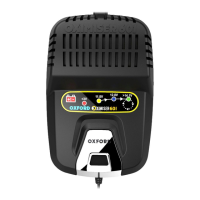

 To Next Page