Need help?
Do you have a question about the Panasonic Lumix DMC-FZ5 and is the answer not in the manual?
This document describes the Panasonic Lumix DMC-FZ5, a digital camera designed for sharp and stable telephoto shooting, offering high functionality within a stylish body.
The Panasonic Lumix DMC-FZ5 is equipped with a Leica 12x optical zoom lens, similar to its predecessor, the DMC-FZ20. However, unlike the FZ20, it does not maintain the f2.8 maximum aperture throughout its entire zoom range. The camera features a 5.0-megapixel effective CCD sensor, capable of capturing high-resolution JPEG and TIFF images.
For still photography, the FZ5 supports three burst modes: high speed, low speed, and continuous. In high-speed mode, it records four Fine (or seven Standard) JPEG images at 0.3 frames per second. The other modes capture images at 0.5 frames per second for the same number of shots (in low-speed mode) or up to the card's capacity (unlimited mode). When in 'Simple' mode, the burst speed is fixed at low. The camera also includes a focus button that allows users to pre-focus on a subject without fully pressing the shutter release, a useful feature for capturing anticipated events like fireworks. This button locks the focus on the selected subject until pressed again.
The FZ5 also offers movie recording capabilities, similar to those found on the FZ3. It records QVGA resolution video at either 10 or 30 frames per second, with accompanying sound. During movie recording, the focus, zoom, and aperture settings are fixed at the beginning of each clip. A 25-second clip recorded at 30 frames per second will fill the supplied 16MB memory card, indicating that a larger memory card would be necessary for extended video capture.
The camera incorporates a 'Mega O.I.S.' (Optical Image Stabiliser) system with three selectable modes: continuous, standby, and off. The continuous setting is the default and works for both viewing the subject and capturing images, proving particularly helpful when composing telephoto shots. The standby mode is specifically for still shooting and activates the stabiliser only when the shutter button is pressed. This feature offers an enhanced degree of stabilisation, especially beneficial when using the digital zoom.
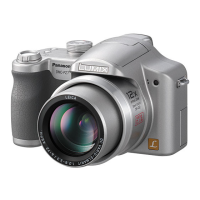
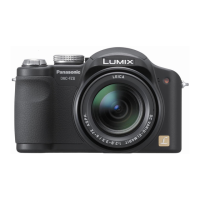
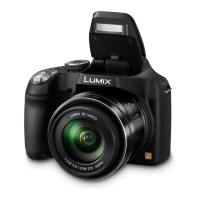
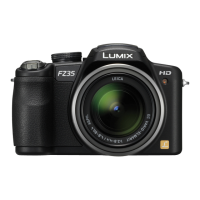
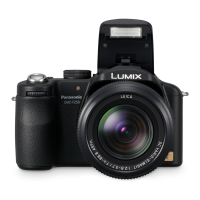
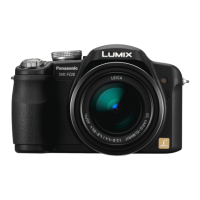
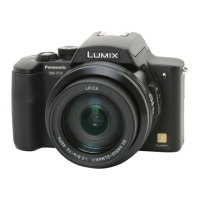
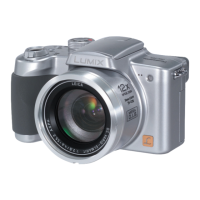
The DMC-FZ5 is available in black or silver and features a plastic body that is nearly identical to that of the 3-megapixel FZ3. It is notably smaller, roughly 40% lighter, and 20% cheaper than the FZ20. The camera's body is well-made and designed to feel comfortable in the user's hands. The grip has been slightly enlarged, and the shutter release button has been moved forward to accommodate the 'Mega O.I.S.' button.
The camera's viewfinder is an Electronic Viewfinder (EVF) that is described as remarkably good, accurately covering the sensor's field of view. Its color reproduction is excellent, and it exhibits less streaking in backlit conditions compared to many other EVFs. A high eyepoint makes it comfortable for users wearing glasses, and it provides a wide adjustment range of +/-4 diopters. The larger 1.8-inch LCD screen offers an advantage over its predecessor and some competing models, enhancing the viewing experience.
Most of the controls on the FZ5 are straightforward. The mode dial includes a special 'Simple' setting, which allows the camera to be used as a basic point-and-shoot device. The menu design is intuitive, excellent, and quick to navigate. However, when switching to the A (Aperture Priority), S (Shutter Priority), and M (Manual) modes, changing camera settings requires the use of the Exposure button in conjunction with the four-way controller, a process that can be somewhat clumsy and slow.
The camera's performance includes a power-up and shut-down time of approximately three seconds, which is considered good for a long zoom camera. The average capture lag when focusing is required is 0.6 seconds, which can be reduced to 0.1 seconds with pre-focusing. Processing a high-resolution JPEG file takes less than a second, while a TIFF image takes almost three seconds. Both are considered relatively fast cycle times.
The camera delivers nicely-exposed pictures with accurate colors and modest saturation levels. Skin tones are rendered slightly warm. The lens/sensor combination provides above-average image sharpness, with negligible chromatic aberration. The auto white balance performs well in fluorescent lighting but struggles to eliminate the orange cast from incandescent lights. However, using the pre-set or manual control for white balance yields excellent results. While highlight details may be lost in bright outdoor conditions, the overall image contrast range is excellent in subdued lighting, and image noise remains low at all ISO settings during long exposures in dark conditions. The image stabiliser effectively allows for candid shots in indoor conditions without flash. The built-in flash, however, is comparatively weak and requires ISO 400 sensitivity to adequately illuminate an average-sized room. It also produces poor results for close-ups due to the lens tending to block much of its light.
The document does not explicitly detail maintenance features. However, the mention of the camera's body being "well made" suggests a degree of durability. The camera's design, with its comfortable grip and accessible controls, implies ease of handling during use, which can contribute to its longevity. The effectiveness of the image stabiliser in various conditions, including indoor shots without flash, reduces the need for external lighting equipment, simplifying usage and potentially reducing wear on accessories. The camera's ability to perform well in subdued lighting with low image noise at all ISO settings in long exposures after dark indicates robust internal processing that minimizes the need for extensive post-processing or reliance on additional lighting, which could be considered a form of operational maintenance by reducing strain on the device. The note about needing a much larger memory card for extended video recording implies that users should consider this for optimal performance and to avoid frequent data transfers or deletions, which can be a form of data management maintenance.
 General
| Megapixel | 5 MP |
|---|---|
| Camera type | Compact camera |
| Sensor type | CCD |
| Image stabilizer | Yes |
| Image sensor size | 1/2.5 \ |
| Maximum image resolution | 2560 x 1920 pixels |
| Digital zoom | 4 x |
| Optical zoom | 12 x |
| Focal length range | 6 - 72 mm |
| Interface | AV out, USB |
| Digital SLR | No |
| Camera shutter speed | 8 - 1/2000 s |
| Focal length (35mm film equivalent) | 36 - 432 mm |
| Focus adjustment | Auto |
| Normal focusing range | (W)0.3 - ∞, (T) 2 - ∞ m |
| Macro focusing range (tele) | 2 - ∞ m |
| Macro focusing range (wide) | 0.05 - ∞ m |
| Normal focusing range (wide) | 0.3 - ∞ m |
| Light metering | Centre-weighted, Spot |
| ISO sensitivity | 80, 100, 200, 400, Auto |
| Flash modes | auto, Red-eye reduction, Slow synchronization |
| Flash range (wide) | 0.5 - 4.8 m |
| Motion JPEG frame rate | 30 fps |
| Maximum video resolution | 320 x 240 pixels |
| Field of view | 100 % |
| Display diagonal | 1.8 \ |
| Display resolution (numeric) | 114000 pixels |
| USB version | 2.0 |
| Photo effects | black&white, Sepia, Vivid |
| White balance | auto, Cloudy, daylight |
| Camera playback | Movie |
| Self-timer delay | 2, 10 s |
| Product color | Silver |
| Battery type | 7.2V |
| Battery capacity | 680 mAh |
| Compatible memory cards | sd |
 Weight and Dimensions
| Depth | 84.8 mm |
|---|---|
| Width | 108 mm |
| Height | 68.4 mm |
| Weight | 326 g |