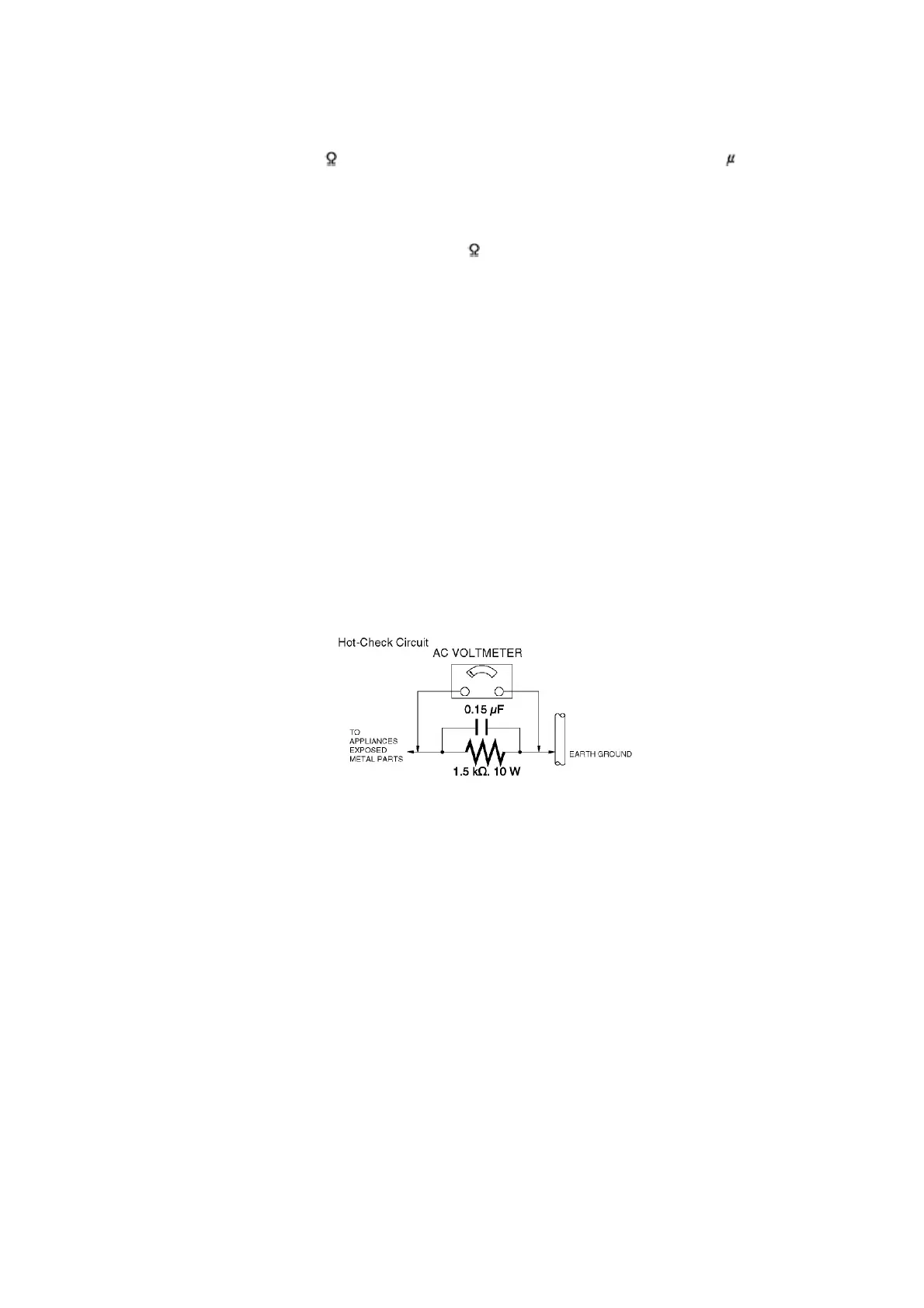
2. Connect a 1.5 k , 10 W resistor, in parallel with a 0.15 F
capacitor, between each exposed metallic part on the set and a
good earth ground, as shown in figure 1.
3. Use an AC voltmeter, with 1 k /V or more sensitivity, to measure
the potential across the resistor.
4. Check each exposed metallic part, and measure the voltage at
each point.
5. Reverse the AC plug in the AC outlet and repeat each of the above
measurements.
6. The potential at any point should not exceed 0.75 V RMS. A
leakage current tester (Simpson Model 229 or equivalent) may be
used to make the hot checks. Leakage current must not exceed 1/2
mA. In casea measurement is outside of the limits specified, there
is a possibility of a shock hazard, and the equipment should be
repaired and rechecked before it is returned to the customer.
Figure 1
2. PREVENTION OF ELECTRO-STATIC DISCHARGE
(ESD) TO ELECTROSTATICALLY SENSITIVE (ES)
DEVICES
Some semiconductor (solid state) devices can be damaged easily by static electricity. Such
components commonly are called Electrostatically Sensitive (ES) Devices. Examples of typical
ES devices are integrated circuits, some field-effecttransistors and semiconductor "chip"
components. The following techniques should be used to help reduce the incidence of
component damage caused by electrostatic discharge (ESD).
1. Immediately before handling any semiconductor component or
semiconductor-equipped assembly, drain off any ESD on your
body by touching a known earth ground. Alternatively, obtain
andwear a commercially available discharging ESD wrist strap,
which should remove electrostatic charge for potential shock
3


 To Next Page
 Loading...