XP 20 Owners Manual Rev 0.4 14
With balanced operation, the common mode rejection of the preamp reflects the intrinsic
common mode rejection of the topology, the matching of the gain devices, and the
matching of the attenuator channels. In this case we have been able to keep the total
mismatch to about .1%, for a common mode rejection of approximately -60 dB.
The input system of the preamplifier will exhibit full common mode noise rejection with
passive balanced sources, where the negative input is connected to ground at the
source through the appropriate source impedance. This allows adaptation of
unbalanced sources to balanced operation with passive cable connections in a manner
that achieves the superior noise rejection of active balanced sources.
The use of a micro-controller allows all of the preamplifier functions to be repeatable
and accurately controlled. The microprocessor only controls the functions of the
preamplifier. At no time does any of the input or output signal come into contact with
the digital control signals.
The digital circuits are powered by a power supply that is isolated from the analog
supply. Should it ever be necessary to update the software that controls the functioning
of the preamp only the socketed micro-processor need be changed.
Rugged mechanical muting relays, which delay connection during turn-on and shut off
the output when insufficient power supply is available to maintain regulation, guard the
output of the preamplifier and offer protection to the power-amplifier and loudspeakers.
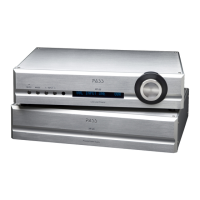
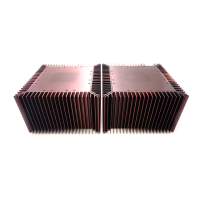
The XP-20 consists of two chassis, shipped in a single box.


 To Next Page
 Loading...