This document is an assembly and user manual for the Patiojoy Outdoor Round Daybed, model HW66656.
Function Description
The Patiojoy Outdoor Round Daybed is a piece of outdoor furniture designed for relaxation and lounging. It features a circular base with multiple seating sections and a retractable canopy, allowing users to enjoy sun or shade as desired. The daybed is modular, consisting of several individual components that are assembled to form the complete unit. It is intended for outdoor use, providing a comfortable and stylish seating solution for patios, gardens, or other outdoor spaces. The design suggests a focus on comfort and versatility, with cushions and a canopy for an enhanced user experience.
Important Technical Specifications
While specific material specifications (e.g., type of metal for the frame, fabric for cushions/canopy) are not explicitly detailed in the provided pages, the assembly diagrams and part lists offer insights into the construction.
Key Components and Structure:
The daybed's frame is constructed from numerous curved metal bars and panels, suggesting a robust and durable structure suitable for outdoor conditions.
- Frame Parts (A1-A4, B1-B4, C1-C4, D1-D4): These are curved bars that form the main structural arcs of the canopy and base sections. There are 4 sets of 4 bars each, indicating a multi-sectioned design.
- Canopy Frame (E, F, H): These parts form the upper structure of the retractable canopy. 'E' and 'H' appear to be end sections, while 'F' is a central section.
- Side Panels (B, E, F, H, V, W, X, Y): These are various panels that form the sides and backrests of the seating sections and the canopy structure. 'W' appears to be the canopy fabric/cover itself, while 'B', 'E', 'F', 'H', 'V', 'X', 'Y' are structural or decorative panels.
- Seating Base Sections (K, O, Q): These are the base frames for the individual seating segments. 'K' and 'Q' are curved sections, and 'O' is a corner or central section.
- Central Table/Ottoman (Z): A circular component that can function as a table or an ottoman, featuring an adjustable height mechanism.
- Cushions (L, M, N, T, U): These include seat cushions ('L', 'M', 'N'), backrest cushions ('U'), and a central cushion ('T') for the ottoman.
- Hardware:
- Screws (1, 2, 3, 6): M6x20mm (17 pcs), M6x30mm (36 pcs), M6x25mm (8 pcs), M4x12mm (12 pcs). These are likely for securing frame components.
- Washers (4): Φ6x14x1mm (16 pcs). Used with screws for better fastening.
- Nuts (5): M6 (8 pcs).
- Allen Key (7): 4X98 (2 pcs). For tightening screws.
- Link Parts (8): (6 pcs). These are crucial for connecting the modular seating sections.
- Connectors (9): (2 pcs). Likely for connecting canopy sections.
Dimensions: Not explicitly provided, but the visual representation suggests a substantial size, typical for a daybed designed for multiple users or spacious lounging.
Modularity: The daybed is highly modular, with individual seating sections (K, O, Q) that can be linked together. The canopy also appears to be retractable or adjustable, indicated by its separate frame components and the presence of connectors.
Usage Features
- Modular Design: The daybed is composed of several independent seating units (K, O, Q) that can be arranged in a circular configuration. This modularity allows for flexibility in setup and potentially in storage.
- Retractable Canopy: The presence of canopy frame parts (E, F, H) and a canopy cover (W) suggests a retractable or adjustable canopy feature. This allows users to easily switch between sun exposure and shaded comfort, enhancing usability in varying weather conditions.
- Central Adjustable Table/Ottoman (Z): A unique feature is the central circular component (Z) which can be adjusted in height. This allows it to function either as a convenient table for drinks and snacks or as an ottoman, integrating seamlessly with the seating when lowered. The adjustment mechanism is illustrated in steps 12-14.
- Comfort Elements: The inclusion of various cushions (L, M, N, T, U) indicates a focus on user comfort, providing soft seating and back support.
- Outdoor Suitability: The "Outdoor Round Daybed" designation implies that the materials and construction are designed to withstand outdoor elements, though specific weather resistance details are not given.
- Assembly Required: The product requires assembly, as detailed in the step-by-step instructions. This is a common feature for furniture of this type, allowing for more compact shipping.
Maintenance Features
The manual provides general advice for assembly and handling, which indirectly contributes to the longevity and maintenance of the product.
- Careful Assembly: Instructions emphasize reading all instructions carefully, retaining them for future reference, separating and counting parts, and following the proper order. This ensures correct assembly, which is foundational for product stability and durability.
- Placement Recommendations: Users are advised to assemble the item near its intended use location to avoid unnecessary movement once assembled, and always place the product on a flat, steady, and stable surface. Proper placement prevents undue stress on the frame and components.
- Safety Precautions: Keeping small parts and packaging materials away from children is highlighted as a safety measure, but also implies careful handling of components during assembly.
- Return/Damage Claim Instructions: This section outlines procedures for handling damaged parts or returns, which is crucial for product support and ensuring users receive a fully functional and undamaged product.
- Do Not Discard Original Packaging: Essential for returns, indicating that the packaging is part of the product's lifecycle for potential service.
- Photo Documentation: Requiring photos of box markings and damaged parts (if applicable) is a maintenance-related feature, as it streamlines the process of identifying and replacing specific components, thus aiding in the repair or restoration of the product. This suggests that individual parts can be replaced, extending the product's life.
- Email Communication: Directing users to email with images and descriptions simplifies the support process for maintenance and repair issues.
While specific cleaning instructions for the cushions or frame materials are not provided in the excerpt, the emphasis on proper assembly and the detailed return/damage claim process indicate a design philosophy that supports the long-term usability and maintainability of the daybed through component replacement and user support. The modular nature also implies that individual sections could potentially be repaired or replaced if damaged, rather than requiring the replacement of the entire unit.

 Need help?
 General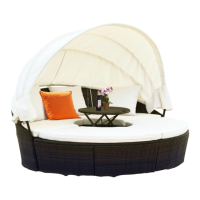

 To Next Page