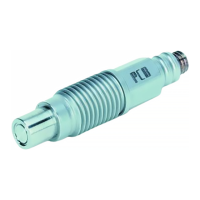
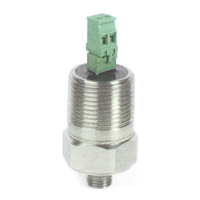
This document describes the Model 352C33, a Platinum Stock Products, high-sensitivity, ceramic shear ICP® accelerometer. It includes an installation and operating manual, along with warranty, service, repair, and return policies.
Function Description
The Model 352C33 is an ICP® accelerometer designed for vibration measurement. ICP® sensors require constant current excitation for proper operation, typically supplied by PCB constant-current signal conditioners or other approved sources. The device provides an AC-coupled output signal compatible with most standard readout devices. It is suitable for various applications, including machinery condition monitoring, predictive maintenance, spot checks, and vibration trending.
Important Technical Specifications
- Sensitivity: 100 mV/g (10.2 mV/(m/s²))
- Measurement Range: ±50 g pk (±490 m/s² pk)
- Frequency Range (±5%): 0.5 to 10,000 Hz
- Frequency Range (±10%): 0.3 to 15,000 Hz
- Resonant Frequency: ≥50 kHz
- Broadband Resolution (1 to 10,000 Hz): 0.00015 g rms (0.0015 m/s² rms)
- Non-Linearity: ≤1%
- Transverse Sensitivity: ≤5%
- Overload Limit (Shock): ±5000 g pk (±49000 m/s² pk)
- Operating Temperature Range: -65 to +200 °F (-54 to +93 °C)
- Excitation Voltage: 18 to 30 VDC
- Constant Current Excitation: 2 to 20 mA
- Output Impedance: ≤200 ohm
- Output Bias Voltage: 7 to 12 VDC
- Discharge Time Constant: 1.0 to 2.5 sec
- Settling Time (within 10% of bias): <10 sec
- Spectral Noise (1 Hz): 39 µg/√Hz (380 (µm/s²)/√Hz)
- Sensing Element: Ceramic Shear
- Housing Material: Titanium
- Sealing: Hermetic
- Size (Hex x Height): 0.44 in x 0.62 in (11.2 mm x 15.7 mm)
- Weight: 0.20 oz (5.8 gm)
- Electrical Connector: 10-32 Coaxial Jack, Side position
- Mounting Thread: 10-32 Female
- Mounting Torque: 10 to 20 in-lb (113 to 226 N-cm)
Optional Versions:
- HT (High Temperature): Extends normal operation temperatures to -65 to +325 °F (-54 to +163 °C) with an excitation voltage of 22 to 30 VDC.
- J (Ground Isolated): Offers electrical isolation (>10⁸ ohm) and different frequency ranges (9 kHz for ±5%, 14 kHz for ±10%) and resonant frequency (≥40 kHz).
- T (TEDS Capable): Compliant with IEEE P1451.4 for digital memory and communication. Includes variations for LMS International (Free Format, Automotive, Aeronautical) and IEEE 1451.4. TEDS option adds 1.0 VDC to bias voltage.
- W (Water Resistant Cable): Features a sealed integral cable with side electrical connection.
Usage Features
The manual details several mounting methods for the accelerometer:
- Stud Mount: Recommended for permanent installations, providing high frequency response. Requires a smooth, flat mounting surface (63 µin finish) and proper torque (10 to 20 in-lb) for the mounting stud.
- Adhesive Mount: Suitable for situations with space restrictions or convenience. Can be done directly to the test structure or via an adhesive mounting base. Requires a smooth, flat mounting surface (63 µin finish). Debonding agents are necessary for removal to prevent sensor damage.
- Magnetic Mount: Convenient for quick, portable measurements, often used in machinery condition monitoring. Requires a smooth, flat mounting surface and proper magnet selection (flat or dual-rail). Caution is advised during installation to prevent high acceleration (g) levels that could damage the sensor.
- Handheld or Probe Tip Mount: Not generally recommended for most applications due to questionable accuracy and repeatability, but can be useful for initial vibration location.
Cabling:
- Proper cable selection is crucial; ICP® sensors can use ordinary two-wire or coaxial cables. Low-noise cables are essential for CE conformity.
- Thread-locking compound can secure cable connections. Silicone rubber sealant, O-rings, or heat-shrink tubing can seal connections in harsh environments.
- Cables should be routed to minimize stress on the sensor/cable connection and avoid physical damage or electrical noise (e.g., near high-voltage wires). Shielded cables should be grounded at one end only.
Powering:
- ICP® sensors require constant current excitation (18 to 30 VDC, 2 to 20 mA).
- Use only PCB constant-current signal conditioners or approved sources.
- Never supply voltage to an ICP® accelerometer without a current-regulating diode or equivalent circuit, as this can cause damage not covered by warranty.
- Signal conditioners often include meters or LEDs to monitor bias voltage, check operation, and detect cable faults.
Calibration:
- Routine calibration is recommended to ensure measurement accuracy.
- PCB Piezotronics offers ISO-9001 certified and A2LA accredited calibration services, traceable to N.I.S.T.
- Special testing (e.g., sensitivity at extreme temperatures, phase response) is also available.
- Back-to-Back Calibration is the preferred method for determining the sensitivity of piezoelectric accelerometers, comparing the test sensor to a previously calibrated reference standard.
Maintenance Features
- Routine Maintenance: Includes cleaning electrical connectors, housings, and mounting surfaces with solutions that will not harm the material. Avoid liquids migrating into non-hermetically sealed devices.
- Repair: User servicing or repair is not recommended and may void the factory warranty. Equipment should be returned to PCB Piezotronics for repair.
- Total Customer Satisfaction: PCB Piezotronics guarantees to repair, replace, exchange, or refund the purchase price of any product if the customer is not completely satisfied.
- Returning Equipment: Contact a distributor or customer service representative to obtain a Return Materials Authorization (RMA) number before returning any equipment. Include a Purchase Order for repair if the item is outside warranty or if the repair cost exceeds 50% of the replacement cost.

 Need help?
 General

 To Next Page