Regular Maintenance
66
Thermal Cover Care
Always use the locking thermal cover when not in use to reduce heat-up me, operang costs and keep unwanted out. To
prolong the life of the cover, handle it with care and clean it regularly using mild soap and water. Periodic treatments with a vinyl
condioner will help protect against deterioraon caused by UV rays from the sun. Never allow anyone to stand or sit on the cover,
and avoid dragging it across rough surfaces. Be sure to lock all straps when not in use for safety and to prevent wind damage. Keep
cover open at least 15 minutes aer adding chemicals.
EverPure™ Ozone Care
The ozone hose and check valve connecon between the ozone generator and ozone injector should be inspected or replaced, if
necessary, annually. The air quality pulled into the generator may cause rapid wear on the hose and check valve. The EverLite™
will light green when the ozone generator is operang (during the filtraon cycle) indicang the EverPure™ system is indeed
sanizing the water.
Plumbing Care
Hot tubs are plumbed with plasc jets, pipes and fings which are glued together. These plasc parts and their many glue
joints are subjected to harsh treatment with years of operaon, subjected to many hot-cold cycles and the high pressure
generated by the powerful jet pump stressing pipes and joints. Although the factory has a rigorous tesng procedure, even
transportaon from the factory to you can cause vibraon and possible loosening of the joints.
Should a leak occur, remove that appropriate secon of cabinet wall exposing the leaking area. Drain the hot tub to below the leak
and contact a qualified technician for repair.
Filter Cartridge Care
Hot tub water filtraon begins as soon as the flow is steady through the pump. As the filter cartridge removes dirt from the water,
the accumulated debris will cause a resistance to flow. When this is noced, along with cloudy water, clean or replace the filter
element as noted below. This generally occurs monthly depending upon use and water care.
PowerFlo™ System: (Luxury and Premium Series)
1. Shut off power at the main or sub panel.
2. Open the small, black bleeder valve on top of the filter cover slightly to release pressure. (Be sure to re-close the valve snugly
before reacvang the spa. Do not overghten, there is a risk of cracking.)
3. Remove the black lock ring. Li the dome lid and remove the filter element. Clean any debris from the filter housing. Soak the
filter element in a non-sudsing filter cleansing soluon.
4. Rinse the filter element with a garden hose or pressure hose, and replace in the filter housing. (It is recommended to have an
extra filter cartridge on hand so that a clean element will always be available while the soiled element is being cleaned. This will
minimize downme of the spa during the cleaning procedure.) When replacing the element into the housing, be sure that the o-ring
is in place and clear to assure a snug fit of the filter dome lid to prevent leakage. Hand ghten the lock ring unl snug and locking tab
engages. Do not overghten, there is a risk of cracking. Re-check bleeder valve to be sure it is closed.
Prisne™ System: (Lifestyle Series)
1. Shut off power at the main or sub panel.
2. Remove the filter housing top by using the raised porons of the filter top and turning it counter clockwise. Aer top
stops turning, li up to remove top from filter.
3. Li the skimmer basket out of the filter canister.
4. Remove the filter from the canister.
5. Replace with clean filter ( Review above for cleaning recommendaons.)
6. Place skimmer basket back in filter canister.
7. Place filter top onto filter canister and turn clockwise unl top stops.
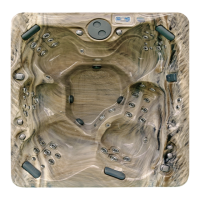
Hot Tub Acrylic Surface Care
To preserve the sheen of the acrylic surface, clean and sanize with clean water to remove any parcles and use rubbing alcohol
or a non-abrasive, non-sudsing cleaner to wipe clean. Use a so, lint free cloth and never use an aggressive solvent such as a
lacquer thinner or acetone which will cause damage to the acrylic.



 To Next Page
 Loading...