EasyManua.ls Logo

Penn A28 Series - User Manual

Penn A28 Series
2 pages
Print Icon
To Next Page IconTo Next Page
Loading...
Application
These two-stage controls are designed to cover
a broad range of general purpose operating
temperature control applications in the
refrigeration, air conditioning, and heating fields.
Two SPDT switches permit independent control
circuits. Each switch may be wired for “open high”
or “close high” action, as required, providing
automatic changeover on heating-cooling or
similar applications. Models are available with
narrow differential on each switch. A jumper
across the “common” terminals is supplied as a
standard feature. Models are available with fixed
or adjustable interstage differential.
Important: A28 Series two-stage temperature
controls are intended to control equipment under
normal operating conditions. Where failure or
malfunction of an A28 temperature control could
lead to an abnormal operating condition that could
cause personal injury or damage to the equipment
or other property, other devices (limit or safety
controls) or systems (alarm or supervisory)
intended to warn of or protect against failure or
malfunction of an A28 temperature control must
be incorporated into and maintained as part of the
control system.
Operation
Figure 8 illustrates the operation of an A28 Series
control calibrated for cooling applications. On a
temperature increase to the dial setting, the circuit
between R and Y of the low stage switch (RY
L
)
closes.
Simultaneously, the circuit between R and B (RB
L
)
opens. On a further increase in temperature, the
high stage switch operates and closes RY
H
while
opening RB
H
. The reverse sequencing takes place
on a temperature fall.
Installation
Follow equipment manufacturer’s instructions if
provided. If instructions are not provided, proceed
as follows:
A28 Series Two-Stage Temperature Controls with NEMA 1 Enclosure
Installation Guide
Part No. 996-318, Rev. E
Issue Date: May 2022
Risk of Electrical Shock.
Disconnect the power supply
before mounting and wiring to prevent possible
electrical shock. On multiple circuit units, more
than one circuit may have to be disconnected.
Mounting
Controls are normally mounted to a surface
through holes in the back of the case.
Important: On rough mounting surfaces use the
top two mounting holes only. When these controls
are mounted on an uneven surface using screws in
all four holes, the case can be twisted enough to
affect the control’s calibration and operation.
For closed tank applications without well assembly,
Part FTG13A-600R packing nut assembly may be
supplied. See Fig.4 for sequence of installation.
Place the parts over support tube section of the
element and place the bulb in the tank. Ensure the
tank is drained so the liquid level is below tank
opening.
Figure 1: Interior view showing high stage (left)
and low stage (right) switches
Tighten the 1/2 in. NPT adapter. Screw packing
nut into adapter with the retaining washers and
packing in place as shown.
Risk of Personal Injury.
In closed tank applications,
relieve any system pressure before loosening or
attempting to replace an existing bulb well.
To install models supplied with a bulb well, first
install the bulb well into the tank opening. Remove
bushing from the bulb well and slide the bushing
over capillary.
Place the bulb and bushing into the well. Push
bulb into position in bottom of the well. Tighten
set screw in end of the adapter to hold bulb in
position. See Fig. 5 for bulb well installation.
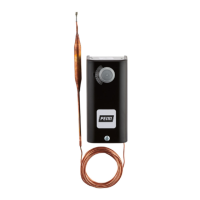
Figure 2: A28 control
Important: Do not dent or deform the sensing
bulb of this control. A dent or deformation will
change the calibration and cause the control to
cycle at a temperature lower than the dial setting.
When the bulb mounting clip is used to mount
the bulb near refrigerant tubing, be sure the sheet
metal screw does not pierce the tubing.
Wiring
Risk of Electrical Shock.
Disconnect the power supply
before mounting and wiring to prevent possible
electrical shock. On multiple circuit units, more
than one circuit may have to be disconnected.
Follow equipment manufacturer’s diagrams if
provided. Wire to conform to local, national, and
regional regulations. Wiring terminals of each
Pennswitch are color coded for convenience and
to simplify wiring. Red is the common terminal;
red to yellow circuit closes on temperature
increase, red to blue circuit opens on temperature
increase. Use copper conductors only.
Use terminal screws furnished (8-32 x 1/4 in.
binder head). Do not substitute screws of a
different size.
Figure 3: Style 1 swaged bulb with support tube
for clamp-on or closed tank applications
Figure 4: Part number FTG13A-600R packing nut
assembly. Use with Style 1 bulb with support tube
for direct immersion applications

Question and Answer IconNeed help?

Do you have a question about the Penn A28 Series and is the answer not in the manual?

Summary

Control Operation

Switch Action Description

Describes the switch action for cooling applications, detailing RY and RB circuit behavior on temperature changes.

Installation and Mounting

General Installation Guidelines

Follow equipment manufacturer's instructions or standard installation procedures.

Mounting Procedures

Details how to mount the control, emphasizing surface mounting and avoiding case twisting.

Wiring Instructions

Provides guidance on wiring, including safety precautions and terminal color coding.

Control Adjustments

Interstage Differential Adjustment

Explains how to adjust interstage differential by rotating the adjusting wheel counterclockwise.

Setpoint and Low Stop Adjustment

Covers adjustment of setpoint via knob/slot and setting the low stop using the stop screw.

Checkout and Repairs

Checkout Procedure

Observe at least three complete operating cycles to ensure correct functioning.

Repairs and Replacement

States that field repairs are not permitted; replacement controls must be obtained from distributors.

Electrical Ratings

Summary

Control Operation

Switch Action Description

Describes the switch action for cooling applications, detailing RY and RB circuit behavior on temperature changes.

Installation and Mounting

General Installation Guidelines

Follow equipment manufacturer's instructions or standard installation procedures.

Mounting Procedures

Details how to mount the control, emphasizing surface mounting and avoiding case twisting.

Wiring Instructions

Provides guidance on wiring, including safety precautions and terminal color coding.

Control Adjustments

Interstage Differential Adjustment

Explains how to adjust interstage differential by rotating the adjusting wheel counterclockwise.

Setpoint and Low Stop Adjustment

Covers adjustment of setpoint via knob/slot and setting the low stop using the stop screw.

Checkout and Repairs

Checkout Procedure

Observe at least three complete operating cycles to ensure correct functioning.

Repairs and Replacement

States that field repairs are not permitted; replacement controls must be obtained from distributors.

Electrical Ratings

Overview

The Penn A28 Series Two-Stage Temperature Controls with NEMA 1 Enclosure are designed for general-purpose operating temperature control in refrigeration, air conditioning, and heating applications. These controls feature two SPDT (Single-Pole Double-Throw) switches that allow for independent control circuits. Each switch can be wired for either "open high" or "close high" action, enabling automatic changeover for heating-cooling or similar applications. Models are available with a narrow differential on each switch and can have either fixed or adjustable interstage differential. A jumper across the "common" terminals is supplied as a standard feature.

Function Description:

The A28 Series controls operate based on temperature changes. For cooling applications, as the temperature increases to the dial setting, the circuit between R (common) and Y (yellow) of the low stage switch closes, and simultaneously, the circuit between R and B (blue) opens. With a further increase in temperature, the high stage switch operates, closing RY (red to yellow) and opening RB (red to blue). The reverse sequence occurs when the temperature falls. The wiring terminals are color-coded for convenience: red is the common terminal, red to yellow closes on temperature increase, and red to blue opens on temperature increase.

Important Technical Specifications:

  • Electrical Ratings (A28AA, A28AB models):
    • Volts, AC: 120, 208, 240, 277
    • Full Load Amp: 16.0 (120V), 9.2 (208V), 8.0 (240V)
    • Locked Rotor Amp: 96.0 (120V), 55.2 (208V), 48.0 (240V)
    • Non-Inductive Amp: 16.0 (120V), 9.2 (208V), 8.0 (240V), 7.2 (277V)
  • Electrical Ratings (A28AJ models):
    • Volts, AC: 120, 208, 240, 277
    • Full Load Amp: 6.0 (120V), 3.4 (208V), 3.0 (240V)
    • Locked Rotor Amp: 36.0 (120V), 20.4 (208V), 18.0 (240V)
    • Non-Inductive Amp: 15.0 (120V), 9.2 (208V), 8.0 (240V), 7.2 (277V)
  • Pilot Duty: 125 VA, 24 to 277 VAC
  • Maximum Connected Load: Not to exceed 2000 VA.
  • Terminal Screws: 8-32 x 1/4 inch binder head.
  • Conductors: Use copper conductors only.

Usage Features:

  • Mounting: Controls are typically mounted to a surface using holes in the back of the case. For rough or uneven mounting surfaces, only the top two mounting holes should be used to prevent twisting of the case, which could affect calibration.
  • Bulb Installation:
    • For closed tank applications without a well assembly, a packing nut assembly (Part FTG13A-600R) can be used. This involves placing parts over the support tube section of the element and placing the bulb in the tank, ensuring the tank is drained below the opening. The 1/2 inch NPT adapter is tightened, and the packing nut is screwed into the adapter with retaining washers and packing.
    • For models supplied with a bulb well, the well is first installed into the tank opening. The bushing is removed from the well, slid over the capillary, and then the bulb and bushing are placed into the well. The bulb should be pushed to the bottom of the well, and the set screw in the adapter's end should be tightened to hold the bulb in position.
    • Caution: Do not dent or deform the sensing bulb, as this will change calibration and cause the control to cycle at a temperature lower than the dial setting. If a bulb mounting clip is used near refrigerant tubing, ensure the sheet metal screw does not pierce the tubing.
  • Adjustments:
    • Interstage Differential: Models with interstage differential can be adjusted by rotating the adjusting wheel counterclockwise to widen the differential (increase spread). A small screwdriver inserted into the serrated wheel is used for this adjustment.
    • Setpoint Adjustment: Setpoint adjustment is available via a knob or screwdriver slot.
    • Convertible Adjustment Models: These models can be changed between concealed screwdriver slot, knob, or external screwdriver slot adjustment. They are supplied with a snap-in plug for concealed screwdriver slot adjustment. Removing the snap-in plug enables exposed screwdriver slot adjustment. Remote bulb models include a bulb mounting clip.
    • Low Stop Adjustment: The low stop is an integral part of the control and can be adjusted by a sliding stop. To set the low stop:
      1. Remove the cover.
      2. Set the dial to the desired temperature.
      3. Loosen the stop screw, slide it to the front of the temperature control against the plastic step behind the dial, and tighten the screw. If an exact setting is not possible, set it to the closest step corresponding to the required dial setting.
      4. Replace the cover.
  • Wiring: Follow equipment manufacturer's diagrams and conform to local, national, and regional regulations.

Maintenance Features:

  • Safety Precautions: Always disconnect the power supply before mounting or wiring to prevent electrical shock. For multiple circuit units, more than one circuit may need to be disconnected. In closed tank applications, relieve any system pressure before loosening or attempting to replace an existing bulb well.
  • System Integration: A28 Series controls are intended for normal operating conditions. If failure or malfunction could lead to personal injury or equipment damage, other safety devices (limit controls, alarm systems) must be incorporated and maintained as part of the control system.
  • Checkout Procedure: After installation, observe at least three complete operating cycles to ensure all components are functioning correctly.
  • Repairs and Replacement: Field repairs are not to be made. For a replacement control, contact the nearest Johnson Controls distributor.

Penn A28 Series Specifications

General IconGeneral
BrandPenn
ModelA28 Series
CategoryControl Systems
LanguageEnglish

Related product manuals