GUIDELINES FOR SELECTING
THE IDEAL PENTAX BINOCULAR
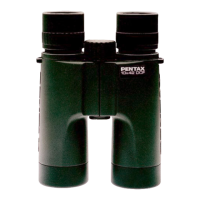
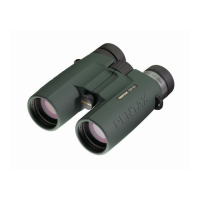
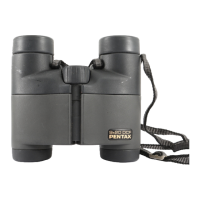
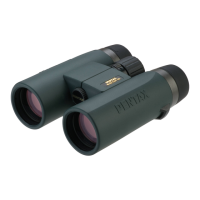
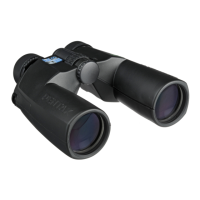
PCF WP II SERIES
The following are several important guidelines to
help you select the pair of binoculars that best suit
your requirements.
Roof Prism vs. Porro-Prism
Both roof and porro-prism optics are designed to
turn the image upside down — from an inverted
image to an erect image — by incorporating convex
optical elements in their objective and eyepiece
lenses. However, each design has some definite
advantages.
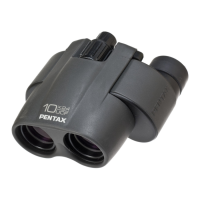
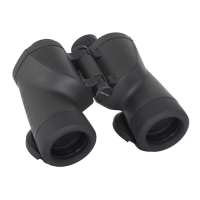
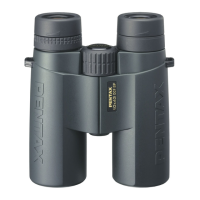
Featuring a straight-line axis and high-precision
optics, the roof prism design is better equipped for
specialized applications. At the same magnification,
it also allows for a more compact, streamlined body
for enhanced maneuverability and portability.
On the other hand, the porro-prism design combines
time-honored optics and solid viewing performance
with a familiar, functional styling. It is customarily
employed in popular, multi-purpose models.
Magnification
The term “magnification” refers to the degree
at which your subject appears larger through
binoculars than with the naked eye. At eight-times
magnication, for instance, a subject standing at
800 yards away appears as if it were standing at a
distance of 100 yards. Objective lenses being the
same, the greater the magnification, the less bright
the image and the narrower the angle of view. Since
high-magnification models also increase the risk of
binocular shake, use of a tripod is recommended for
these models. If your application involves occasional
high-magnification viewing, a zoom model may be a
good option.
Image Brightness
When you hold your binoculars at one foot away
from your eye, you will see a bright spot, or “exit
pupil,” in the middle of the eyepiece lens. The
larger the diameter of the exit pupil, the brighter the
image field. As a simple guide, a diameter of three
millimeters assures comfortable daytime viewing,
while that of five to seven millimeters is required for
astronomical observation.
The exit pupil can be easily calculated by dividing
the effective aperture of the objective lens by the
magnification, while the relative brightness can be
obtained by squaring the exit pupil. For the same
magnification, binoculars with a larger exit pupil
offer a brighter image field and are better equipped
for observations under poor lighting conditions at
dawn or dusk.
Angle of View
Expressed in degrees, the term “angle of view”
is a grade for the image field that can be seen
without moving the binoculars. The greater the
magnification, the narrower the angle of view.
So binoculars with a greater angle of view are
recommended for observation of fast-action sports
and active subjects, while a pair with a greater
magnification is better suited for observation of
subjects at great distance.
If the subject is at a distance of 1,000 yards for
instance, binoculars with a five-degree angle of view
offer a circular image eld of 87 yards in diameter.



 To Next Page
 Loading...