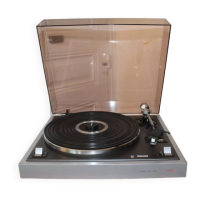
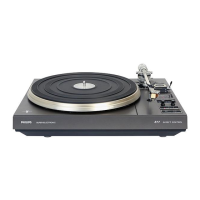
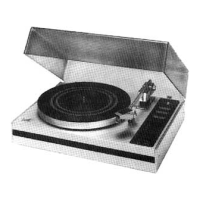
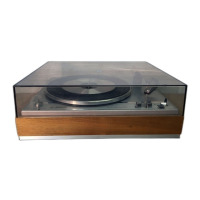
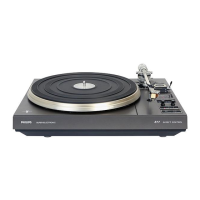
This document is a service manual for the Philips Hi-Fi record player 22GC037/00. It provides detailed information for servicing and maintaining the device, including exploded views, parts lists, and adjustment procedures.
Function Description:
The 22GC037/00 is a Hi-Fi record player designed for playing vinyl records at two standard speeds: 33 and 45 RPM. It features a belt-drive system, which is evident from the exploded view showing the motor, belt, and turntable. The device includes an automatic stop mechanism, which halts the turntable rotation at the end of a record, preventing unnecessary wear on the stylus and record. The manual also details the adjustment procedure for this automatic stop function, ensuring precise operation. The tonearm is equipped with a lift mechanism, allowing for manual cueing and protecting the stylus from accidental drops onto the record surface. The "FREE RUNNING PU ARM" section describes how to adjust the tonearm's freedom of movement, which is crucial for optimal tracking and sound quality. The record player is designed to operate on various AC voltages (110-127V, 220-240V) at both 50Hz and 60Hz frequencies, consuming 5W of power, making it adaptable to different regions.
Important Technical Specifications:
- Model: 22GC037/00 Hi-Fi record player
- Speeds: 33/45 RPM
- Power Supply: 110-127V / 220-240V AC, 50-60Hz
- Power Consumption: 5W
- Wow and Flutter (Pleurage et Scintillement): ≤ 1.8%
- Rumble (Ronronnement):
- DIN. A: ≤ -35 dB
- DIN. B: ≤ -55 dB
- Mechanical Noise (Bruit Mécanique): ≤ 33 dB
- Dimensions: 385 x 315 mm
- Stylus Compatibility: The manual references several stylus types (22GP400, 22GP401, 22GP412, 22GP422), indicating flexibility in stylus replacement.
- Capacitors: Specific capacitors are listed with their part numbers, values, and voltage ratings:
- C601: 4700 pF ± 20%, 400 V (4822 122 10113)
- C602 (50 Hz): 0.22 µF ± 10%, 400 V (4822 121 40181)
- C602 (60 Hz): 0.18 µF ± 10%, 400 V (4822 121 40011)
Usage Features:
The record player is designed for straightforward operation. The front panel likely features a "START/MARCH" button to initiate playback and a "STOP/ARRET" button to halt it. The speed selection (33/45 RPM) is controlled by a switch, as indicated by the "33/45" label. The tonearm includes a lift mechanism, allowing users to manually raise and lower the stylus onto the record, providing precise control over playback initiation. The automatic stop feature enhances user convenience by preventing the stylus from continuously running in the end groove. The "KNOB 72 POSITION 'OFF'" suggests a control knob for specific functions, possibly related to power or mode selection. The "BOWDEN CABLE" references indicate mechanical linkages for various controls, ensuring smooth and reliable operation.
Maintenance Features:
The service manual is primarily a maintenance and repair guide. It includes:
- Exploded View (Fig. 1): A comprehensive diagram showing all components and their assembly, with part numbers for easy identification. This is crucial for disassembling, repairing, and reassembling the unit.
- Parts List: A detailed list of all components with their Philips part numbers, facilitating ordering and replacement. This list covers mechanical parts, electrical components, and accessories.
- Turntable Height Adjustment (Fig. 2): Instructions for adjusting the turntable's height, which can be important for maintaining proper tonearm geometry and tracking.
- Automatic Stop Adjustment (Fig. 3): A step-by-step guide for calibrating the automatic stop mechanism, ensuring it activates at the correct position on the record. This involves adjusting a screw (118) to fine-tune the lift piece (138).
- Bowden Cable Adjustment (Fig. 4, 5): Diagrams illustrating the routing and adjustment of Bowden cables, which are used for mechanical linkages, likely for speed change or tonearm lift mechanisms.
- Lift Manual Adjustment (Fig. 6): Instructions for adjusting the manual tonearm lift, ensuring it raises and lowers the tonearm smoothly and to the correct height.
- Free Running PU Arm Adjustment (Fig. 7): A critical procedure for setting the tonearm's freedom of movement, which directly impacts tracking ability and sound quality. This involves adjusting a screw (118) to achieve the desired arm behavior.
- Wiring Diagrams (Fig. 8, 9): Electrical schematics for the power supply (Fig. 8) and the PU shell/muting switch (Fig. 9), essential for diagnosing electrical faults and ensuring correct wiring during repairs.
- Safety Regulations: The manual emphasizes adherence to safety regulations, requiring that the device be restored to its original condition using identical specified parts. This ensures both operational safety and performance integrity.
- Multilingual Instructions: The manual provides instructions in multiple languages (GB, NL, F, D, I, S, DK, N, SF), making it accessible to a wider range of service technicians.

 Need help?

 To Next Page
 General