Need help?
Do you have a question about the Philips DVP3260/05/12 and is the answer not in the manual?
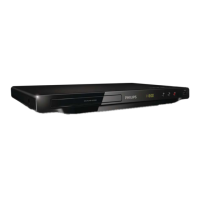
This document serves as a comprehensive Service Manual for a range of Philips DVD Players, specifically designed for an "Exchange" scenario, implying that it primarily focuses on procedures relevant to the replacement or basic servicing of units rather than in-depth component-level repair. The manual covers several models including DVP3260, DVP3264, DVP3252, DVP5990, DVP3266K, and DVP5996K, with various regional and generation specificities (e.g., /05, /12, /51, /75, Second Generation).
The core function of these devices is to play DVDs, providing entertainment through video and audio playback. As DVD players, they are designed to read optical discs containing digital video and audio data, decode this information, and output it to a display device (like a television) and an audio system. The manual implicitly refers to standard DVD player operations, such as disc insertion, playback control, and interaction via a remote control. The presence of "Second Generation" models suggests continuous product development, likely incorporating minor enhancements or revisions over time, though the fundamental playback functionality remains consistent across the listed models. The manual's focus on service procedures rather than user operation details confirms the device's primary role as a consumer electronics product for media consumption.
While this is a service manual, it touches upon certain usage features indirectly through the context of maintenance and software upgrades. The device operates with a disc tray mechanism, which is a common feature in DVD players for loading and ejecting discs. The mention of a "guider" for manual disc removal indicates a physical mechanism for disc handling. User interaction is primarily through a remote control, as evidenced by instructions to "press
The manual is primarily a maintenance document, outlining specific procedures for servicing the DVD players. A key maintenance feature described is the manual removal of a CD from the tray. This procedure is crucial for situations where the disc tray fails to open electronically, preventing a disc from being stuck inside the device. It involves powering off the unit and gently pushing a "guider" to manually release the tray. This indicates a mechanical override for disc ejection, a thoughtful design for user and service convenience in case of electronic malfunction.
Another significant maintenance feature is the software upgrade process. This allows for updating the device's internal firmware, which is essential for addressing software-related issues, improving performance, or ensuring compatibility with new media formats or standards. The process involves:
A critical caution is provided regarding the software upgrade: "The set must not be power off during upgrading, Otherwise the Main board will be damaged entirely." This emphasizes the sensitivity of the firmware update process and the potential for irreversible damage if interrupted, underscoring the importance of following the procedure carefully.
The manual also includes an Accessories Spare Parts List, which is a crucial maintenance feature for service personnel. It lists the 12NC (12-digit Philips internal part number) and a description for various remote controls and AV cables compatible with the different DVD player models. This facilitates the identification and ordering of correct replacement parts, ensuring that the device can be maintained with genuine and compatible accessories. The detailed listing for remote controls, differentiating by model and generation (e.g., "Remote control for DVP3260/05/12, DVP3264/12, DVP3260/05/12(Second Generation) and DVP3264/12 (Second Generation)"), indicates a modular approach to accessories, allowing for targeted replacements.
Finally, the Revision List section of the manual itself serves as a maintenance feature for the documentation. It tracks changes and additions to the service manual over different versions (e.g., Version 1.0 to 1.4). This ensures that service personnel are always using the most up-to-date information, including newly added models, updated accessory lists, and potentially revised procedures. For instance, "Adding DVP3252/51" or "Update Accessory Spare Part List" entries in the revision history directly support ongoing maintenance efforts by keeping the documentation current with product line expansions and parts availability. The mention of "OPU type: IM" for certain models in Version 1.4 suggests that the manual also tracks internal component variations, which can be critical for specific repair or replacement tasks, although the details of OPU (Optical Pickup Unit) types are not elaborated in this excerpt.
 General
| Type | DVD Player |
|---|---|
| Video D/A Converter | 12 bit / 108 MHz |
| Audio D/A Converter | 24 bit / 192 kHz |
| Still Picture Playback | Yes |
| Progressive Scan | Yes |
| Screen Fit Adjustments | Yes |
| Parental Control | Yes |
| USB Port | Yes |
| Video Formats | MPEG-2, DivX |
| Audio Formats | MP3, WMA |
| Disc Formats | DVD, CD, CD-R, CD-RW |
| Connectivity | Composite video output |
| Dimensions | 360 x 220 x 45 mm |
| Playback Media | DVD, CD, USB |
| Compression formats | MPEG-2, MPEG-4, DivX |
| Power Supply | 220-240V, 50/60 Hz |


 To Next Page