EasyManua.ls Logo

Philips PM 6671 - Practical Measurements: Count, Ratio, and Time; Count Measurement Procedures; Ratio Measurement Procedures; Time Interval Measurement Procedures

Philips PM 6671
21 pages
Print Icon
To Next Page IconTo Next Page
To Previous Page IconTo Previous Page
Loading...
19
Count
measurements
There
are
three
different
count
modes:
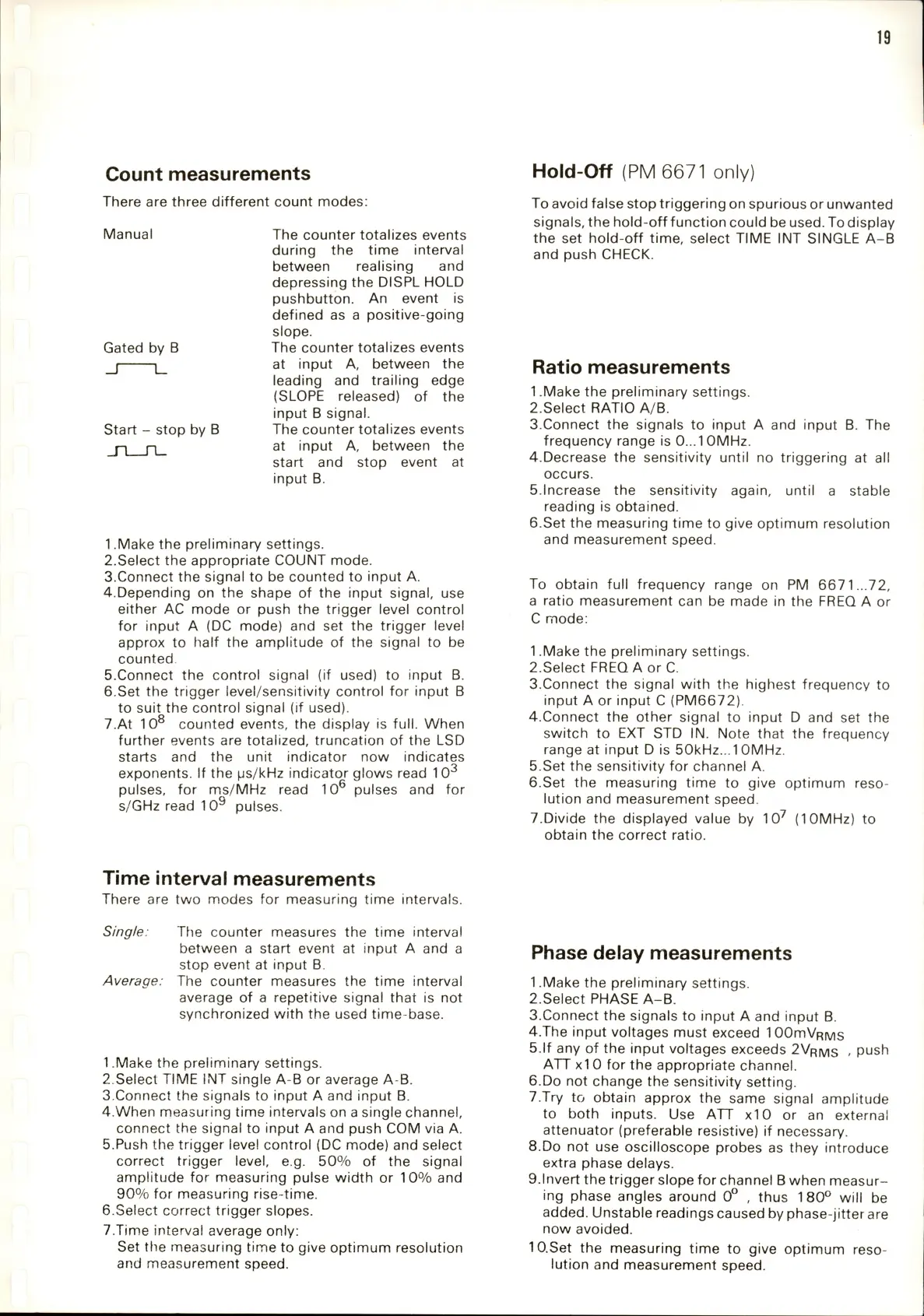
Manual
Gated
by
B
_J
L_
Start
-
stop
by
B
The
counter
totalizes
events
during
the
time
interval
between
realising
and
depressing
the
DISPL
HOLD
pushbutton.
An
event
is
defined
as
a
positive-going
slope.
The
counter
totalizes
events
at
input
A,
between
the
leading
and
trailing
edge
(SLOPE
released)
of
the
input
B
signal.
The
counter
totalizes
events
at
input
A,
between
the
start
and
stop
event
at
input
B.
1
.Make
the
preliminary
settings.
2.Select
the
appropriate
COUNT
mode.
3.Connect
the
signal
to
be
counted
to
input
A.
4.Depending
on
the
shape
of
the
input
signal,
use
either
AC
mode
or
push
the
trigger
level
control
for
input
A
(DC
mode)
and
set
the
trigger
level
approx
to
half
the
amplitude
of
the
signal
to
be
counted.
5.Connect
the
control
signal
(if
used)
to
input
B.
6.Set
the
trigger
level/sensitivity
control
for
input
B
to
suit
the
control
signal
(if
used).
7.At
10®
counted
events,
the
display
is
full.
When
further
events
are
totalized,
truncation
of
the
LSD
starts
and
the
unit
indicator
now
indicates
exponents.
If
the
ps/kHz
indicator
glows
read
10®
pulses,
for
ms/MHz
read
10®
pulses
and
for
s/GHz
read
10®
pulses.
Hold-Off
(PM
6671
only)
To
avoid
false
stop
triggering
on
spurious
or
unwanted
signals,
the
hold-off
function
could
be
used.
To
display
the
set
hold-off
time,
select
TIME
INT
SINGLE
A-B
and
push
CHECK.
Ratio
measurements
1
.Make
the
preliminary
settings.
2.Select
RATIO
A/B.
3.Connect
the
signals
to
input
A
and
input
B.
The
frequency
range
is
0...1
OMHz.
4.Decrease
the
sensitivity
until
no
triggering
at
all
occurs.
5.Increase
the
sensitivity
again,
until
a
stable
reading
is
obtained.
6.Set
the
measuring
time
to
give
optimum
resolution
and
measurement
speed.
To
obtain
full
frequency
range
on
PM
6671...72,
a
ratio
measurement
can
be
made
in
the
FREQ
A
or
C
mode:
1
.Make
the
preliminary
settings.
2.Select
FREQ
A
or
C.
3.Connect
the
signal
with
the
highest
frequency
to
input
A
or
input
C
(PM6672).
4.Connect
the
other
signal
to
input
D
and
set
the
switch
to
EXT
STD
IN.
Note
that
the
frequency
range
at
input
D
is
50kHz...10MHz.
5.Set
the
sensitivity
for
channel
A.
6.Set
the
measuring
time
to
give
optimum
reso
lution
and
measurement
speed.
7.Divide
the
displayed
value
by
10^
(10MHz)
to
obtain
the
correct
ratio.
Time
Interval
measurements
There
are
two
modes
for
measuring
time
intervals.
Single:
The
counter
measures
the
time
interval
between
a
start
event
at
input
A
and
a
stop
event
at
input
B.
Average:
The
counter
measures
the
time
interval
average
of
a
repetitive
signal
that
is
not
synchronized
with
the
used
time-base.
I.Make
the
preliminary
settings.
2.Select
TIME
INT
single
A-B
or
average
A-B.
3.Connect
the
signals
to
input
A
and
input
B.
4.When
measuring
time
intervals
on
a
single
channel,
connect
the
signal
to
input
A
and
push
COM
via
A.
5.Push
the
trigger
level
control
(DC
mode)
and
select
correct
trigger
level,
e.g.
50%
of
the
signal
amplitude
for
measuring
pulse
width
or
10%
and
90%
for
measuring
rise-time.
6.Select
correct
trigger
slopes.
7.Time
interval
average
only:
Set
the
measuring
time
to
give
optimum
resolution
and
measurement
speed.
Phase
delay
measurements
1
.Make
the
preliminary
settings.
2.Select
PHASE
A-B.
3.Connect
the
signals
to
input
A
and
input
B.
4.The
input
voltages
must
exceed
lOOmVRMS
5.If
any
of
the
input
voltages
exceeds
.
Push
ATT
x10
for
the
appropriate
channel.
6.Do
not
change
the
sensitivity
setting.
7.Try
to
obtain
approx
the
same
signal
amplitude
to
both
inputs.
Use
ATT
xlO
or
an
external
attenuator
(preferable
resistive)
if
necessary.
8.Do
not
use
oscilloscope
probes
as
they
introduce
extra
phase
delays.
9.Invert
the
trigger
slope
for
channel
B
when
measur
ing
phase
angles
around
,
thus
180°
will
be
added.
Unstable
readings
caused
by
phase-jitter
are
now
avoided.
lO.Set
the
measuring
time
to
give
optimum
reso
lution
and
measurement
speed.

Related product manuals