Chapter 1
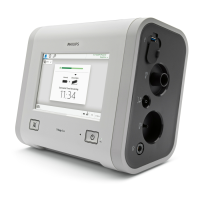
1-2 Respironics V60 Ventilator User Manual 1047358 Rev N
Warnings, cautions, and notes
WARNING: To reduce the risk of CO
2
rebreathing, make sure EPAP pressures and
exhalation times are sufficient to clear all exhaled gas through the
exhalation port. In noninvasive ventilation continuous air flow through the
port flushes exhaled gases from the circuit. The ability to completely
exhaust exhaled gas from the circuit depends on the EPAP setting and I:E
ratio. Higher tidal volumes further increase the volume of CO
2
rebreathed
by the patient.
WARNING: To reduce the risk of CO
2
rebreathing, monitor the patient for changes in
respiratory status at the start of ventilation and with each change in
ventilator settings, circuit configuration, or patient condition. Pay
attention to ventilator alarms that warn of increased CO
2
rebreathing risk.
WARNING: To ensure accuracy of oxygen administration and to monitor for the
presence of contamination (incorrect gas connected), use an external
oxygen monitor to verify the oxygen concentration in the delivered gas.
WARNING: To reduce the risk of fire, use the ventilator in well-ventilated areas away
from flammable anesthetics. Do not use in a hyperbaric chamber or other
similarly oxygen-enriched environments. Do not use near an open flame.
WARNING: To reduce the risk of electric shock from liquid entering the device, do
not put a container filled with a liquid on the ventilator.
WARNING: To reduce patient risk of oxygen toxicity, keep free-flowing oxygen away
from air inlet of ventilator.
WARNING: The nurse call/remote alarm should be considered a backup to the
ventilator’s primary alarm system.
WARNING: To ensure that the alarm will be heard, make sure the alarm loudness is
adequate and avoid blocking the alarm speakers beneath the ventilator.
WARNING: Do not leave the ventilator unattended when stationed on an incline.
WARNING: The V60 ventilator may cause radio interference or may disrupt the
operation of nearby equipment. It may be necessary to take mitigation
measures, such as re-orienting or relocating the ventilator or shielding
the location.
WARNING: Use of non-approved accessories, transducers or cables may increase
EMC emissions or decrease the EMC immunity performance of the
equipment.
CAUTION: Federal law (USA) restricts this device to sale by or on the order of a
physician.
CAUTION: The Respironics V60 Ventilator is designed to operate in the
temperature range of 5 to 40 ºC (41 to 104 ºF). To minimize the risk
of overheating the device, do not operate adjacent to heaters or other
heat sources.
NOTE: The displays shown in this manual may not exactly match what you
see on your own ventilator.
NOTE: Pressures are indicated on the ventilator in cmH
2
O. Millibars and
hectopascals (hPa) are used by some institutions instead. Since
1 millibar equals 1 hPa, which equals 1.016 cmH
2
O, the units may
be used interchangeably.



 To Next Page
 Loading...