Chapter 3
3-2 Respironics V60 Ventilator User Manual 1047358 Rev N
General information
Potential side effects Advise the patient to immediately report any unusual chest discomfort,
shortness of breath, or severe headache. Other potential side effects of
noninvasive positive pressure ventilation include: ear discomfort,
conjunctivitis, skin abrasions due to mask/patient interface, and gastric
distention (aerophagia). If skin irritation or breakdown develops from the use of
the mask, refer to the accompanying mask instructions for appropriate action.
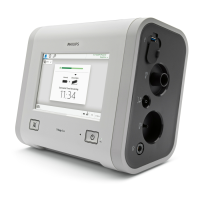
General description The Respironics V60 Ventilator (Figure 3-1) is a microprocessor-controlled,
bilevel positive airway pressure (BiPAP) ventilatory assist system that provides
noninvasive positive pressure ventilation (NPPV) and invasive ventilatory
support for spontaneously breathing adult and pediatric patients.
Figure 3-1: Respironics V60 Ventilator
Ventilation modes. The ventilator offers a range of conventional pressure
modes, CPAP (continuous positive airway pressure), PCV (pressure-controlled
ventilation), and S/T (spontaneous/timed). The volume-targeted AVAPS
(average volume-assured pressure support) mode combines the attributes of
pressure-controlled and volume-targeted ventilation. The optional PPV mode
provides pressure ventilation in proportion to the patient’s efforts.
Auto-Trak Sensitivity allows the ventilator to automatically compensate for
intentional and unintentional leaks by maintaining a stable baseline and
adjusting trigger and cycle thresholds for optimum patient-to-ventilator
synchrony. The optional Auto-Trak+ feature lets you further adjust the level of
Auto-Trak Sensitivity.
User interface. The ventilator’s ergonomic design, including a 12.1-inch (31-
cm) color touchscreen, a navigation ring, and key panel, lets you easily access
ventilator settings and monitored parameters.
Monitoring. The ventilator displays monitored parameters as numbers and as
real-time waveforms (curves or scalars).



 To Next Page
 Loading...