High voltage risks
Never touch any electrical conductors to avoid electrical shock.
Never work on live (energized) electrical equipment.
When working around a battery, do not allow tools to bridge the battery terminals, or short
circuit any part of the battery.
Use only tools with insulated handles.
Operation of this device may produce a high voltage which could cause severe injuries or death
in case of improper installation or operation of the device.
PV modules can generate high DC voltages!
Mains and charging current risks
Make sure the cables are always connected to the correct terminal. An electrical shock can
be lethal. In general, any electric shock can be dangerous to your health.
CE labeling
The product is CE compliant.
Major Functions
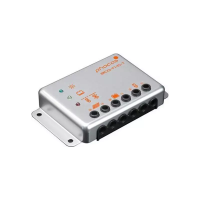
Individual MPS units can be used as charge controller or load-controlling switch. A single
MPS unit can be used as an independent device within off-grid battery charging systems
for lead acid batteries. Also, multiple MPS units can operate within the same battery-based
system with the help of optional accessory MCU for more complex system designs.
MPS can be used to perform one of several tasks:
DC Load Control:
1. Load switch, positive/negative grounded
Battery Charge Control:
2. Panel switch, positive/negative grounded
3. Diversion load switch for battery charging via wind/hydro inputs. Diverts current from
wind/hydro inputs to a dump load resistor when battery is fully charged.
To construct systems using multiple MPS units, MPS has the ability to communicate with
Phocos' Modular Central Unit (MCU) in order to exchange system information, to program
and to receive all necessary system settings (see MCU manual).
There are two available MPS versions: MPS45 and MPS80.
The MPS controller automatically detects the nominal system voltage when connected to
a 12 V, 24 V or 48 V battery bank.
The MPS has a number of safety and display functions.
25
EN


 To Next Page
 Loading...