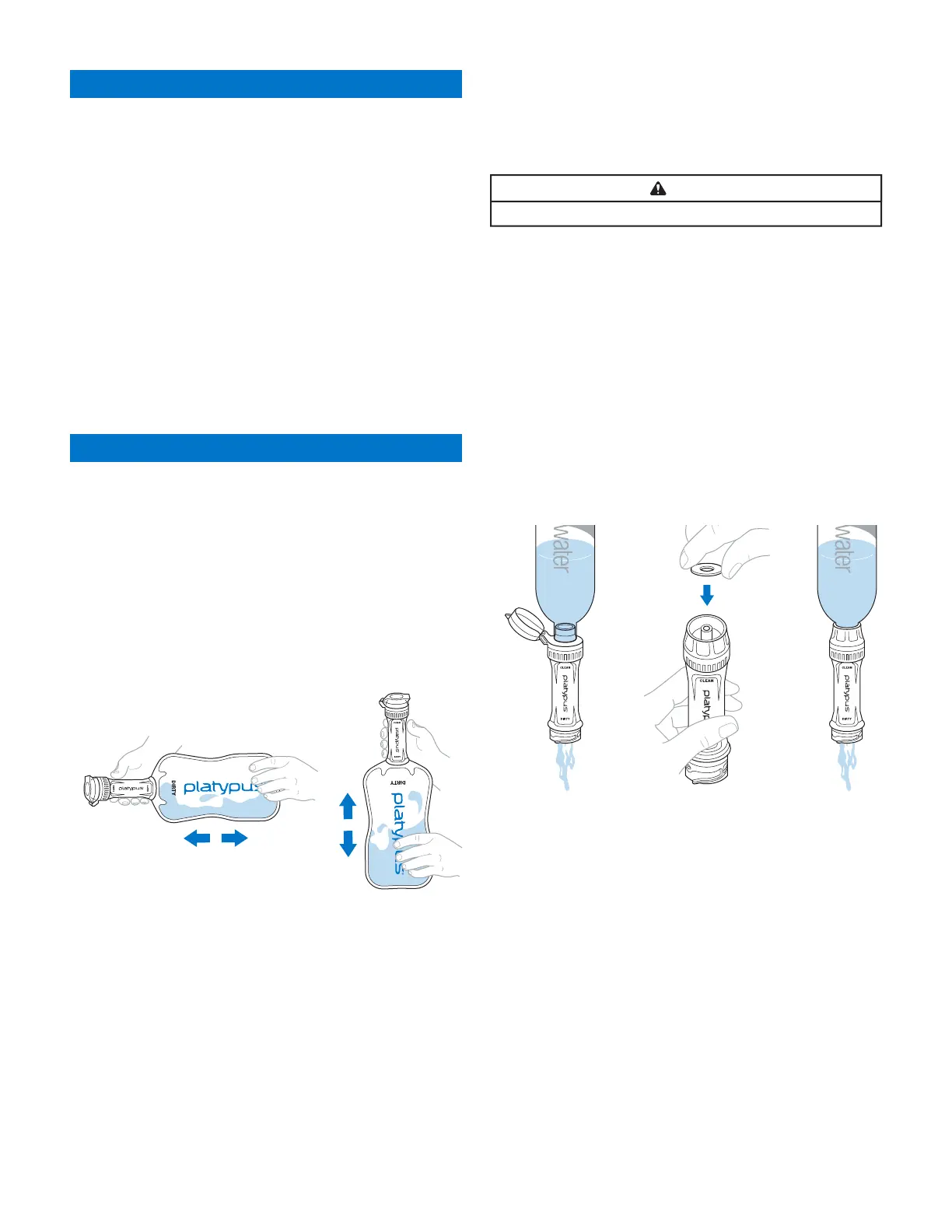
(Fig. 8a)
(Fig. 8b)
(Fig. 10b)
(Fig. 9) (Fig. 10a)
CLEANING THE FILTER
The best cleaning method is prevention. Proactively cleaning the filter will prolong its life
and keep it flowing fast. The frequency of cleaning depends on the water quality, but good
cleaning habits will make a difference in the long run.
▪ Perform a quick shake-to-clean before each fill up.
▪ Backflush after approx. every 10L filtered.
Shake-to-Clean
The shake-to-clean method is the quickest way to clean the filter. It works by dislodging
particulates stuck on the hollow fibers, particularly at the entrance on the Dirty side.
1. Fill your Dirty bottle or reservoir with 1/2L of water.
2. Holding the filter and reservoir horizontally, shake vigorously for 15 seconds. (Fig.
8a) Then, hold them vertically so the filter is above the reservoir and shake vigorously
for 15 seconds. (Fig. 8b)
3. Unscrew the filter and empty dirty reservoir or bottle. Refill and resume filtering.
Backflushing
Backflushing is the most effective way to clean the filter. Backflushing requires clean
water in your Clean reservoir or bottle and is done by reversing your system’s direction of
flow to send clean water back through your filter to purge the particulates clogging the
hollow fibers.
▪ Backflush at least 1/2L of water or until water runs clear out of the Dirty side.
AIR MANAGEMENT
WARNING
Only backflush with a dedicated Clean bottle or reservoir to avoid cross-contamination.
Backflushing with the DrinkCap (Fig. 9)
1. Press the spout of the DrinkCap into a Clean narrow-mouth bottle filled with at least
1/2L of clean water to create a seal.
2. Squeeze the bottle and backflush at least 1/2L of water or until water runs clear out of
the Dirty side.
Backflushing with the ConnectCap (Fig. 10b)
Note: This method requires the backflush washer.
1. If necessary, remove the ConnectCap cover. Press the backflush washer into the
ConnectCap to block the vents and prevent leaking. (Fig. 10a)
2. Screw on a Clean narrow-mouth bottle filled with at least 1/2L of clean water.
3. Squeeze the bottle and backflush at least 1/2L of water or until water runs clear out of
the Dirty side.
4. Remove washer from ConnectCap by tipping the filter over and shaking it out.
Tip: Take care not to lose the backflush washer—store it somewhere safe, like your first
aid kit.
Air is one of the primary causes of a clogged filter or slow filtration rates. Properly
managing air will help maintain the best performance.
Wetting Out the Filter
Wetting out the filter is the process of purging air from the hollow fibers and replacing it
with water. Air and water cannot occupy the same space, and trapped air will slow flow
rates. The amount of water that it takes to properly wet out the filter is typically 1L,
though up to 4L may be needed.
Air & the Integrity Check
When intact and wetted out, the QuickDraw’s hollow fibers will not let air pass through
from the Dirty side to the Clean side. The integrity check is the attempt to force air
through the hollow fibers from the Dirty side to the Clean side. A steady stream of bubbles
means air is passing through and indicates broken fibers. Note that air can enter the
clean side of intact fibers. When performing an integrity check, do not mistake purging a
small amount of air as a ‘steady stream of bubbles’. Wetting out the filter before an
integrity check is a good practice to avoid uncertainty.
Air & Hard-Sided Clean Bottles
An empty hard-sided bottle like a Nalgene® is full of air. In a sealed system, this air
needs to be able to escape for water to flow into the bottle. To make filtering into
hard-sided bottles possible, the ConnectCap and bottle adapter were designed with vents
to allow air to escape.


 To Next Page
 Loading...