EasyManua.ls Logo

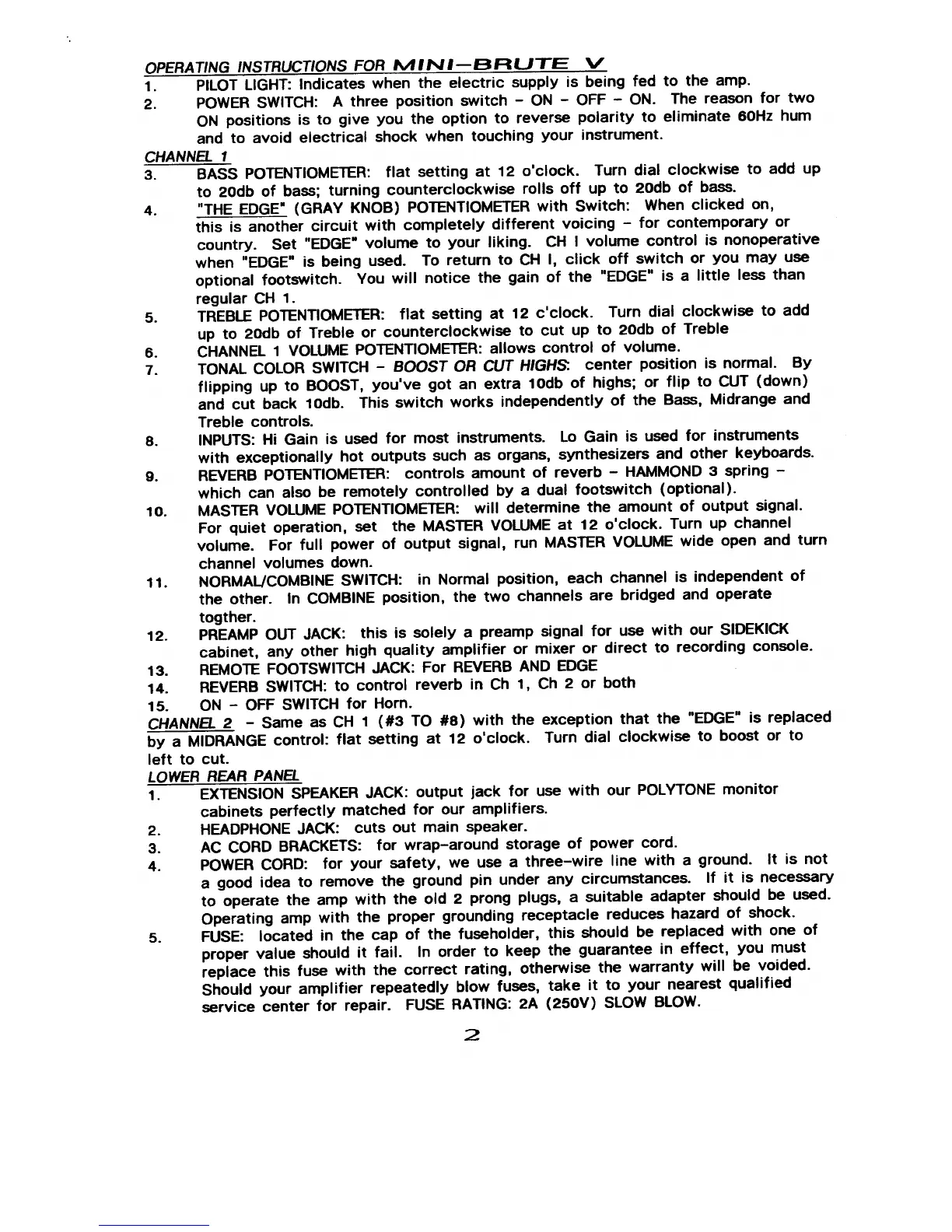
Polytone MINI-BRUTE V - Operating Instructions for Mini-Brute V; Pilot Light and Power Switch; Channel 1 Controls Overview; The Edge Control and Voicing

Default Icon
2 pages
Print Icon
To Previous Page IconTo Previous Page
Loading...
OPERAI'NG
'NSIRUCT'ONS
FOR
I\/''NI-EIFITJTE
V
micateswhenthee|ectricsupp|yisbeingfedtotheamp.
2.
POWER
SWITCH:
A
three
position
suritch
-
ON
-
OFF
-
ON.
The
reason
for
two
ON
positions
is to
give
you
the option
to reverse
polarity
to
eliminate
6OHz
hum
and
to avoid
electrical
shock
when
touching
your
instrument.
CHANNEI-
'
s.
BASS
POTENTIOMETER:
flat
setting
at
12
o'clock.
Turn
dial
clockwise
to
add up
to zodb
of
bass;
turning
counterclockwise
rolls
off up
to 2odb
of bass.
4.
.THE
EDGE.
(GRAY
KNOB)
POTENTIOMETER
with Switch:
when
clicked
on,
this
is
another
circuit
with
completely
different
voicing
-
for
contemporary
or
country.
set
"EDGE"
volume
to
your
liking.
cH
I
volume
control
is
nonoperative
when
"EDGE"
is
being
used.
To
return
to
cH
l,
click
off switch
or
you
may
use
optional
footsl/itch.
You
will
notice
the
gain
of
the
"EDGE"
is
a
little
less than
regular CH
1.
5.
TRTBLE
pOTENTIOMETER:
flat
setting
at
12
c'clock.
Turn
dial
clockwise
to add
up
to
2gdb
of
Treble
or
counterclockwise
to
cut
up
to Zodb
of
Treble
6.
CHANNEL
1 VOLUME
POTENTIOMETER:
AIIOWS
CONTTOI
Of VOIUME.
7.
TONAL
COLOR
SWTTCH
-
BOOST OR
A)T
H,GHS
center
position
is normal.
Bv
flipping
up
to
BOOST,
you've got
an extra
lOdb
of
highs;
or
flip
to
CUT
(down)
and
cut
back
1Odb.
This
switch
works
independently
of the
Bass,
Midrange
and
Treble
controls.
8.
INpUTS:
Hi Gain
is used
for
most
instruments.
Lo Gain
is
used
for
instruments
with
exceptionally
hot
outputs
such
as
organs,
synthesizers
and
other
keyboards.
9.
REVERB
POTENTIOMETER:
controls
amount
of reverb
-
HAMMOND
3 spring
-
which
can
also
be
remotely
controlled
by
a dual
footswitch
(optional).
10.
MASTER
VOLUME
POTENTIOMETER:
will determine
the
amount
of
output
signal.
For
quiet
operation,
set
the MASTER
VOLUME
at 12
o'clock.
Turn
up
channel
volume.
For
full
power
of output
signal,
run
MASTER
VOLUME
wide
open and
turn
channel
volumes
down.
11.
NORMAUCOMBINE
SWITCH:
in Normal
position,
each
channel
is
independent
of
the
other.
In
coMBlNE
position,
the two
channels
are
bridged
and
operate
togther.
12.
pREAMp
OUT
JACK:
this is
solely
a
preamp
signal
for
use
with
our SIDEKICK
cabinet,
any
other
high
quality
amplifier
or
mixer
or
direct
to
recording
console.
13.
REMOTE
FOOTSWITCH
JACK:
FOT
REVERB
AND
EDGE
14.
REVERB
SWITCH:
to
control
reverb
in
Ch
1,
Ch
2
or both
15.
ON
-
OFF
SWITCH
for
Horn-
1HANNH-
2
-
Same
as
CH
1
(#3
TO
#8)
with
the
exception
that
the
"EDGE"
is replaced
h,,/
a
MIDRANGE
control:
flat
setting
at 12
o'clock.
Turn
dial
clockwise
to
boost
or to
left
to
cut-
LOWER
REAR
PANFI
1.
EXTENSTON
SPEAKER
JACK:
output
jack
for
use
with
our
POLYTONE
monitor
cabinets
Perfectly
matched
for our
amplifiers.
2.
HEADPHONE
JACK:
cuts
out
main
speaker.
3.
AC CORD
BRACKETS:
for
wrap-around
storage
of
power
cord.
4.
pOWER
CORD:
for
your
safety,
we use
a
three-wire
line
with
a
ground-
lt
is not
a
good
idea
to
remove
the
ground
pin
under
any
circumstances.
lf it
is necessary
to
operate
the
amp
with
the old
2
prong
plugs,
a suitable
adapter
should
be used-
Operating
amp
with
the
proper
grounding
receptacle
reduces
hazard
of shock-
5.
FUSE:
located
in
the
cap
of thi
fuseholder,
this
strould
be
replaced
with
one
of
proper
value
should
it
fail.
In order
to
keep
the
guarantee in
effect,
you
must
repiace
this
fuse
with
the correct
rating,
otherwise
the
warranty
will
be
voided.
Should
your
amplifier
repeatedly
blow
fuses,
take
it to
your
nearest
qualified
service
center
for
repair.
FUSE
RATING:
2A
(25OV)
SLOW
BLOW.
2

Related product manuals