2
T
o
d
i
s
c
o
n
n
e
c
t
a
p
r
o
b
e
f
r
o
m
a
b
o
d
y
,
p
o
w
e
r
-
d
o
w
n
t
h
e
i
n
s
t
r
u
m
e
n
t
a
n
d
s
l
i
d
e
t
h
e
p
l
a
s
t
i
c
p
r
o
b
e
c
o
n
n
e
c
t
o
r
h
o
r
i
z
o
n
t
a
l
l
y
(
i
n
t
h
e
d
i
r
e
c
t
i
o
n
o
f
t
h
e
a
r
r
o
w
)
a
w
a
y
f
r
o
m
t
h
e
b
o
d
y
.
R
e
v
e
r
s
e
t
h
e
s
e
s
t
e
p
s
t
o
a
t
t
a
c
h
a
n
e
w
p
r
o
b
e
.
W
h
e
n
p
o
w
e
r
e
d
-
u
p
t
h
e
P
o
s
i
T
e
c
t
o
r
a
u
t
o
m
a
t
i
c
a
l
l
y
d
e
t
e
r
m
i
n
e
s
w
h
a
t
t
y
p
e
o
f
p
r
o
b
e
i
s
a
t
t
a
c
h
e
d
a
n
d
d
o
e
s
a
s
e
l
f
-
c
h
e
c
k
.
Probes
Probes
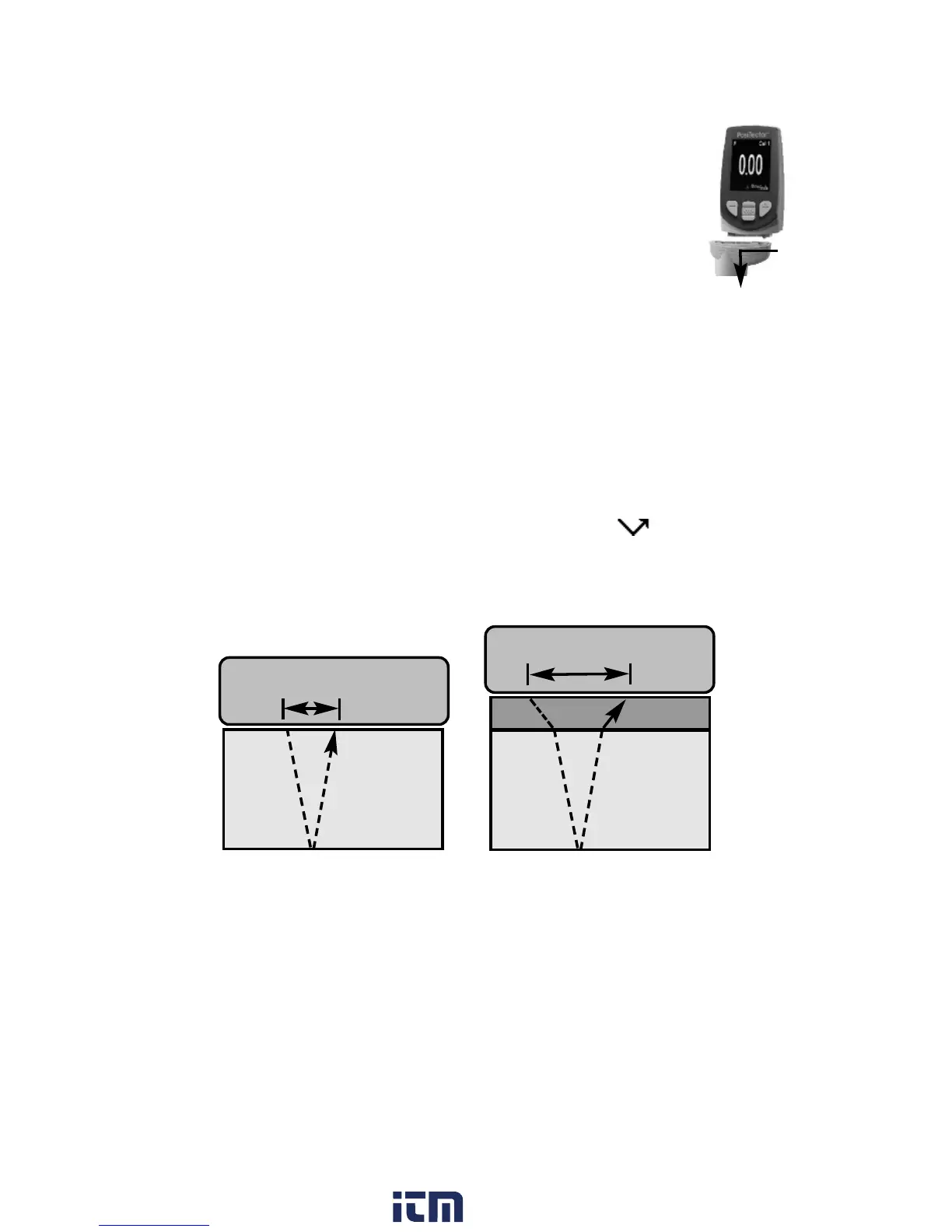
PosiTector UTG probes transmit an ultrasonic pulse into the
material to be measured. This pulse travels through the material
towards the other side. When it encounters an interface such as air
(back wall) or another material, the pulse is reflected back to the
probe. The time required for the pulse to propogate through the
material is measured by the Gage, represented as t
1
and t
2
below.
PosiTector UTGC and UTGM (in single-echo mode) probes
determine thickness by measuring t
1
(uncoated) or t
2
(coated),
dividing it by two and then multiplying by the velocity of sound for
that material (steel). See Figure 1.
For uncoated materials t
1
relates directly to material thickness.
When a material is coated the propagation time is increased and
is shown above as t
2
.
Coatings such as paint have a slower velocity of sound than that
of metal. Thus the single-echo technique will produce a thickness
result greater than the actual combined coating+metal thickness.
steel
coating
steel
2
t
>
1
t
Figure 1
2
t
1
t
Probe
Probe
w ww. . com
information@itm.com1.800.561.8187



 To Next Page